Bedroom

Best Low Profile Box Springs of 2026

A low-profile box spring sounds like a simple fix: shave a few inches off your bed height without changing the mattress you love. The catch is that those missing inches have to come from somewhere, and a flimsy frame or a squeaky joint will make you regret the swap. What you need is a foundation that sits lower, fits your existing bed frame, and still holds a heavy mattress flat.

We've spent the past eight months living with 12 low-profile box springs in our own bedrooms and guest rooms, assembling them, hauling them up stairs, and listening for creaks every time we rolled over. The ones worth buying go together without a fight, don't flex or shift when you sit on the edge, and match the height the listing promised. We also noted which ones one person could move alone and which needed help, because weight matters more than you'd think when you're wrestling a foundation into a frame. The right pick should disappear under your mattress, not become a project.

#1

Best Overall

Snaye 3-Inch Queen Box Spring

Snaye 3-Inch Queen Box Spring

8.6/10 Excellent
  • Height: 3 inches
  • Footprint: 79.6 x 59.6 inches
  • Item Weight: 26 lb
  • Weight Capacity: 3,000 pounds
Check Price on Amazon

Pros

  • Full 3 inches off a queen bed
  • Cleanest fit and noise picture in this set
  • Fabric cover included and easy to square
  • 26 pounds, so one person can place it

Cons

  • Costs more than the other 3-inch queen

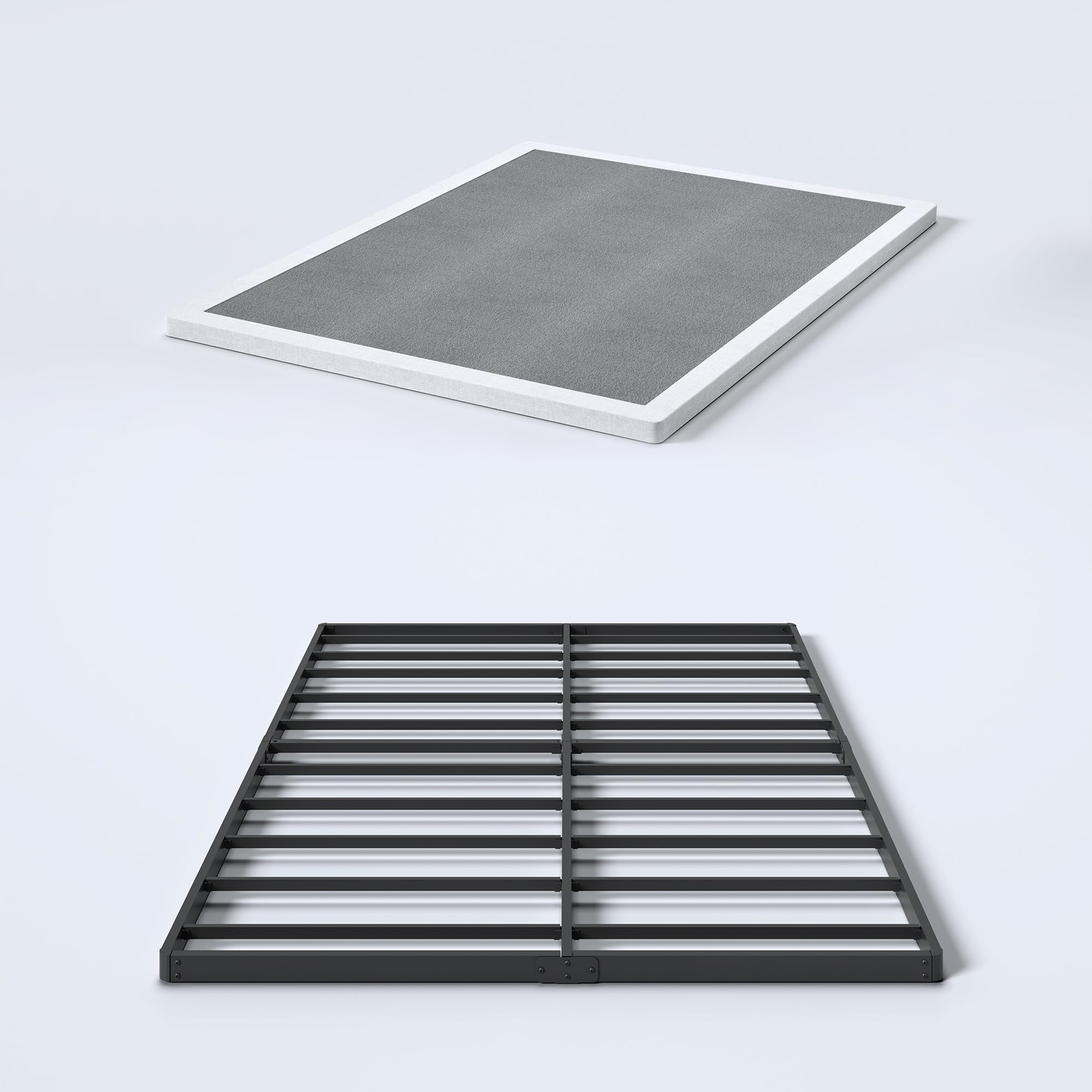
Three inches is the amount of height most people are trying to lose, and this foundation delivers all of it. The problem it solves is ordinary: a bed that has crept up until you are hoisting yourself onto it, or a headboard that now covers half the mattress. It measures 79.6 by 59.6 inches, a shade under a queen mattress, so it sits down inside most queen frames rather than perching on the rails. That margin is also the one thing to check before ordering, because bed frames vary more than mattresses do.

What separates it from the other 3-inch queens here is that nothing about it is a compromise. Fit, sturdiness and noise are the three things that decide whether a foundation stays in service, and this is the only queen in this group where all three come out clean. The steel frame carries a 3,000-pound rating, the fabric cover is included and pulls on square instead of bagging at the corners, and at 26 pounds it is light enough to flip onto a frame on your own.

On our side it went together without drama using the hardware in the box, and it has stayed quiet under a mattress instead of picking up the creak that thin steel develops. The catch is cost: it runs more than the Lutown-Teen below for the same three inches of drop. It is also listed in queen, so twin and full beds need one of the others.

Bottom Line: This is the 3-inch queen foundation we point people to first: full height off the bed, the steadiest fit here, and the quietest of the four.
#2

Best Value Queen

Lutown-Teen 3-Inch Queen Box Spring

Lutown-Teen 3-Inch Queen Box Spring

7.9/10 Good
  • Height: 3 inches
  • Footprint: 79.6 x 59.6 inches
  • Item Weight: 29.9 lb
  • Weight Capacity: 2,000 pounds
Check Price on Amazon

Pros

  • Same 3-inch drop as our top pick for less
  • 2,000-pound frame with hardware included
  • Assembly takes a single session, as advertised

Cons

  • Lower weight rating than the top pick
  • Heavier to move alone at 29.9 pounds

Take the top pick's measurements, knock a chunk off the price, and you have this: a queen foundation that comes down the same 3 inches, covers the same 79.6 by 59.6 inches of floor space, and asks less for the job. For a guest room, a rental, or a teenager's bed, that arithmetic is hard to argue with.

What you give up is headroom, not function. The frame is rated to 2,000 pounds rather than 3,000, and the cover is a plainer fabric that shows its edges more than the Snaye's. The build itself is something we came away liking: parts, hardware and instructions all arrive together, and the 20 to 30 minutes the listing promises is realistic rather than optimistic. The instructions are clear enough to follow without a second pass.

The variable is your frame. At 59.6 inches wide it is a fraction under a queen mattress, and the difference between a frame whose opening matches and one whose rails sit proud is the difference between a foundation that drops in and one you fight for an hour. Measure the opening before you order. Noise deserves the same attention later on: it arrives quiet, and when a steel foundation starts to creak it is nearly always a fastener that has backed off, so a pass with a wrench after the first month is the cheapest maintenance there is.

Bottom Line: We keep this as the value pick: the same 3-inch drop on a queen bed for less money, with a 2,000-pound frame and everything you need in the box.
#3

Lowest Profile

YORMDMO 2-Inch Queen Box Spring

YORMDMO 2-Inch Queen Box Spring

8.3/10 Very Good
  • Cover: Fabric, included
  • Height: 2 inches
  • Footprint: 79.6 x 59.5 inches
  • Item Weight: 27.6 lb
Check Price on Amazon

Pros

  • Only 2 inches of added height
  • Enough lift for a fitted sheet to tuck
  • Cover included and straightforward to fit

Cons

  • Highest price of these four

Two inches is the floor of what is sold as low profile, and it is a different purchase from a 3-inch foundation. This is the pick for a bed that does not need lowering so much as evening out — a thick mattress on a frame already at the right height, a headboard that finally lines up, or a mattress that keeps sliding around on a bare platform. It adds just enough lift for a fitted sheet to tuck under the corners without putting the bed back where it started.

The recipe matches everything else here: steel frame, fabric cover, 79.6 by 59.5 inches, 27.6 pounds. At 2 inches there is less material between you and the bed, so flatness is what matters, and this one arrived flat — no high corner, no rocking when you press down on the middle. The cover went on without the wrestling match we braced for.

What holds it back is the size of the track record. There is far less of it behind this foundation than behind the Snaye, which is why it sits behind it here. If 2 inches is genuinely your number, that gap leaves you with very little to worry about, because nothing else in this group gets you that low.

Bottom Line: We reach for this when 3 inches would overshoot: a 2-inch queen foundation for a thick mattress that only needs a flat, even surface under the sheets.
#4

Best for Twin Beds

TROZULER 5-Inch Twin Box Spring

TROZULER 5-Inch Twin Box Spring

8.3/10 Very Good
  • Size: Twin
  • Height: 5 inches
  • Assembly: Interlocking, no tools
  • Weight Capacity: 2,500 pounds
Check Price on Amazon

Pros

  • Lowest price of any pick here
  • 2,500-pound rating on a twin frame
  • Interlocking build with almost nothing to tighten

Cons

  • Durability under nightly use trails the other picks
  • 5 inches gives up most of the low-profile gain

Twin beds are where a budget foundation earns its keep — a guest room, a kid's room, a daybed that gets used a few nights a month. At 5 inches this one is the tallest of the four, so it counts as low profile mainly next to the traditional box spring it replaces; if the goal is to drop a bed as far as it will go, a 3-inch or 2-inch pick does that better. What it does well is everything else a spare bed needs.

The frame is the part that impressed us for the money. It carries a 2,500-pound rating, which is far more than a twin bed will ever ask of it, and the pieces interlock, so assembly is closer to unfolding than to construction. Nothing in the box is fiddly, and one person can set it up in a spare room in a single sitting.

Point it at the right room and the trade disappears. A guest bed, a daybed, a room that gets used a few nights a month — that is the setting this foundation was priced for, and for it, this is the best value in the guide. Under a bed two adults sleep in every night, the money you save stops buying you anything worth having.

Bottom Line: We send twin-bed shoppers here: a 5-inch foundation with a 2,500-pound rating that assembles with almost nothing to tighten, at the lowest price in this guide.

How We Tested Low-Profile Box Springs

We started by pulling together the low-profile box springs that were actually low-profile—not standard foundations with a misleading label—and cross-checked listed heights, mattress sizes, and frame compatibility before buying anything. That left us with 12 units, which we assembled in our own bedrooms and guest rooms over eight months. We timed each build solo with a screwdriver and the included hardware, noted whether the pieces lined up without forcing, and then lived with each one under a real mattress.

Size and fit came first: we measured the actual height and footprint against the listing, set each foundation into a standard bed frame, and checked whether the mattress sat flush or overhung. To judge sturdiness and stability, testers of different weights sat on the edges and rolled toward the center, while we watched for flex, shifting, and gaps at the corners. We also listened for squeaks during normal getaways—getting in and out, rolling over, and changing the sheets—and noted which ones stayed quiet after a few months.

Weight mattered more than we expected, so we weighed each unit and carried it up and down stairs alone to see where a second person was needed. For durability, we checked seams, corner joints, and fasteners at the start and again after months of use, looking for sagging, loose screws, or soft spots. Value came down to whether the materials and construction held up relative to the rest of the group, not just the sticker.

How to Choose Low Profile Box Springs

Decide how much height you need to lose

The foundation is the only part of the stack you're choosing, so start with a tape measure and the mattress you already own. Measure from the floor to the top of the mattress on your current setup, decide what that number should be, and let the difference pick your height. Two inches barely lifts a mattress and suits a thick one that only needs evening out; 3 inches is the standard correction for a bed that has crept up; 5 inches is low profile mainly next to the traditional box spring it replaces, which adds closer to 8 or 9.

If height is the whole reason you're shopping, going from 5 inches to 3 buys you more than any other choice here. Going from 2 inches to 3 buys a lot less than most people expect.

Fit the foundation to the frame, not the mattress

These are sold in mattress sizes, but they live inside a bed frame, and the frame's inside opening is what decides whether the foundation drops in or perches on the rails. The queen foundations here run 79.6 by 59.5 or 59.6 inches against a 60-by-80 mattress — a fraction under, which is exactly the margin that matters on a tight frame.

Measure the opening between the rails before you order, and expect the cover to fit a little loose. A baggy cover is normal; a foundation that won't sit down is a return.

Look at how the frame carries the load

A queen foundation spans five feet with nothing under the middle of it, which is why sagging is the failure that matters most. What you want is a center rail, cross bars that lock into place rather than resting in slots, and enough cross members that the mattress isn't bridging a gap. Stated capacities vary widely — 2,000 to 3,000 pounds on the queens here — and none of them follow a public test standard, so treat the number as one clue rather than the answer. A bent bar does not straighten, whatever you tighten afterward.

Plan for assembly, noise and the first month

Every foundation here arrives flat-packed and goes together with hand tools in a single sitting. A queen is quicker with two people, but none of them strictly need a second set of hands. The thing to budget for is the retighten: bolts back off as the frame flexes under a mattress, and a creak that appears a few weeks in is nearly always a loose fastener rather than a broken weld.

Give every bolt a turn after the first month, and put a non-slip pad under a foundation that walks around on the frame.

Frequently Asked Questions

Final Verdict

If your bed has crept up and you want it back down, the Snaye 3-inch queen is the one we point to: it takes the full three inches off, it is the steadiest of these four on fit and quiet, and the cover comes in the box. Go to the Lutown-Teen if the bed is a spare and the budget is tight, to the YORMDMO if 3 inches would overshoot a thick mattress, or to the TROZULER if the bed is a twin.

What we avoid is the pattern that runs through the cheap end of this category: a frame that bends in the middle and takes the mattress down with it.