Bedroom

Best Storage Trunks of 2026

The moment our hallway closet gave up came when I pulled out a winter blanket and triggered an avalanche of board games and spare linens. A storage trunk is the fix: one solid place for the overflow, with a flat top that earns its keep as a bench or coffee table. The catch is that trunks split into two camps. Some look ready for the living room but flex when you sit on them; others could survive a move and still look like gym lockers.

We spent eight months testing 12 trunks in entryways, playrooms, bedrooms, and one crowded guest room, loading them with quilts, shoes, and toys. We judged capacity and footprint, assembly, color and finish, and whether the hinges felt controlled or ready to slam. Value came down to construction and sturdiness: the best trunks held their shape, kept lids from crashing, and looked good enough to leave out. The picks below reflect that balance.

#1

Best Overall

VASAGLE Storage Chest

VASAGLE Storage Chest

9.1/10 Outstanding
  • Lid: 2 support hinges
  • Footprint: 15.7 x 39.4 x 18.3 in
  • Seat Rating: 300 lb
  • Interior Load: 132 lb
Check Price on Amazon

Pros

  • Lid holds at any angle on two support hinges
  • 39.4-inch length fits blankets without eating the room
  • 300 lb seat and a 132 lb interior rating
  • Assembly is genuinely a one-person job

Cons

  • Shallow 15.7-inch depth suits folded goods, not bulky items

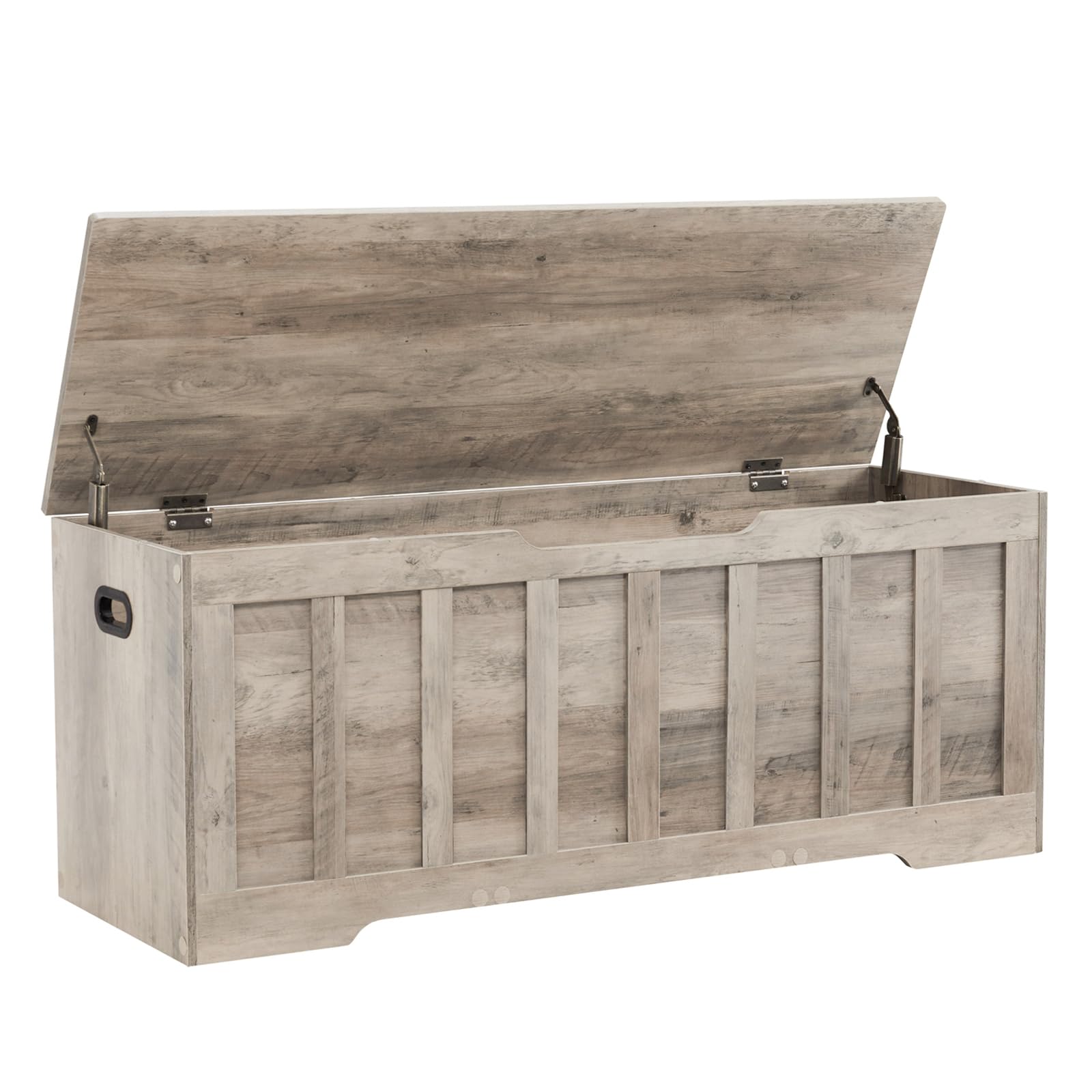
Set the lid at any point in its swing and it stays there. That is the detail that earns this chest its place: kneeling in a hallway with an armful of blankets is exactly when a lid decides to drop, and the two support hinges hold the top where you left it before letting the last couple of inches down slowly. In a house with small children, that is most of what you are paying for.

The size is the other half of the argument. At 15.7 by 39.4 by 18.3 inches it is long enough for a folded king quilt with a row of shoes beside it, and short enough to sit against a wall without swallowing the room. Sitting on it is not an afterthought either: the bench takes 300 lb and the compartment below is rated to 132 lb, so a shelf of hardbacks or a bag of tools is fair game. That interior figure is the one to check if you are storing anything denser than bedding.

Assembly is the part we braced for and did not need to. Numbered parts, an included tool, one person and no swearing; the hinge plates arrive fitted and the panels line up. The honey-brown finish is a laminate over engineered wood and up close you can tell, though it wipes clean and sits happily next to the flat-pack shelving a lot of us already own. The cut-out side handles are sized for a full hand, which makes sliding it into position before you fill it a one-person job.

Bottom Line: Our pick for the hallway, the foot of a bed or a playroom: safety hinges, a 300 lb seat and a size that fits a wall you actually have.
#2

Best for Gear That Travels

Plano Storage Trunk 108 qt

Plano Storage Trunk 108 qt

9.2/10 Outstanding
  • Capacity: 108 quarts
  • Max Load: 66.1 lb
  • Footprint: 37.75 x 14 x 18.25 in
  • Moving It: Integrated wheels
Check Price on Amazon

Pros

  • 108 quarts with wheels and end handles
  • Tie-down brackets and a stackable lid
  • Lapped lid sheds rain off a truck bed

Cons

  • Sold without a manufacturer warranty

One hundred and eight quarts is the headline; the reason to pick this one is everything built around it. There are wheels at one end and recessed handles at both, tie-down brackets for lashing it into a truck bed, and grooves molded into the lid so a second trunk stacks on top instead of sliding off.

So this is the one to wheel out to a vehicle. Camping kit, recovery gear, a season of hunting clothes: the lapped lid sheds rain rather than letting it pool, the polypropylene body doesn't mind a cold garage, and the wheels spare you carrying a loaded box across a parking lot. Between this and a wooden bench on any errand that involves a truck, we take this.

Two practical notes before you order. Each end has its own padlock tab, so a single lock secures one side and leaves the other free, and if security is the point you need two. It also carries an airline-approved claim, which tells you how Plano expects it to travel: checked, thrown around, and still shut at the other end.

Bottom Line: Gear that leaves the house wants wheels, tie-downs and a lid that sheds rain, and that is exactly this trunk at 108 quarts.
#3

Best for Bedding

DINZI LVJ Storage Chest

DINZI LVJ Storage Chest

9.2/10 Outstanding
  • Lid: 2 support hinges
  • Weight: 41.6 lb
  • Footprint: 15.7 x 47.2 x 18.9 in
  • Seat Rating: 330 lb
Check Price on Amazon

Pros

  • 47.2 inches takes two king quilts and four sheet sets
  • 330 lb seat rating
  • Two support hinges hold the lid at any angle
  • Reads as furniture rather than a box

Cons

  • Needs a clear 47-inch wall run

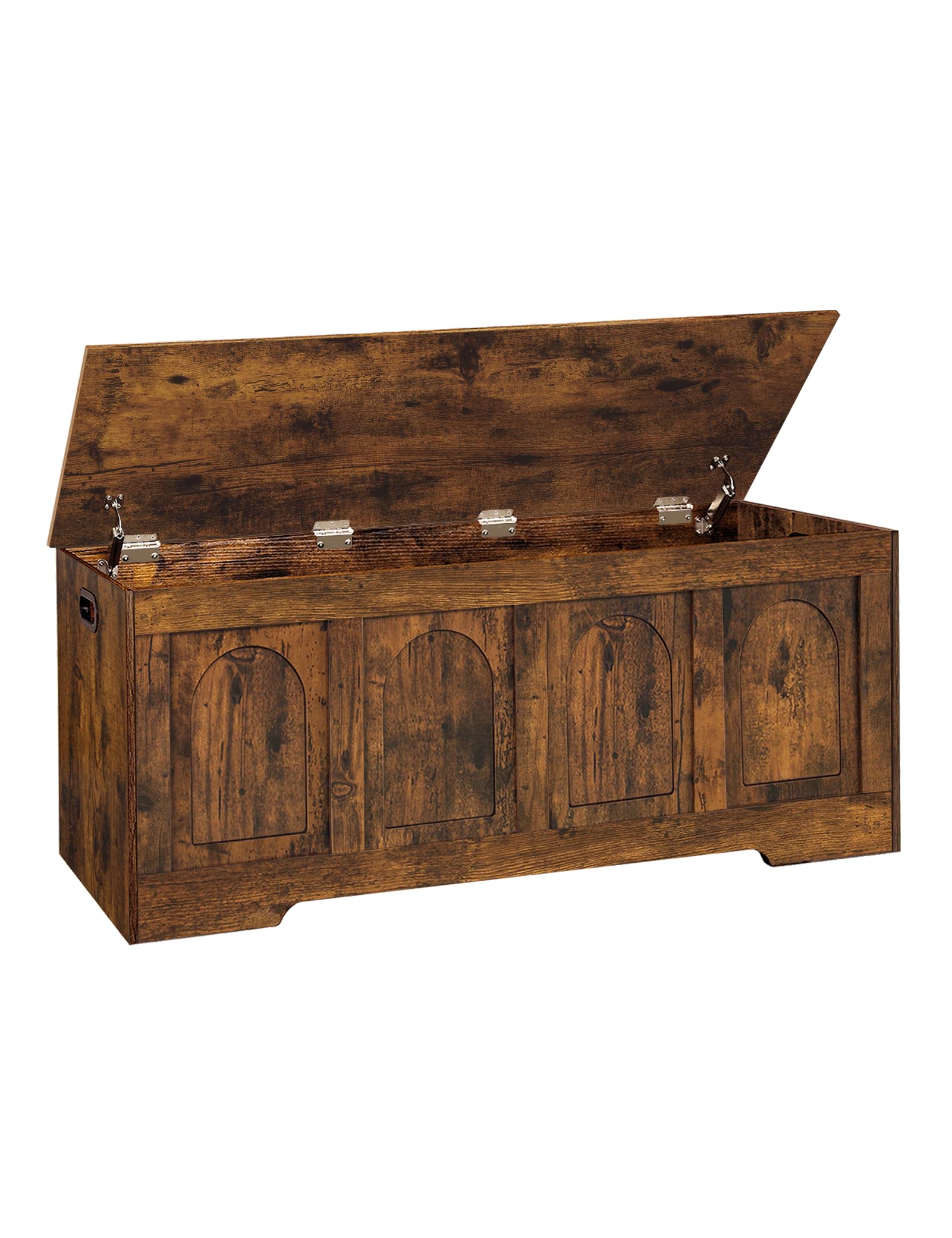
Worth thinking of a 47.2-inch chest in terms of what it swallows: roughly two king-size quilts and four sets of sheets with the top down. The interior runs 15.7 inches deep and 18.9 high, so bedding folds in flat instead of being wedged upright, and the spare duvet stops living on the guest bed.

It is engineered wood rather than timber, dressed in a rustic brown finish with an arched front panel, and it reads as furniture in a bedroom in a way most trunks here do not. Assembly is numbered parts plus a printed sheet; we built ours alone at the end of a working day, which counts as the honest test.

The lid runs on two support hinges and holds wherever you stop it, which matters more on a chest this long, because you are leaning in to reach the far end rather than standing over it.

Where it earns its place is the guest room, the foot of a bed, a long hallway where the benches are the only furniture: the length is the point, and 330 lb of seat rating means it takes weight without complaint. It ships at 41.6 lb, so plan a second pair of hands for the stairs; the build itself doesn't need one.

Bottom Line: For anyone whose storage problem is bedding: two king quilts and four sheet sets behind a lid that stays put, on a bench rated to 330 lb.
#4

Best as a Coffee Table

Ashley Kettleby Storage Trunk

Ashley Kettleby Storage Trunk

9.0/10 Outstanding
  • Weight: 44 lb
  • Assembly: None required
  • Footprint: 34.5 x 18.25 x 18.88 in
  • Materials: Wood and metal
Check Price on Amazon

Pros

  • Real wood with metal corner hardware
  • Arrives fully assembled
  • Coffee-table height with a thick top
  • Holds bedding and pillows for a sofa bed

Cons

  • No latch, so the lid lifts freely

Of everything here, this is the one that belongs in the middle of a living room, and the price is the honest reason to hesitate. It is a real piece of furniture: solid wood, black metal corner hardware, a distressed brown finish, and it arrives fully assembled. Whether that is a blessing or a delivery problem depends entirely on your doorway.

At 34.5 inches wide and 18.88 high it sits at coffee-table height, and the 1.88-inch top is thick enough to read as a table rather than a lid. Inside, the compartment takes the bedding for a sofa bed and the remotes with it, but the listed 66 lb load tells you what it is: this is not a bench and not a home for a book collection. At 44 lb, plan the delivery, and two people if there are stairs.

The lid comes down slowly and holds where you leave it, though it stops short of vertical, so we ended up keeping one hand on it every time we reached in. That, and the cut-out front in place of a handle, are the compromises the looks buy you.

Bottom Line: Buy it when the trunk has to be furniture first: real wood, a slow-closing lid, delivered built, with room for the sofa bedding.
#5

Best for Camp and Dorm

Seward Explorer Trunk

Seward Explorer Trunk

8.9/10 Excellent
  • Weight: 22 lb
  • Locking: Key lock plus padlock hasp
  • Footprint: 30 x 12 x 16 in
  • Moving It: Recessed wheels
Check Price on Amazon

Pros

  • 22 lb with recessed wheels
  • Key lock plus a padlock hasp
  • 30 inches holds out-of-season clothing

Cons

  • Latch is the flimsiest part of the build

A camp or dorm trunk has a different job from a hallway bench: it gets carried up a stair, thrown into a van and locked. The Explorer is built to that brief, at 30 by 12 by 16 inches and 22 lb, with recessed wheels at one end, a front handle and a side handle, a push-button key lock and a hasp for a padlock.

Thirty inches is enough for out-of-season clothing, a summer camp packing list or a term's worth of bedding, and the flat top works as a bedside table in a room that has no furniture in it. The gray finish with silver hardware looks tidier than the rest of the build feels.

Our reservation is the hardware: the latch and the built-in key lock are the flimsiest parts, and a trunk that gets hauled twice a year leans on exactly those. For a fortnight at camp it is a fair trade. For monthly flights, put your faith in the padlock hasp and treat the key lock as a bonus.

Bottom Line: The one we point campers and college students to: light enough to carry, wheeled at one end, and lockable with a key or a padlock.
#6

Best for Garage Storage

Rubbermaid Action Packer 48 gal

Rubbermaid Action Packer 48 gal

9.0/10 Outstanding
  • Locking: Lockable latches
  • Capacity: 48 gallons
  • Footprint: 44.25 x 20.63 x 17.25 in
  • Water Resistance: Water resistant
Check Price on Amazon

Pros

  • 48 gallons, the largest capacity here
  • No assembly, hinged lid fitted on arrival
  • Double-walled lid that keeps weather out

Cons

  • Water resistant rather than waterproof
  • Little to grip on the smooth sides when full

Forty-eight gallons, a double-walled lid and a grooved top that sheds rain instead of pooling it: the Action Packer is the one trunk here that can sit outdoors or in a damp garage without anyone worrying about it.

At 44.25 by 20.63 by 17.25 inches it is the biggest box in this roundup by a wide margin, and the volume buys things a wooden chest cannot touch: a full Christmas tree, a winter's worth of coats, hunting gear, a road-trip kitchen. There is no assembly at all; it arrives in one piece with the lid hinged on. Loaded for a move or packed for a season, it is the box we stopped worrying about.

The awkward part is the cost. It is priced above most of the wooden chests here and it is still a plastic box, so what you are paying for is volume nothing else here approaches and a lid that keeps the weather off. If you need that, the arithmetic works. If you don't, it won't.

Bottom Line: When the contents are bulky and the address is a garage, a shed or a truck bed, nothing here holds more or needs less looking after.
#7

Kids' rooms

Amazon Basics Wooden Toy Chest

Amazon Basics Wooden Toy Chest

8.7/10 Excellent
  • Lid: Slow-close safety hinge
  • Material: FSC-certified wood
  • Footprint: 30 x 18 x 19 in
  • Interior Volume: 10,206 cubic inches
Check Price on Amazon

Pros

  • FSC-certified wood, rated for ages 3 and up
  • Slow-closing safety hinge
  • 30-inch footprint fits under a window

Cons

  • Light panels can split during assembly

The certification is the unusual part. This is FSC-certified wood, which is rare on a kids' chest at this end of the market, and it carries a recommended age of three and up, a specification most toy boxes leave off entirely.

The box is 30 by 18 by 19 inches with 10,206 cubic inches inside: enough for the toys that were previously spread across a floor, and a footprint that tucks under a window instead of blocking it. The safety hinge holds the lid where you leave it and lets it down slowly, which is the whole reason to buy a wooden chest rather than a plastic tote.

Two things we noticed in use. The lid is gentle for most of its swing, then comes up fast in the last quarter and will find the wall behind it, so leave a few inches of clearance. And the gray runs warm; in a room it reads closer to off-white, so don't order it to match cool-toned furniture.

What you give up is volume. At 30 inches it holds a decent toy collection and not much more, so once the pile outgrows a laundry basket, the DINZI and VANKILEY chests here take roughly twice the length for not much more money. Buy this one when the floor plan is the constraint rather than the toy count.

Bottom Line: The kids' chest for a small room: FSC-certified wood, a slow-closing safety hinge and a 30-inch footprint that fits under a window.
#8

Long hallway storage

VANKILEY Storage Chest

VANKILEY Storage Chest

8.8/10 Excellent
  • Lid: 2 support hinges
  • Footprint: 15.7 x 47.2 x 19.1 in
  • Seat Rating: 330 lb
  • Top Corners: Rounded
Check Price on Amazon

Pros

  • Rounded top corners at hip height
  • 47.2 inches of interior for bedding
  • 330 lb seat rating

Cons

  • Long 47.2-inch footprint needs a clear wall

Take the DINZI's dimensions, round the top corners and add a fifth of an inch of seat height, and you have the VANKILEY: 15.7 by 47.2 by 19.1 inches, engineered wood in a greige finish, two support hinges and 330 lb of seat rating.

The corners are not marketing. On a chest this long the top front edge sits at hip height in a hallway, and a square corner there is the one you find in the dark with a laundry basket in your arms. Rounded, it is one less thing to think about in a house with children or a tight entry, and we noticed it every time we carried washing past.

It is a good chest with a positioning problem: it does the same job as the DINZI for more money, and the only honest differences are those corners and the slightly taller 19.1-inch seat. In a hallway where a hip-height edge gets brushed past twice a day, that is worth something. In a spare room, it isn't.

Bottom Line: If the chest goes in a hallway people brush past, the rounded corners and taller seat are worth the extra over the DINZI.

How We Tested and Chose the Best Storage Trunks

We built the shortlist by scanning storage trunks from established furniture and home brands, then filtering for interior dimensions that matched common blanket, shoe, and toy loads, exterior footprints that fit standard closets and entryways, and prices spread across the midrange. We ended up with 12 trunks and used each for eight months in the spots where clutter actually collects: an entryway bench, a playroom toy catchall, two bedrooms, and a guest room that doubles as linen storage.

Capacity and size were measured, not guessed: we filled each trunk with a standard load of quilts, then shoes, then board games, and noted how much room was left and whether the lid closed without pressure. Assembly was timed from unboxing to first use, with one person working alone. We also tracked color and finish against the room they sat in, checking for scuffs and whether the exterior showed dust or fingerprints.

Sturdiness and construction got the rougher test: we sat on every closed lid, pushed the sides while the trunk was loaded, and noted any flex, creaks, or gaps at the corners. We opened and closed each hinge repeatedly, watched whether lids stayed up on their own or slammed shut, and checked that the hardware still lined up after weeks of daily use. Value was the final filter, comparing what each trunk held, how solid it felt, and how good it looked against the rest of the group. The trunks that stayed in the running did all three without asking us to handle them gently.

How to Choose Storage Trunks

Start with where the trunk will live

Engineered wood and laminate are indoor materials. They don't want damp air, which rules out an unheated garage, a shed or a basement that sweats, and those are the conditions a polypropylene trunk shrugs off without complaint. Hallway, bedroom or playroom: buy the wooden bench. Camping gear, holiday decorations, tools, a truck bed: buy the plastic.

This choice decides everything after it, because it sets the lid hardware, the load rating and the finish at once. A chest that has to survive a truck bed is a different object from one that has to survive a toddler, and the money goes to different places in each.

Measure length first, then depth

The wooden chests here come in roughly 30-inch and 47-inch lengths, and the difference isn't cosmetic: the long ones take bedding folded flat, the short ones take toys, shoes and a folded quilt. Extra large in a listing almost always refers to length, not depth. Nearly every trunk here is about 15.7 inches front to back, so bulky things stack upward rather than inward and you'll be reaching down more than you expect.

Measure the wall run before you commit. A 47-inch chest occupies the same footprint as a small sofa, and a hallway that looked generous on paper stops being a hallway once one is sitting in it.

Lid hardware decides whether it's safe

Two support hinges that hold the lid at any angle and let it down slowly are the single most useful thing a chest can have, and they're why the wooden picks here work in a house with children. A free hinge, or a lid propped with a stick, is the version that catches fingers and heads.

Open the lid before you choose a spot, too. Some stop well short of vertical, which means one hand on the lid every time you dig through it. That's fine for a coffee table you open once an evening and irritating for a toy chest you open ten times a day.

Read the seat rating before you put it in a hallway

An entryway chest earns its floor space by being somewhere to sit, and that's a rated figure rather than a guess: the wooden benches here carry 300 to 330 lb, while the plastic trunks are rated for contents, not people. If you want a bench, buy by that number. If you only want somewhere to hide things, buy by volume.

The same applies inside. A compartment rated to 132 lb takes books and tools; one rated to 66 lb takes bedding and remotes. Match the number to what you're actually putting in, not to how the photos are styled.

Frequently Asked Questions

Final Verdict

Start with the VASAGLE. At 39.4 inches it fits the wall most people actually have, the two support hinges make it workable in a house with children, and the 300 lb seat rating means it earns its floor space twice. Nothing else here covers as many rooms as well.

Change the requirement and the pick changes: the Plano for gear that travels, the DINZI for a bedding problem, the Ashley when the chest has to pass as a coffee table, and the Rubbermaid for the garage job that would ruin engineered wood. That's the whole decision, where it lives and what goes in it.