Dining Room

Best Display Cabinets of 2026

Every collection eventually outgrows the shelf it started on. Mine was a glass-front bookcase holding my grandmother's pressed-glass tumblers — visible, technically, but dusty within a week and lit by whatever bulb happened to be in the ceiling fixture. A display cabinet solves exactly that: glass on more than one side, a light where you actually need it, and a door that keeps the dust off. What separates one that earns its footprint from one you regret is usually steadiness, how the doors close, and whether the lighting flatters what's inside instead of glaring off the glass.

Over the past eight months, my team and I assembled, loaded, and lived with eight display cabinets, from flat-pack units to pieces that arrived nearly built. Here's what nobody tells a first-time buyer: measure the tallest thing you plan to display before you shop, not the wall. Shelf spacing and interior depth decide whether a cabinet works; the exterior footprint only decides whether it fits. The picks below run the range — brightly lit showpieces, budget-friendly workhorses, and a couple built for people with more glassware than square footage.

#1

Best Overall

BROTTAR 4-Tier Display Cabinet

BROTTAR 4-Tier Display Cabinet

8.7/10 Excellent
  • Tiers: 4
  • Lighting: 36W LED, 3 colors, motion sensor
  • Door Style: Pop-up glass, handle-free
  • Overall Dimensions: 14"D x 31.5"W x 65"H
Check Price on Amazon

Pros

  • Bright 36W lighting on all four tiers
  • Only 14 inches deep
  • Wall bracket included in the box
  • Handle-free press-open glass doors

Cons

  • Acrylic sides rather than glass
  • Light strip can fail early

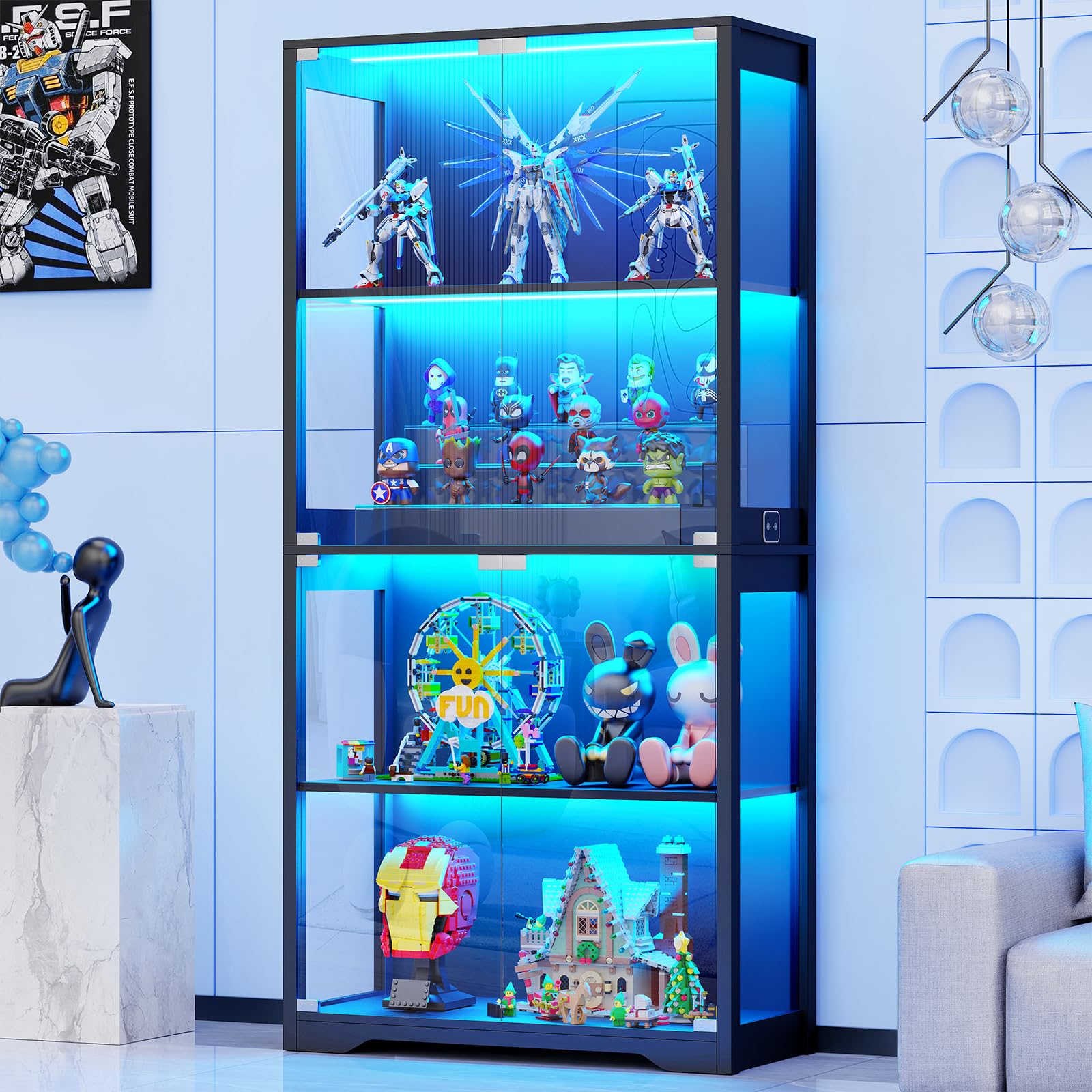
We put the darkest things we own on the bottom shelf — a bronze bookend, a stack of records, a black camera body — and switched the light on. The 36W strip runs down the front of every tier, and it's bright enough that black objects read as objects rather than silhouettes. That is the whole case for this cabinet: on a 31.5-inch-wide, 14-inch-deep footprint, it makes a collection look lit on purpose instead of merely stored.

Everything else is built for people who don't want a project. Four wide tiers, glass doors that press open with no handle to break the line, three light colors with a dimmer, and a sensor that turns the light on as you walk up. At 83.6 pounds it's light enough for two people to set in place, and the wall bracket comes in the box — fit it. Standing free, the case shifts when you press the doors; screwed into a stud, it doesn't. Assembly is at the friendlier end of this category, and the instructions are among the clearer ones we worked through.

Two details the listing doesn't lead with. The side panels are acrylic rather than glass, which is most of the reason this one weighs what it does and worth knowing before you reach for a solvent. And the light is the weak point: a strip section or a sensor can arrive dead, or quit in the first weeks. Test all four tiers before the return window closes — that's the one bit of homework this cabinet asks of you.
Bottom Line: We think it's the safest buy here for a mixed collection: four wide shelves, bright lighting, and a 14-inch depth that fits almost any wall.
#2

Best for Corners

BROTTAR Corner Display Cabinet

BROTTAR Corner Display Cabinet

8.7/10 Excellent
  • Tiers: 4
  • Lighting: 3-color LED, motion sensor
  • Each Tier: 15.7" x 15.7" x 14.4"
  • Overall Dimensions: 15.7"D x 15.7"W x 63"H
Check Price on Amazon

Pros

  • Turns a dead corner into display space
  • Soft-close doors and motion-sensing light
  • Manageable as a one-person build

Cons

  • Shelves too small for wide pieces

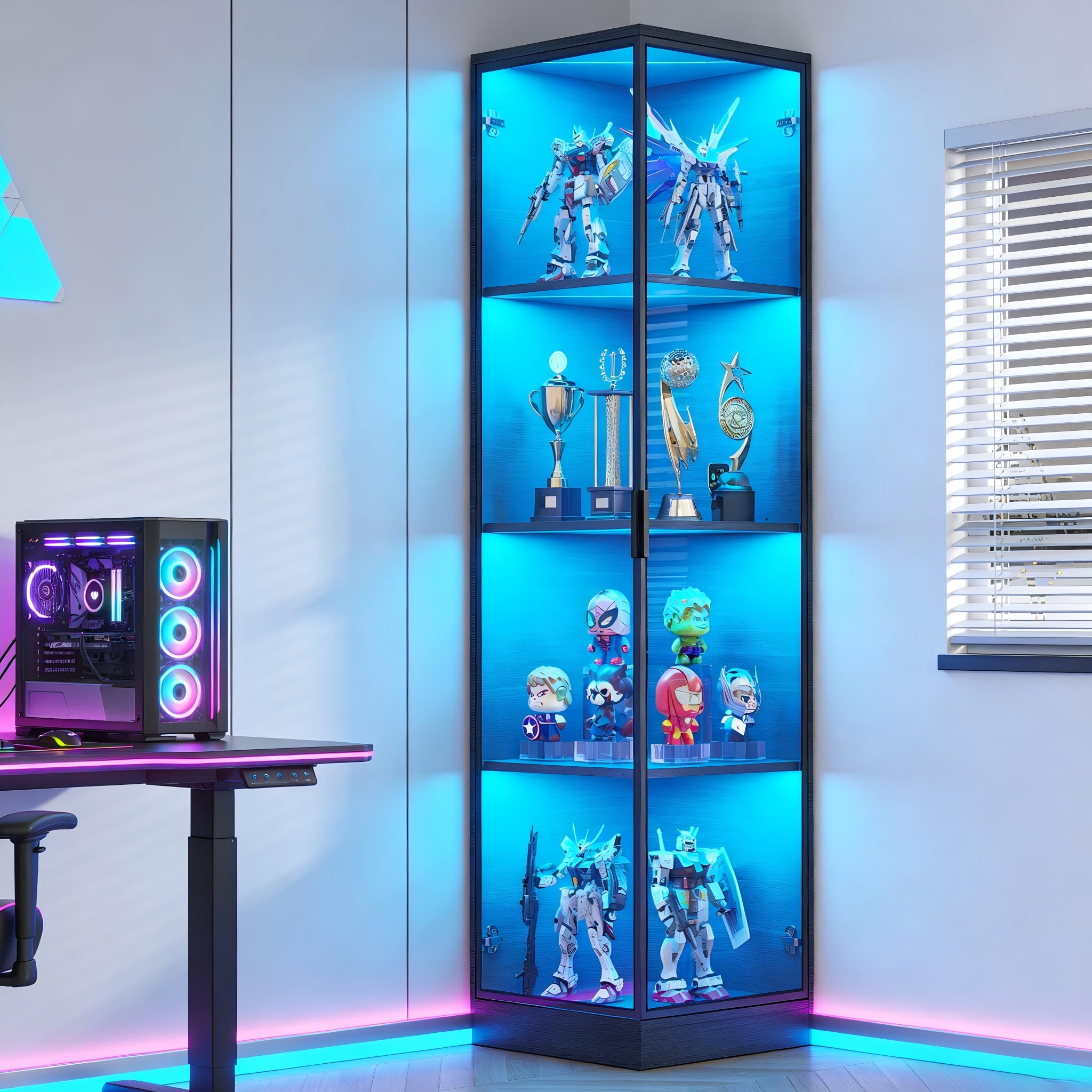
Most display cabinets want a flat wall and three feet of it. This one wants the corner nobody uses — a 15.7-inch square of floor that would otherwise hold a plant you forget to water — and turns it into four lit shelves. That's why it earns a place: it solves a room problem instead of creating one, which is rarer in this category than it should be.

The formula is the same one the bigger cabinets use, done small. Four compartments, each about 15.7 by 15.7 by 14.4 inches, behind glass doors on buffered hinges that close softly instead of banging. Three LED colors, a dimmer and a motion sensor give you the lit-museum effect without any clever wiring. At 63 inches tall and 59 pounds it's a one-person build, and the instructions hold up.

The limits are honest ones. Fifteen inches of shelf won't take a wide platter or a big art book; this is a cabinet for figures, helmets, keepsakes and small ceramics, and it's excellent at those. The magnetic door catches are the one piece of hardware that feels underspecified — the doors line up, but you'll nudge them shut rather than let them snap. Neither is a surprise at the lowest price in this roundup.

Bottom Line: We keep it on the list for one reason: it turns a dead corner into four lit shelves for less money than anything else here.
#3

Best Metal Frame

UNICOLY Metal Display Cabinet

UNICOLY Metal Display Cabinet

8.7/10 Excellent
  • Frame: Powder-coated steel
  • Glass: Tempered
  • Tiers: 4
  • Overall Dimensions: 14"D x 27.5"W x 66.1"H
Check Price on Amazon

Pros

  • Steel frame won't swell or warp
  • Takes magnets and wipes clean
  • Narrow 27.5-inch footprint

Cons

  • No built-in lighting
  • Doors need careful alignment

Cold-rolled steel, powder coat, tempered glass. The difference shows up the moment you stop thinking of this as a wooden cabinet with metal-colored trim. Nothing on the frame swells, warps or delaminates, and the doors close against steel rather than a particle-board edge. If the cabinet is going into a bathroom, a sunroom or a room where plants live, that isn't a detail — it's the whole decision.

Steel also changes how you live with it. Magnets stick, so the side panels become somewhere to hang a small print or a note. The interior wipes out with a damp cloth instead of needing polish, and there's no veneer edge to lift after a year of dusting. At 27.5 inches wide it's the narrowest full-height cabinet here, which is worth real wall space in a hallway or beside a door.

What it can't do is light itself — no LED strip, no sensor, no cable to route, and no glow after dark unless there's a lamp nearby. In a bright room that reads as simplicity; in a dark corner it reads as a gap, so be honest about which room it's going into. The doors are the other thing to get right: they close against the frame rather than latching, and alignment is the fiddliest part of the build. Fit them last, with the cabinet standing and level, and they stay shut.

Bottom Line: For a humid room, a plant cabinet, or a buyer who prefers steel to veneer, this is our pick — plan on lighting it yourself.
#4

Best Looking

RowyPoey Arched Display Cabinet

RowyPoey Arched Display Cabinet

8.8/10 Excellent
  • Tiers: 6, two adjustable
  • Storage: 1 drawer
  • Material: MDF with paper veneer
  • Overall Dimensions: 15.7"D x 31.4"W x 71"H
Check Price on Amazon

Pros

  • Arched silhouette reads as furniture
  • Six tiers plus a base drawer
  • Deep 15.7-inch shelves
  • Two adjustable shelves

Cons

  • MDF under a paper veneer

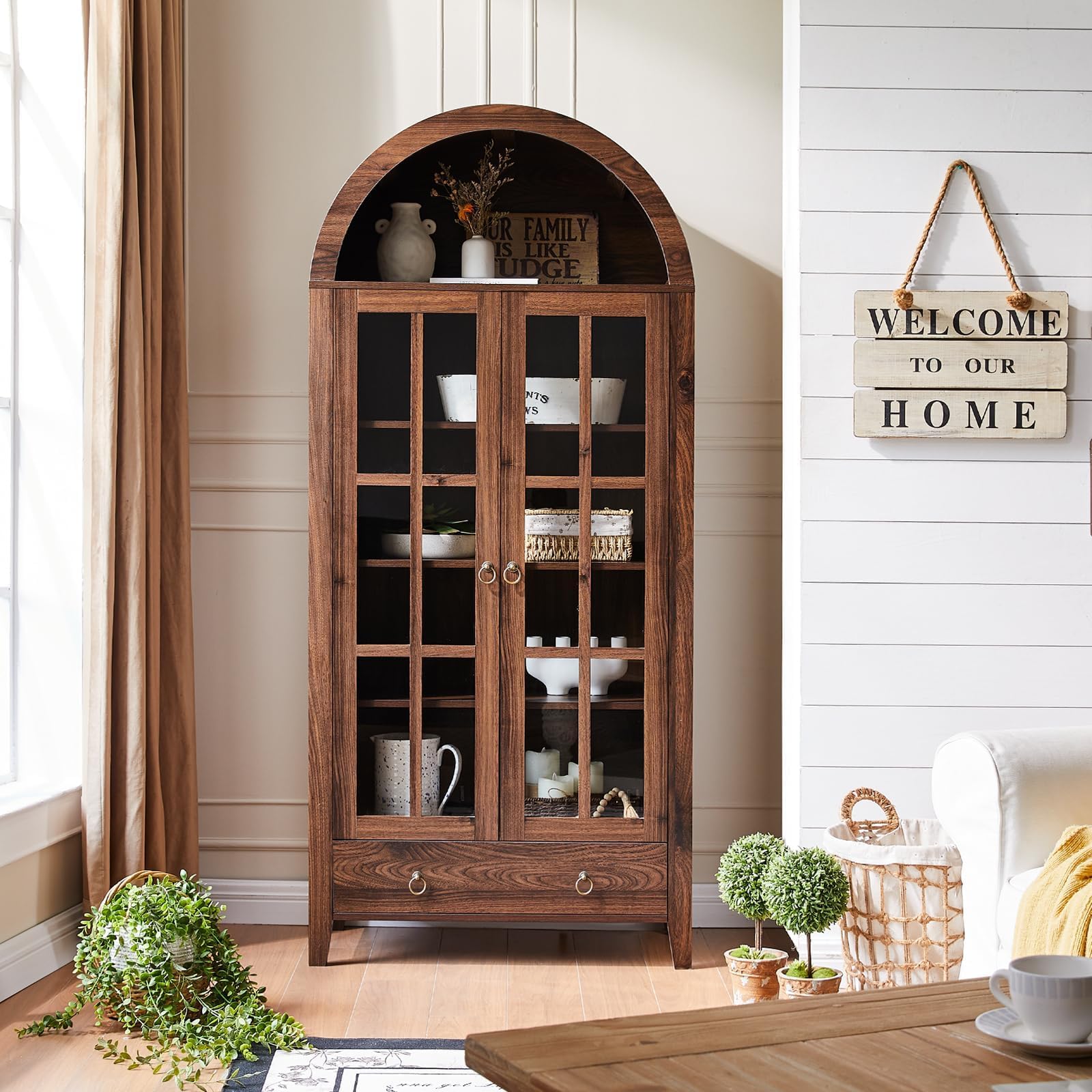
The arch is doing real work. From across a room this doesn't read as a display cabinet at all — it reads as the piece you bought for the dining room and only later filled with glassware. Tempered glass doors sit inside a walnut-toned frame with metal ring pulls, and the silhouette is what you're paying for: straight-sided cabinets are storage, this one is furniture.

Under the shape there's a serious amount of shelf. Six tiers in 71 inches, two of them adjustable, plus a drawer at the base for the chargers, cloths and odds and ends that never had a home. The 15.7-inch depth is the spec we kept coming back to, because it's what lets a stack of art books or a crystal punch bowl sit behind the doors instead of in front of them.

The honest part: the frame is MDF under a paper veneer, so at this price you're buying the arch, the finish and the two-tone look rather than solid wood. Build it face-down on a rug — there are a lot of parts, and flat-pack frames go together better when you're not fighting gravity — then stand it up with a second person and check the doors before you load a shelf.

Bottom Line: Our choice when the cabinet is on show: an arched, walnut-toned case with six tiers and a base drawer, provided MDF under veneer doesn't bother you.
#5

Locking storage

Dystler Display Cabinet

Dystler Display Cabinet

8.4/10 Very Good
  • Lock: Key lock, lower section
  • Tiers: 5, adjustable
  • Lighting: RGB, 7 colors, motion sensor
  • Overall Dimensions: 15.75"D x 31.5"W x 70.87"H
Check Price on Amazon

Pros

  • Lockable lower compartment with a key
  • Five adjustable tiers at 71 inches
  • Seven fixed light colors plus effects

Cons

  • Light panel can switch on by itself

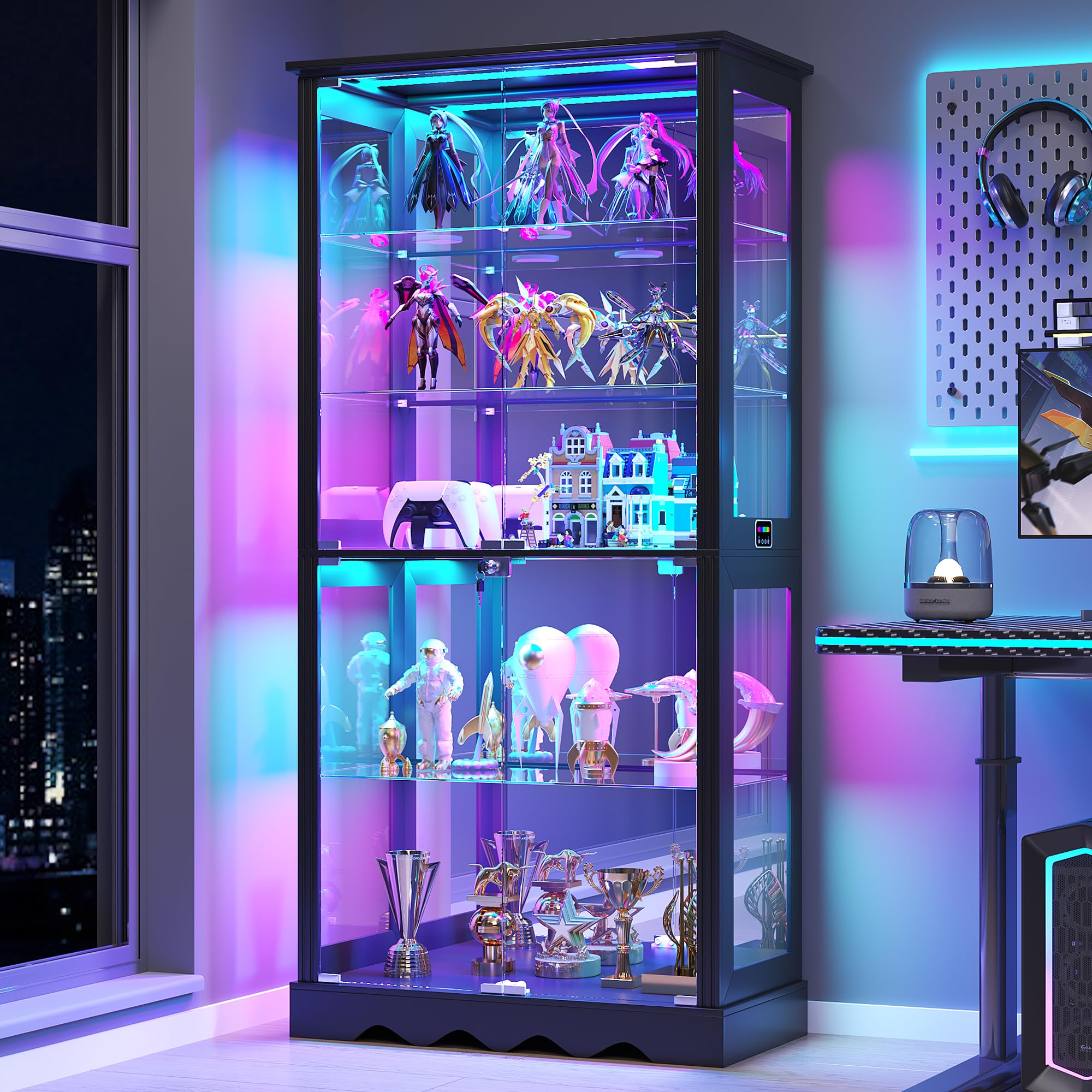
There's exactly one cabinet here with a key, and it changes what you can put inside. The lower compartment locks behind its own glass door, so the watch box, the coins, the passports or the one piece you actually insured go somewhere a visiting eight-year-old can't reach. That's a narrow feature until you need it, and then nothing else on this list will do.

The rest is generous. Five tiers in 71 inches with adjustable shelves, tempered glass throughout, and RGB lighting with seven fixed colors and five animated effects on a motion sensor, so the cabinet lights itself as you walk past. At night it looks closer to a shop display than a bookshelf, which is either exactly the point or far too much, depending on the room.

The light system is also where it misbehaves. The control panel can switch the strips on by itself, with nobody in the room and nothing pressed — a quirk you either live with or return inside the window. And at 99 pounds and 71 inches it's front-heavy enough that the anti-tip bracket isn't optional; fitted to a stud, it stops shifting when you open a door.

Bottom Line: We recommend it when the collection needs a key rather than just a door: five adjustable tiers and lighting that turns itself on.
#6

Narrow walls

FLYMUHJIA Glass Display Cabinet

FLYMUHJIA Glass Display Cabinet

8.6/10 Excellent
  • Door: Single glass door
  • Tiers: 4
  • Shelf Load: 7.7 lb
  • Overall Dimensions: 16.9"D x 14.6"W x 64.2"H
Check Price on Amazon

Pros

  • Fits a 14.6-inch gap
  • No electronics or cables
  • Wall safety device included

Cons

  • Each shelf holds only 7.7 pounds
  • Assembly needs two people

Seven and seven-tenths pounds per shelf is the number that decides this cabinet. That's a row of figurines, a shelf of boxed collectibles, small ceramics, model cars — and it is not a shelf of hardbacks, a case of wine, or your grandmother's crystal. Fix that limit in your head before you look at anything else, because the rest of this tower is genuinely decent and none of it matters if your collection is heavy.

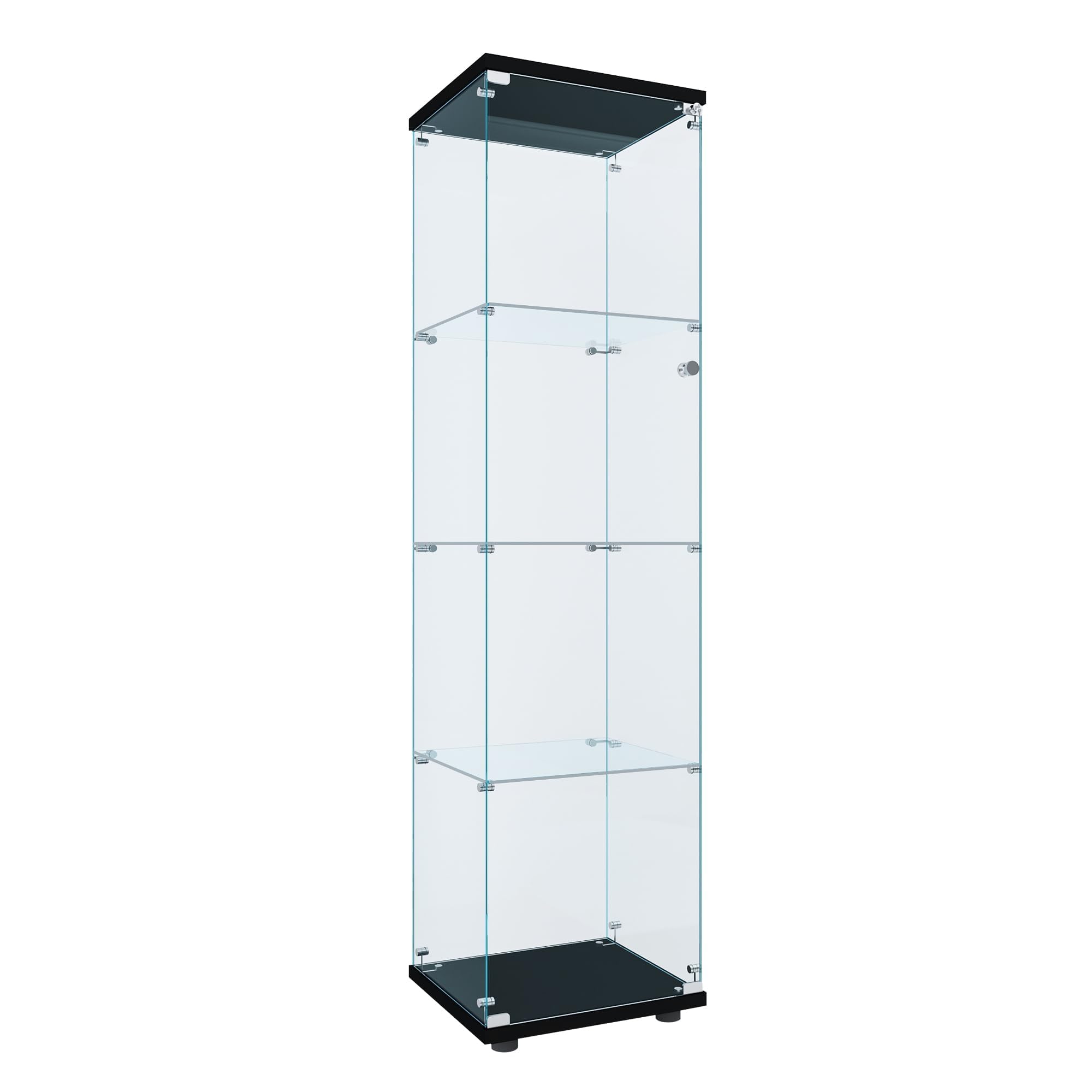
What you get is a plain glass tower: 64 inches tall, 14.6 inches wide, four shelves behind a single door, no LED, no sensor, no adapter and no cable to hide. The narrow width is the real argument — it fits the strip of wall beside a door or at the end of a hallway where a 31-inch cabinet simply won't go. It's also the least complicated cabinet here: fewer parts, fewer things to stop working.

It ships with a wall safety device, and a 64-inch glass tower should use it — glass doors and a light frame are a poor combination with a bumped shoulder or a climbing cat. Fit the strap to a stud, keep the heaviest pieces on the bottom shelf, and put anything irreplaceable somewhere lower down.

Bottom Line: We like it for a tight wall and a light collection — check your heaviest piece against the per-shelf limit before you buy.

How We Chose and Tested the Best Display Cabinets

We started by pulling every cabinet we could find from brands with a track record of shipping furniture without a fight, then narrowed by price, footprint, shelf adjustability, and whether lighting was built in or something you'd have to add later. Anything with fixed shelves too tight for a wine glass or a dinner plate got cut, as did anything whose listed dimensions didn't match the photos. That left eight.

Each one was assembled by a single person in a real living room with a stopwatch running. We noted where the instructions went vague, whether the cam locks and dowels lined up without forcing, and how long it took to get the doors hanging level — the step where most flat-pack furniture falls apart emotionally. Once built, we pushed on a top corner, opened both doors at once, and rocked each cabinet gently on hardwood, on carpet, and on a floor that isn't quite level, watching for sway. We also checked what the back panel was made of, since a thin one is the fastest route to a cabinet that shifts every time you reach inside.

Then we filled them with real collections — barware, ceramic figures, vinyl, a small army of brick-built sets — and watched how the glass shelves handled weight over weeks, whether the middle shelf bowed, and whether the doors still closed cleanly once everything was loaded. Lights went on after dark so we could see if the bottom shelf sat in shadow while the top glowed, and whether the cord reached an outlet without an extension cord. A month in, we ran a finger across the top shelf to check for dust, and compared each price against what the materials actually were.

How to Choose Display Cabinets

Measure the wall before the cabinet

Every cabinet here is 14 to 15.7 inches deep, so depth is rarely the problem. Width and clearance are. A 31.5-inch cabinet needs 31.5 inches of clear wall plus somewhere to stand, because the glass doors press or swing toward you. And watch the word compact: in these listings it usually means shallow, not small — a 14-inch-deep cabinet is still 31.5 inches wide and 65 inches tall.

Tape the footprint on the floor first, then stand where you would stand to reach the top shelf. If you're going into a corner, measure both walls to the corner point; few rooms are exactly square, and a corner cabinet will show it.

Shelf count versus shelf height

Four tiers in 65 inches and six tiers in 71 inches do different jobs. Fewer, taller openings suit statues, vases and anything with height; more tiers give you more separate displays but less headroom each, unless the shelves move. That adjustability is the feature worth paying for, because it's what lets a shelf of figurines become a shelf for one big piece.

Then check the load rating. One cabinet here is rated at 7.7 pounds per shelf, which rules out hardbacks and full decanters before you ever get to the styling.

Lighting: what it adds and what it costs

Built-in LED is the biggest visual upgrade in this category. A lit shelf makes glass and glazed ceramics look intentional, and three color settings let you warm up a black cabinet that would otherwise read cold. Two practical caveats: the light needs power, so plan the outlet and decide how you'll hide the cord; and the strip is the component most likely to give trouble, so test every tier and the motion sensor in the first week while returning is still simple.

If the room is already bright, a cabinet without electrics is simpler and cheaper to own.

Steel, engineered wood, or a veneered arch

Where the cabinet stands should pick the material. Steel and tempered glass shrug off a humid bathroom or a plant room: nothing swells, nothing delaminates, and magnets stick to the frame. Painted engineered wood covers most of the styles here and is the sensible middle. A paper veneer over MDF buys you a shape — an arch, a walnut tone — that would cost far more in solid wood, but it is a finish rather than a material, and damp air is its enemy. Buy steel for a wet room, engineered wood for a hallway, veneer for a dining room.

Frequently Asked Questions

Final Verdict

The BROTTAR four-tier is what we point most people to: four wide shelves, lighting that flatters what's on them, and a 14-inch depth that fits more walls than anything else here. If the problem in your house is a dead corner, the smaller BROTTAR turns it into display space for less. If the cabinet is going somewhere damp, buy the steel UNICOLY and add a lamp.