Dining Room

Best Sideboard Cabinets of 2026

A sideboard has a split personality: it has to look like furniture and behave like a warehouse. The listing photo shows a clean-lined oak console with a lamp on top; what arrives might have doors hanging a quarter inch out of square and a top that bows under a stack of plates. That gap between photo and delivery is the whole problem with buying one online. Get it right, though, and the dining room finally has a home for the linens, the board games, and the tangle of chargers — and the clutter that lived on the table disappears.

Over the past nine months, my team and I have assembled, loaded, and lived with eight sideboards in dining rooms, entryways, and one long-suffering home office. Two things I'd tell anyone shopping for one: a finished back is worth the extra money if you plan to float the piece, and listed widths rarely include the top's overhang. All eight held up to daily opening, closing, and stacking; the ones below are the ones I'd trust with my own plates.

#1

Best Overall

RoyalCraft 58-Inch Sideboard

RoyalCraft 58-Inch Sideboard

8.6/10 Excellent
  • Size: 16"D x 58"W x 31"H
  • Finish: Forest green, painted
  • Storage: 4 doors, 2 adjustable shelves
  • Top Load Capacity: 200 lb
Check Price on Amazon

Pros

  • Center leg keeps the 58-inch span rigid
  • Painted finish resists water and wipes clean
  • Carved handles and solid wood legs lift the look
  • Labeled hardware makes assembly simpler

Cons

  • No drawers for cutlery or small items

A 58-inch cabinet with nothing under the middle will sag once you load it, so the center support leg is the first thing we check on a wide sideboard, and RoyalCraft includes one. The stated top load is 200 pounds, which leaves room for a coffee machine, a stack of plates and a lamp without anyone doing weight math at the table.

What sold us is the finish. The forest green is sprayed on rather than wrapped, water-resistant and easy to wipe down, and it sits between carved bronze handles and solid wood legs. Those legs are the tell: they lift the cabinet off the floor and give it a silhouette that flat-pack pieces usually lose.

Behind four doors sit two compartments with thick adjustable shelves, so a slow cooker and a stack of serving bowls can share a shelf without one crushing the other. The hinges adjust with a screwdriver, which is what separates a door you can true up in five minutes from one that stays proud forever.

Two compartments take a dinner service for eight with room left over, and the 31-inch top height lands within easy reach when you are setting the table. That is the arithmetic that decides whether a sideboard earns its floor space in a dining room.
Bottom Line: Our pick for most dining rooms: a 58-inch painted cabinet with a center support leg, adjustable shelves and a finish that looks like furniture rather than flat-pack.
#2

Best Budget

VASAGLE Sliding Door Sideboard

VASAGLE Sliding Door Sideboard

8.0/10 Very Good
  • Size: 15.7"D x 55.1"W x 29.5"H
  • Doors: 2 sliding panels
  • Weight: 59.1 lb
  • Storage: 4 compartments, adjustable shelves
Check Price on Amazon

Pros

  • Sliding doors need no swing clearance
  • Screwed-on back panel holds the frame square
  • Four compartments with three shelf heights
  • Clear instructions and tools included

Cons

  • Top sits lower than the other picks here

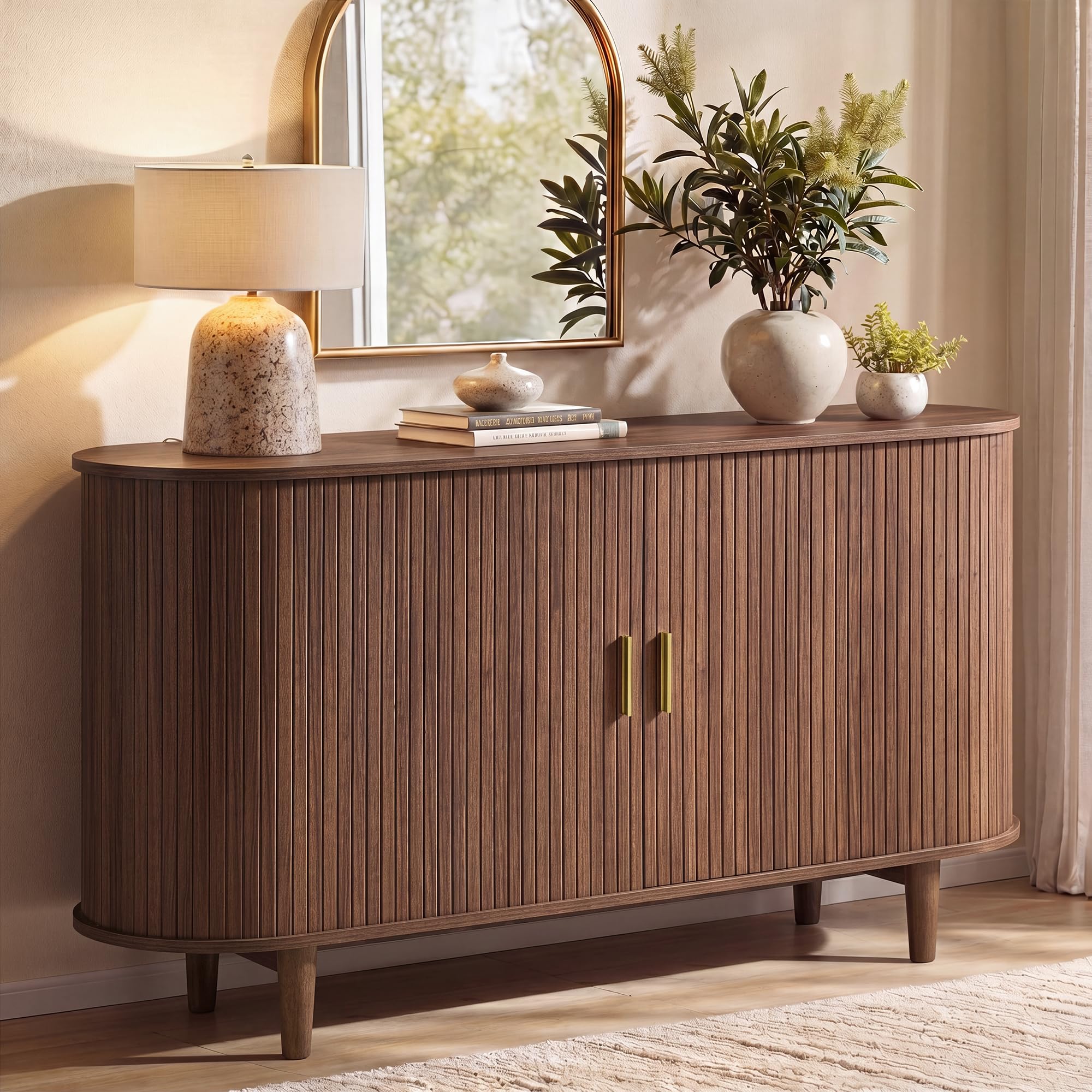
Doors that slide rather than swing are the whole argument for this VASAGLE, and we think it is a strong one in a dining room where chair backs sit close to the cabinet. Nothing opens into the walkway, the panels ride top and bottom tracks, and 55 inches of walnut-grained storage lands for less than most of the cabinets here.

The details are what lift it above budget-looking: a walnut grain finish, slim gold handles and rounded rubber wood legs. We also appreciated the back panel, which is a thick board that screws on rather than the thin nailing card you find at this level — that is what keeps a flat-pack cabinet square when it is shoved or moved.

The panels can jump their tracks if the cabinet is dragged or a door is forced, and they drop back in without tools. Empty the shelf below before sliding a panel right out, and the mechanism stays as smooth as it was on the first day.

Bottom Line: For a dining room where chairs sit close to the wall, this is the one: sliding doors need no clearance, and the walnut-and-gold finish looks far from budget.
#3

Best for Large Rooms

FORTUNETEC 67-Inch Arched Sideboard

FORTUNETEC 67-Inch Arched Sideboard

8.2/10 Very Good
  • Size: 15.7"D x 66.9"W x 31.5"H
  • Doors: 4 arched doors
  • Weight: 121 lb
  • Top Load Capacity: 300 lb
Check Price on Amazon

Pros

  • 67-inch span fills a large wall
  • 300-pound top handles appliances and serveware
  • Heavy 121-pound build stays rigid
  • Anti-tip strap included

Cons

  • Walnut finish reads redder than the photos

At 121 pounds, this is the heaviest cabinet in the group, and the weight is doing real work: a 67-inch body that does not shimmy when a door swings, and a stated 300-pound top load, the highest here. Plan on two people for the carry and the lift, not just for the doors.

The arched doors are the draw. Four of them run across the front under a lacquered walnut grain that reads as furniture rather than a box with handles, and the interior gives you two adjustable shelves behind them.

Size is where we land on it. Sixty-seven inches fills a wall that would leave a 55-inch cabinet stranded, and the top takes a drinks tray, a lamp and a serving setup on a holiday without complaint. In a narrow dining room it will crowd everything, so measure twice before you order.

Doors are the slow part of the build, with four panels to hang and line up, though one person can manage it with patience. An anti-tip strap comes in the box, and the pedestal base sits flush to the floor so nothing collects underneath.

Bottom Line: For a large dining room that needs presence, this 67-inch arched cabinet earns it: a 300-pound top, four doors and a build heavy enough to stay put.
#4

Best for Small Spaces

Smuxee Oak Sideboard

Smuxee Oak Sideboard

8.9/10 Excellent
  • Size: 14.9"D x 31.5"W x 30.6"H
  • Doors: 2 line-groove doors
  • Weight: 43.2 lb
  • Shelf Positions: 3 heights
Check Price on Amazon

Pros

  • Fits walls a 55-inch cabinet cannot
  • Line-groove doors and gold handles look considered
  • Shelf adjusts to three heights
  • Scratch- and water-resistant surface

Cons

  • Small top leaves little room for appliances

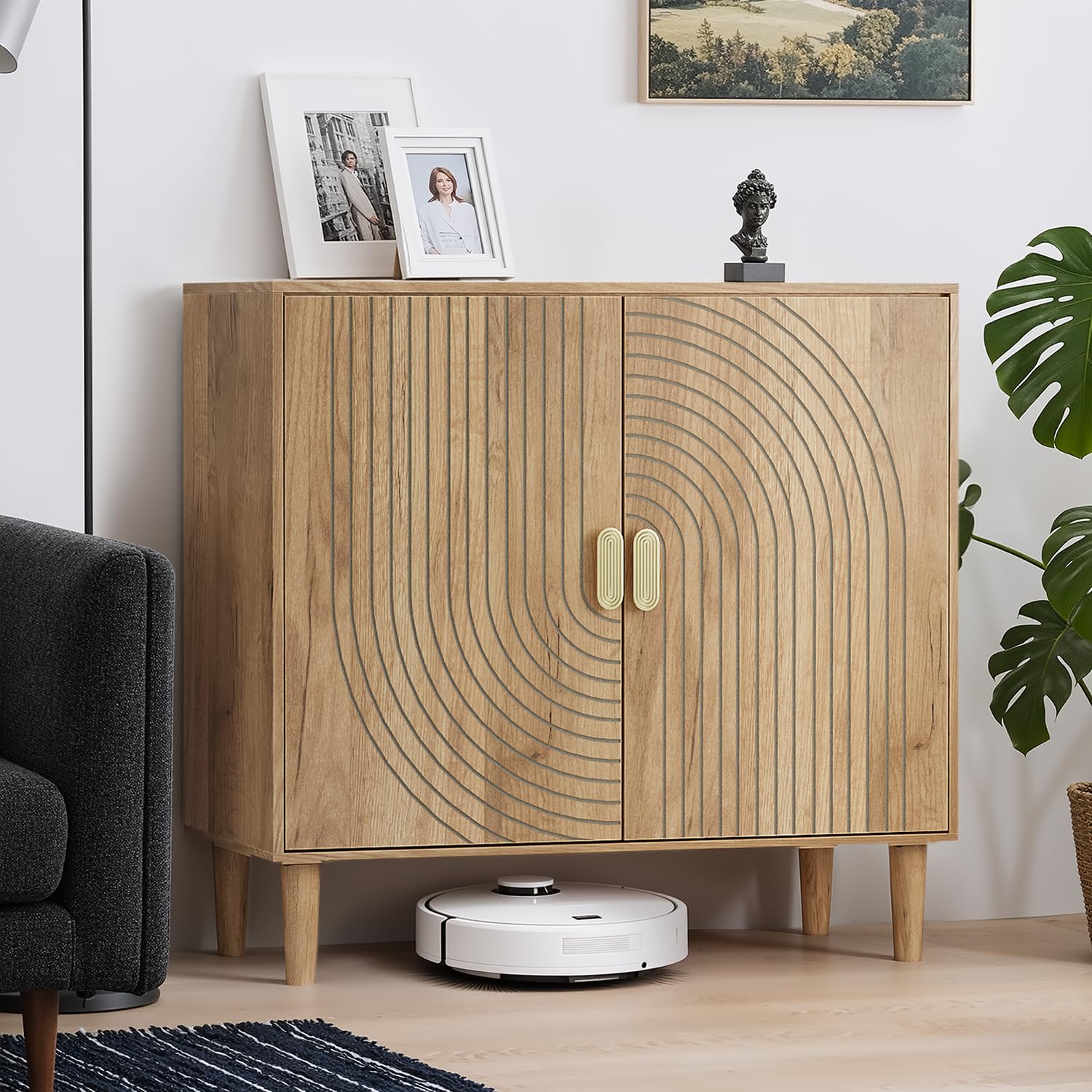
Thirty-one and a half inches is the number that matters here. In a rental dining nook, at the end of a hall, or beside a kitchen door, a 55-inch cabinet simply will not fit, and this Smuxee gives you the sideboard shape — doors, legs and a top with room for a lamp — in a footprint that does.

The details explain why it holds up so well against the bigger cabinets: groove-lined door fronts that catch light as you walk past, an oak grain finish, gold handles, and a shelf that moves through three heights. The MDF is finished to shrug off spills, which matters if this becomes the coffee station.

Assembly is a solo job with clear instructions, though the doors go on more easily with someone holding them, and the hinges turn a few times with a screwdriver until the gaps close up. If you want a longer run later, two of these are designed to sit side by side.

Bottom Line: The best small sideboard here: 31.5 inches wide, three shelf heights, and groove-lined doors that make a tight dining nook look deliberate.
#5

Best for Hallways

Homhedy 35-Inch Buffet Cabinet

Homhedy 35-Inch Buffet Cabinet

8.5/10 Excellent
  • Size: 11.8"D x 35.4"W x 31.5"H
  • Weight: 44 lb
  • Storage: 3 doors, 2 drawers
  • Shelf Positions: 3 heights
Check Price on Amazon

Pros

  • Shallow body keeps hallways clear
  • Two drawers for keys and small clutter
  • Shelf adjusts through three heights
  • Labeled parts and clear instructions

Cons

  • Drawers run on wood runners, not slides

At 11.8 inches deep, this is the shallowest cabinet here by a wide margin, and that is exactly what a hallway wants: it holds its line against the wall and never becomes something you turn sideways to squeeze past.

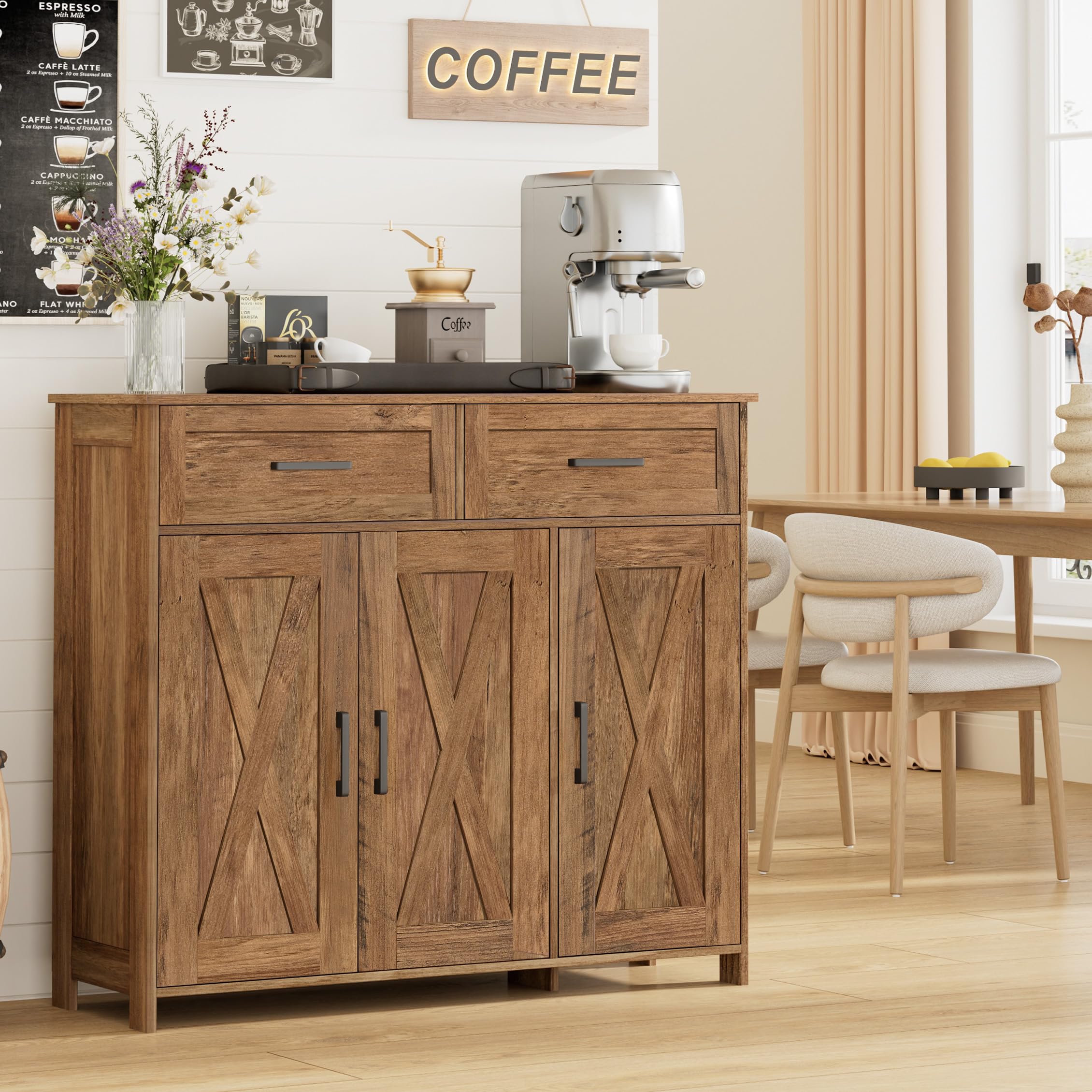
The two drawers are what make it earn that spot by the door. Keys, chargers, dog treats and the rest of the small debris live in them, and three doors hide the baskets and shoes behind. We think a shallow cabinet with drawers beats a deeper one with more cupboard space in an entry, because you use the drawers every day and the cupboard once a season.

Assembly is a solo job with labeled parts and readable instructions, and the finish wipes clean. The payoff for that shallow body is that plates stack flat rather than standing on edge, so plan on serving pieces, boxes and appliances rather than a full dinner service.

Bottom Line: For a hallway you still have to walk through, this is the pick: 11.8 inches deep, two drawers for keys and clutter, three doors for everything else.
#6

Long empty walls

IFGET 92-Inch Modular Sideboard

IFGET 92-Inch Modular Sideboard

8.6/10 Excellent
  • Size: 15.75"D x 92.63"W x 34"H
  • Doors: 6 fluted arched doors
  • Configuration: 3 modular units
  • Base Clearance: 5.7 inches
Check Price on Amazon

Pros

  • Covers 92 inches in three modules
  • Fluted arched fronts throw light and shadow
  • 5.7-inch clearance for robot vacuums
  • Adjustable shelves in each unit

Cons

  • Door gaps take repeated adjusting
  • Adhesive labels can lift the finish

Ninety-two and a half inches of sideboard sounds excessive until you have stood in front of a wall that a 55-inch cabinet leaves gaping. IFGET gets there with three separate units that line up as one run, so the length is built from modules rather than a single enormous box.

The fluted arched panels are the payoff: the carving throws light and shadow across the front, and at 34 inches tall it stands higher than the rest of this group, which brings the top closer to a comfortable serving height. Underneath there are 5.7 inches of clearance, enough for a robot vacuum to keep the floor clean along a piece this long.

Where it earns a place is length. Nothing else here covers 92 inches, and three modules mean you can set the seams where the room wants them. It ships in two packages that can arrive on different days, so do not book help for the first delivery alone.

Each unit assembles like any flat-pack cabinet; the work is in squaring the modules before you push them together, because a run this long shows any misalignment at the joins.

Bottom Line: When the wall is the whole problem, three fluted arched modules cover 92 inches and leave 5.7 inches of clearance for a robot vacuum underneath.
#7

Cutlery and linens

FUSUNBAO 57-Inch Fluted Sideboard

FUSUNBAO 57-Inch Fluted Sideboard

8.5/10 Excellent
  • Size: 15.7"D x 57"W x 33"H
  • Weight: 105 lb
  • Shelves: 2 adjustable
  • Storage: 3 drawers, 4 doors
Check Price on Amazon

Pros

  • Three drawers keep small items sorted
  • Fluted fronts and scalloped base add character
  • Adjustable feet level an uneven floor
  • Anti-tip kit included

Cons

  • Door gaps need patient hinge adjustment

Three drawers on a sideboard is rarer than it should be. Almost every cabinet here is doors and shelves, which is how cutlery, candles, batteries and the good napkins end up in a box behind a door. FUSUNBAO gives the top row over to drawers and keeps four doors below.

The fronts are fluted and the base is scalloped along the bottom edge, so it has a period look the flat-panel cabinets here do not attempt. The walnut grain is warm rather than red, and the hardware is small and dark, which keeps the detail from shouting across the room.

At 57 inches wide and 105 pounds it lands between the budget cabinets and the 67-inch pieces, and adjustable feet mean an uneven old floor does not turn into a wobble under a full load. The shelves adjust, an anti-tip kit is included, and the 33-inch height puts the top slightly higher than most here — good for serving, less good under a low window.

This is the one for a dining room that should look collected rather than modern, and where 57 inches is the honest measurement of the wall. Check that figure before you order, because there is no trimming a sideboard down.

Bottom Line: For drawers and a period silhouette, this is it: three drawers up top, four fluted doors below and adjustable feet that settle it on an old floor.
#8

Open-plan dining

Joaxswe 46-Inch Arc Credenza

Joaxswe 46-Inch Arc Credenza

8.7/10 Excellent
  • Size: 16"D x 46"W x 31.5"H
  • Storage: 3 doors, 6 compartments
  • Top Load Capacity: 75 lb
Check Price on Amazon

Pros

  • Curved edges suit a walkway
  • Six compartments behind three doors
  • Convincing wood grain finish

Cons

  • Top is rated for only 75 pounds

Rounded corners matter more than they sound. This Joaxswe has curved edges rather than sharp ones, and on a piece that sits between the kitchen and the dining table, that is the difference between a bruise and nothing at all.

It is 46 inches wide and 16 inches deep — bigger than the small cabinets here, smaller than the 55- and 67-inch pieces — which is the size that fits a dining area carved out of an open plan. Behind three doors there are six compartments, more separate cubbies than most of the cabinets here give you.

The dark wood grain is convincing and the build is straightforward, with directions that read clearly and parts that go where they should. Hanging the three doors is the one step to save for a second person.

We like it best as the sideboard in an open-plan dining corner, where you walk past the ends on the way to the kitchen and the rounded profile pays off every time you carry a laundry basket through.

Bottom Line: For an open-plan dining corner, 46 inches of curved-edge storage with six compartments — just keep heavy pieces off its 75-pound top.

How We Tested: Eight Sideboards, Nine Months, a Lot of Plates

We started with a list of about 40 sideboards and cut it down by the things you can check before you buy: listed dimensions, materials, price, and whether the cabinet had a finished back. What survived was a mix of solid wood, veneer-over-MDF, and one budget pick — eight units total, each assembled and used in a real home for nine months.

Every cabinet was assembled by one person with a timer running and the hardware sorted into bowls first. We noted where the instructions went vague, whether the cam locks lined up on the first try, and whether the doors hung square out of the box or needed a second pass with a screwdriver. A month in, we went back with a ruler and measured the gap at the top and bottom of every door to see which ones had sagged.

Then we loaded them the way people actually load a sideboard: stacks of dinner plates, heavy linen, board games, a record player, a child's art supplies. Shelves took weighted bins, and we gave each cabinet a firm nudge at the top corner to see how much it rocked on its own legs. Sliding doors were opened and closed fifty times while we listened for rattle or a jump off the track; the tops got a sweating glass, a hot mug, and a wet cloth. We measured usable interior depth rather than trusting the listed spec, and checked whether a standard stack of plates cleared the door hinges.

Appearance was judged over months, not minutes — how the finish handled a wet rag, whether fingerprints showed on the fronts, whether the edge banding lifted. Value came down to what the money actually bought: solid wood where it counts, or a veneer that only pretends.

How to Choose Sideboard Cabinets

Start With the Wall, Not the Finish

Width is the first number, and it is where most of us get it wrong: a 67-inch or 92-inch cabinet looks magnificent on a screen and swallows a small dining room. Mark your width on the floor with painter's tape and check that a chair still pulls out behind it.

Depth matters just as much. Most cabinets here run about 16 inches, and the hallway pick is 11.8, which is the difference between walking past a sideboard and turning sideways to squeeze by it.

Decide Between Doors and Drawers

Cupboards with adjustable shelves hold bowls, serving dishes and appliances. Drawers hold the small things that otherwise end up in a shoebox behind a door, and only one cabinet here gives you three of them across the top.

Count the tallest thing you plan to store, then look at the shelf positions: three heights is common, and one shelf per compartment is typical. Interior depth decides whether dinner plates stand upright or have to stack flat, which matters the first time you set the table.

Hinges Decide How the Finished Piece Looks

Four doors across 67 inches are four chances for uneven gaps, and alignment is the issue that touches nearly every cabinet in this set, whatever the finish. It is an assembly problem more than a quality one: adjustable hinges let you correct a door that hangs proud, and nearly all of these picks have them.

So decide by how much adjusting you want to do. A two-door cabinet is a short job; a six-door run is an afternoon, and the fluted and arched fronts show a crooked gap more than a flat panel does.

Materials, Finish and the Weight Test

Nearly everything at this level is engineered wood, and that is fine — the finish and the hardware do more for how a sideboard wears than the substrate does. A sprayed or baked paint wipes clean and resists water; a veneer shows every scuff.

Weight is a rough proxy for rigidity. A 43-pound cabinet and a 121-pound one are not built to the same tolerance, and the heavy ones need two people to move. Colors drift from the listing too, so judge warm walnut and painted green in your own room's light before the return window closes.

Frequently Asked Questions

Final Verdict

Buy the RoyalCraft. It gets the three things that matter right at once: a 58-inch span that fits a normal dining wall, a center leg and 200-pound top that let you load it properly, and a painted finish that shrugs off spills and wipes clean. It also happens to look better than most of the cabinets here.

If your chairs sit tight against the cabinet, take the sliding-door VASAGLE instead. If the wall is only 31 inches wide, the Smuxee is the one that fits — and it is the best-finished small cabinet in this group.