Entryway

Best Entryway Dressers of 2026

The entryway is the hardest-working square footage in a house. It catches keys, mail, a leash, the shoes you kicked off in a hurry, and it does all of that in front of guests. So a dresser that lives there has to do more than photograph well: the drawers need to still glide on the two-hundredth open, the top needs to survive being a landing pad, and the footprint needs to leave room for a human being to walk past. Get it wrong and you will feel it every single day — a case that racks when you pull a drawer, a finish that rings at the first wet umbrella, a flat-pack that never quite squares up.

Over the past eight months my team and I built, loaded, and lived with seven entryway dressers, from simple two-drawer consoles to proper three-drawer workhorses. Here's a piece of wisdom worth having before you buy: assembly is the tell. If the dowels seat with hand pressure and the cam locks catch on the first turn, the rest of the piece usually follows. If you are re-drilling at step three, you will be fighting that dresser for years. The picks below are the ones that went together cleanly and then held up.

#1

Best Overall

Xixini Fluted 6-Drawer Dresser

Xixini Fluted 6-Drawer Dresser

8.7/10 Excellent
  • Drawers: 6 deep, metal handles
  • Anti-tip: Device included
  • Material: Engineered wood, MDF
  • Dimensions: 15.6 D x 47.2 W x 30.5 H in
Check Price on Amazon

Pros

  • Console-height top doubles as a drop zone
  • Six engineered-wood drawers on slides
  • Fluted oak finish hides marks at grab height
  • Anti-tip device included

Cons

  • Engineered wood and MDF, not solid oak
  • Some units arrive with split or damaged panels

The figure that decided this one for us is 30.5 inches — the height of the top. That is counter height, so the Xixini takes keys, post, gloves and a lamp where your hand naturally falls, instead of the chest-high shelf you get from most dressers at this price. Push it against the wall beside the door and the fluted front and oak grain do the rest. It is the only pick here that reads as furniture in the first ten feet of the house, which is exactly where an entryway dresser has to work.

Underneath are six engineered-wood drawers on center-mounted slides, with wide metal handles and a scratch-resistant finish. We paid close attention to the drawer boxes, because that is where cheaper units give themselves away: these hold folded jeans and a stack of sweaters without the sag you get from fabric bins, and the handles take a full-hand pull. Depth is the compromise — 15.6 inches clears a hallway but is shallower than a bedroom dresser, so bedding and bulky coats need somewhere else to live.

Assembly is the catch. Ninety pounds arrives flat-packed, and the build runs to an evening rather than a coffee break; a power screwdriver turns it into a job you finish before dinner, and the anti-tip device is worth fitting while the drawers are still empty. The fluting earns its keep in a hallway too — those vertical grooves break up scuffs and handprints at exactly the height where people grab the top to steady themselves.
Bottom Line: This is the one we put by our own front door: console height, six real drawers and a finish that survives close inspection. Buy it if the entryway has to look furnished.
#2

Best Budget

WLIVE 9-Drawer Tall Dresser

WLIVE 9-Drawer Tall Dresser

8.8/10 Excellent
  • Feet: 4 adjustable
  • Frame: Steel with wood top
  • Drawers: 9 foldable fabric
  • Dimensions: 11.8 D x 39.6 W x 40.2 H in
Check Price on Amazon

Pros

  • Shallow 11.8-inch depth clears tight halls
  • Nine deep bins swallow soft goods
  • 29 pounds, movable by one person
  • Adjustable feet level out old floors

Cons

  • Fabric bins, not rigid drawer boxes

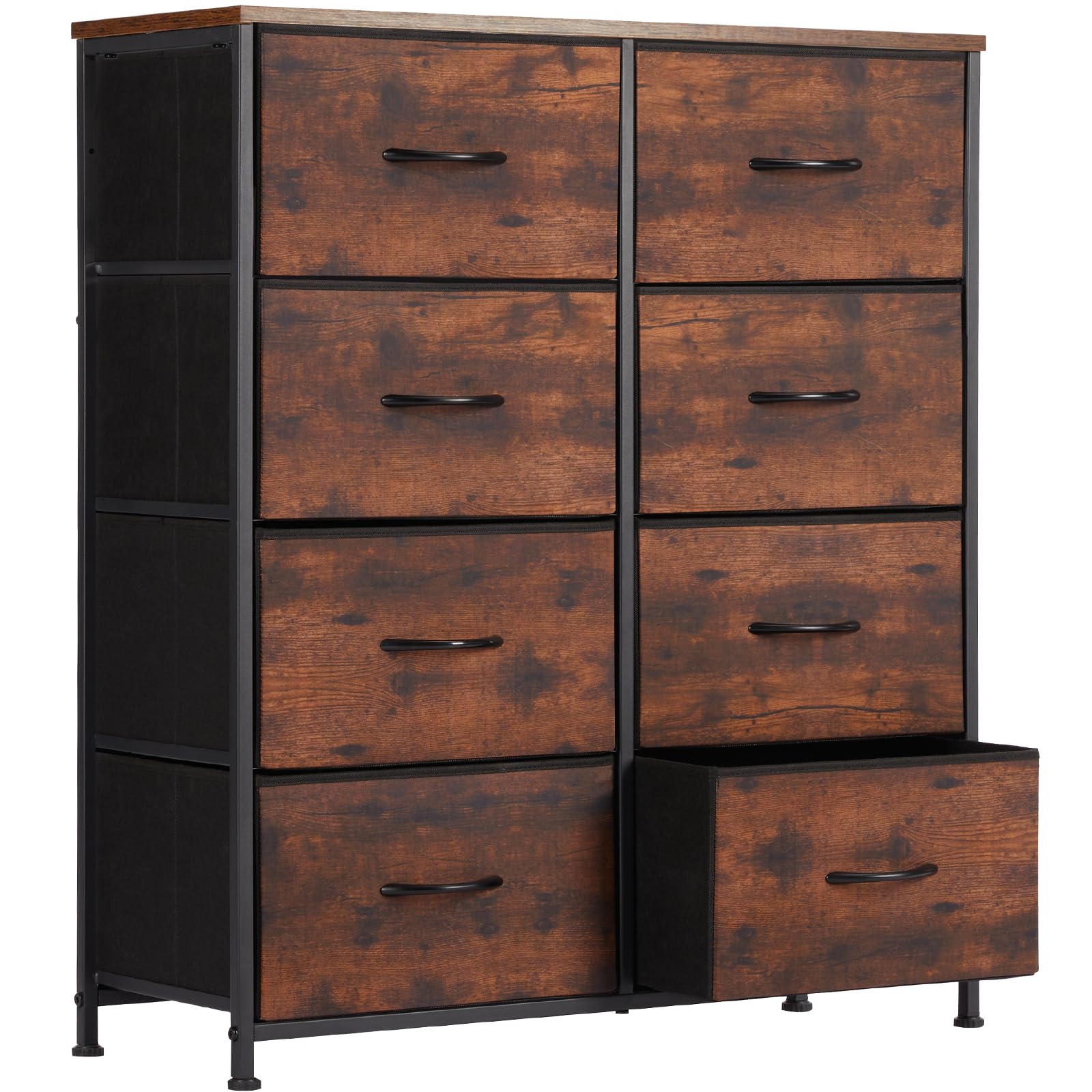
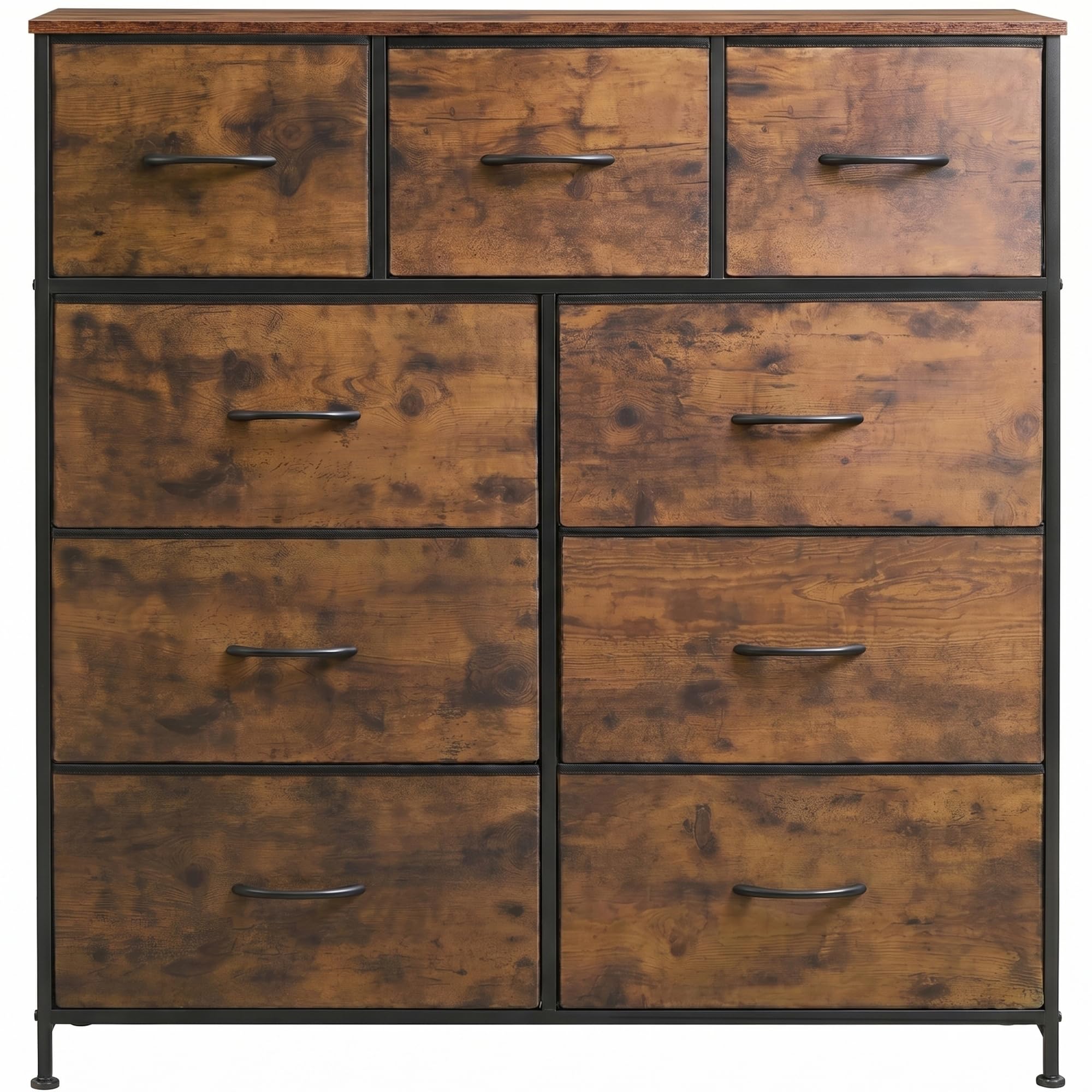
Far less money than our top pick, and 11.8 inches deep: the WLIVE is the one we point at when a hallway is tight and the budget is tighter. It is 39.6 inches wide, 40.2 inches tall, and built as nine foldable fabric bins inside a steel frame under a wood top — a dresser's job done at the price of a piece of flat-pack shelving.

What you give up is presence. The bins do not ride on rails; they pull out in your hand, and they keep their shape with soft goods — socks, gloves, hats, scarves, the things that actually pile up by a door — rather than with a bag of dog food or a stack of denim. We think that is a fair trade for an entryway, where most of what you store is textile and paper anyway, and the bins are deep enough that a family's winter accessories disappear into two of them.

The rest is quietly sensible: four adjustable feet that cope with an old uneven floor, a water-resistant top for a wet umbrella, 29 pounds so one person can carry it upstairs, and a build that goes together with the included tools and no power screwdriver. Plan around the height, though. At 40.2 inches the top sits above your natural drop, so hang a mirror over it and treat the surface as a shelf rather than a landing strip.

Bottom Line: Nine deep bins and a frame shallow enough for the narrowest hallway, at a price that leaves room for the rest of the entryway. The pick for a first apartment or a rental.
#3

Best for Narrow Hallways

Somdot 5-Drawer Tall Dresser

Somdot 5-Drawer Tall Dresser

8.7/10 Excellent
  • Top: FSC-certified wood
  • Drawers: 5 removable fabric
  • Warranty: 1 year
  • Dimensions: 11.8 D x 16.5 W x 45.1 H in
Check Price on Amazon

Pros

  • 16.5-inch width fits the tightest slot
  • Bins lift out and carry to the bedroom
  • Stated 14.3 x 11 x 8.1 in bins
  • FSC-certified wood top and a 1-year warranty

Cons

  • Tall, narrow frame needs a wall strap

If the space by your door is a slot — the gap between a closet and the frame, with a light switch you still need to reach — the Somdot goes in it. It is 16.5 inches wide, 11.8 inches deep and 45.1 inches tall, five removable fabric bins stacked in a steel frame under a wood top: a hall tree's footprint with a dresser's job.

The lift-out bins are the detail we keep coming back to. Each one measures 14.3 by 11 by 8.1 inches, which is a stack of T-shirts and a couple of folded sweaters, and because it comes out entirely you can carry a whole drawer to the bedroom, sort it on the bed and drop it back — no crouching in the hallway, and cleaning underneath takes seconds. The wood top is FSC-certified, which we do not expect at this price. What it is not is a landing strip: at 45 inches the top sits above a shorter adult's natural reach, so this is storage first and a surface second.

Bottom Line: Five lift-out bins in 16.5 inches of wall, which is the whole reason to buy it. The pick when the entryway is a slot and nothing wider fits.
#4

Best Tall Chest

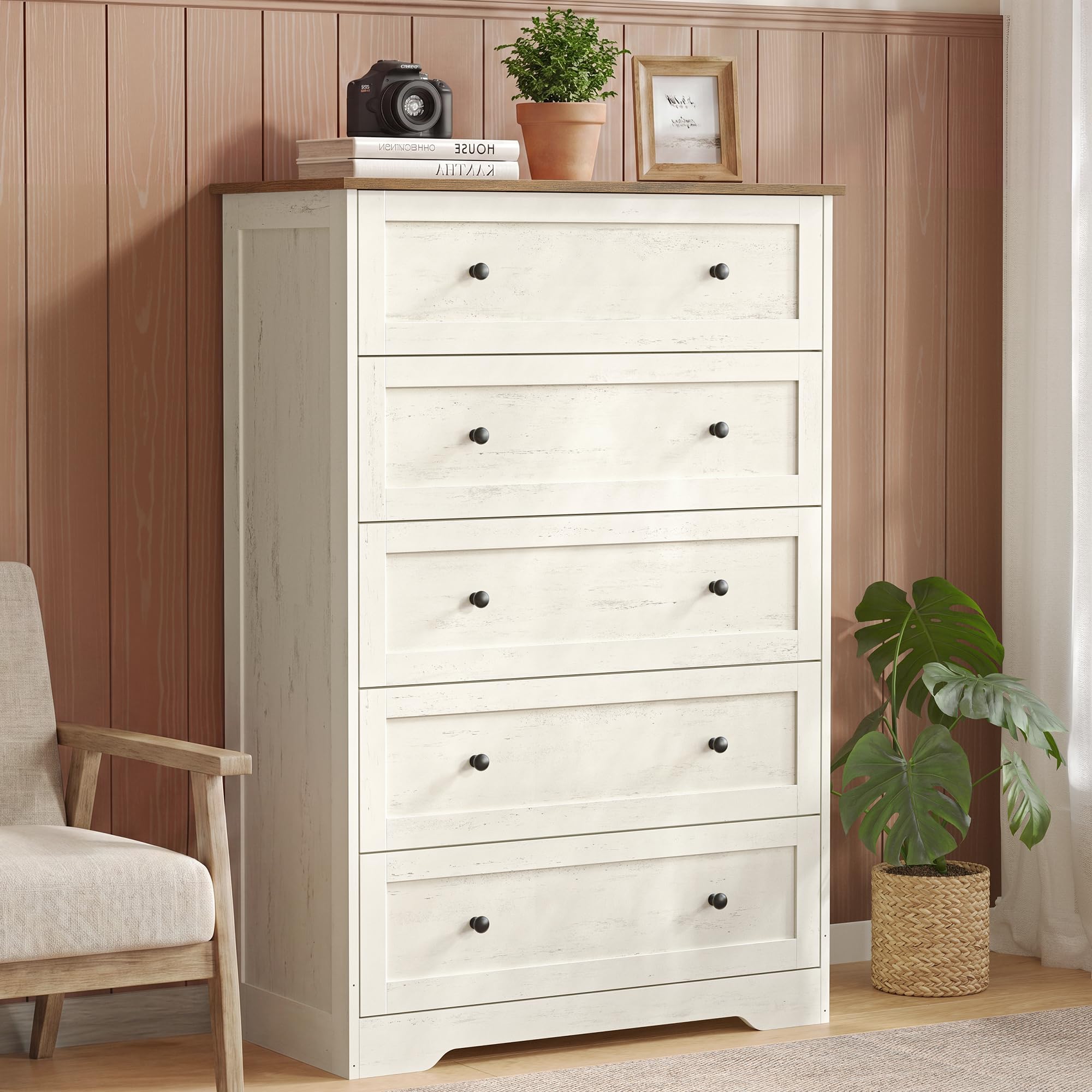
VASAGLE 5-Drawer Chest

VASAGLE 5-Drawer Chest

8.7/10 Excellent
  • Drawers: 5 with stoppers
  • Anti-tip: Kit included
  • Material: Particleboard and MDF
  • Dimensions: 15.7 D x 31.5 W x 47.4 H in
Check Price on Amazon

Pros

  • Narrow 31.5-inch width suits a tight wall
  • Drawer stoppers keep full boxes in place
  • Anti-tip kit and floor pads included
  • Solid, non-warping build for particleboard

Cons

  • Misaligned pilot holes on some units
  • Particleboard and MDF, not solid wood

VASAGLE's flat-pack has a reputation for fighting back, and this chest earns it: labeled parts, an evening of your life, and instructions that assume you have built furniture before. We went in braced for it and still spent longer on the frame than on any other pick here. Keep a power screwdriver and a rubber mallet to hand, and what you end up with is genuinely sturdy for particleboard.

Five drawers, each with a stopper so a full box cannot end up on your foot, plus an anti-tip kit and pads on the bottom to protect the floor. The drawer depth is the usable part — about 13 inches front to back — so a folded stack sits in a single layer instead of a jumble. At 31.5 inches wide and 15.7 inches deep it tucks against a narrow wall without eating the hallway, and the cloud-white and warm-brown finish looks better in the room than it does in the listing photos.

Where it lands is the height. At 47.4 inches this is a chest, not a console: the top is shelf height, good for a lamp or a bowl, useless for dropping keys into. That makes it the right buy for a narrow wall in an entryway that already has a bench or a table by the door — and the wrong one if this dresser is the only surface you will have.

Bottom Line: A narrow, genuinely sturdy chest with drawer stoppers, an anti-tip kit and a finish that outranks its price. Buy it for a wall, not for a drop zone.
#5

Best with Built-In Charging

Furnulem 5-Drawer Charging Dresser

Furnulem 5-Drawer Charging Dresser

8.9/10 Excellent
  • Drawers: 5 fabric plus shelf
  • Anti-tip: Included
  • Charging: 2 AC outlets, 2 USB
  • Dimensions: 11.5 D x 16.1 W x 43.3 H in
Check Price on Amazon

Pros

  • 2 AC outlets and 2 USB ports built in
  • Charging strip mounts front, back or not at all
  • 16.1-inch width fits a hall nook
  • Anti-tip strap and adjustable feet included

Cons

  • Outlets sit close together
  • Fabric bins suit light items only

Two AC outlets and two USB ports built into the frame is why this one made the guide. In an entryway the socket is always in the wrong place — behind the coat rack, under the bench — and the Furnulem puts power at the top of a 43.3-inch column that is just 16.1 inches wide and 11.5 inches deep. We think that is genuinely useful beside a door: phone, earbuds, a bike light and a laptop charging where you drop them instead of on the kitchen counter.

The mounting is smarter than it needs to be. The frame is pre-drilled front and back, so the charging strip can face into the room, hide behind the unit, or come off altogether if you change your mind — a small thing that makes the piece much easier to live with. Below it sit five foldable fabric drawers and an open shelf, enough for gloves, mail, chargers and a pair of shoes. Two things to know: the outlets sit close enough together that a chunky adapter can crowd its neighbor, and the light frame wobbles on carpet until you wind the adjustable feet down. Neither is a dealbreaker, and the anti-tip strap goes on regardless.

Bottom Line: Outlets, USB ports and five bins in a 16-inch footprint. If your hallway is where the phones pile up, this is the one we point at.
#6

Kids and rentals

Sweetcrispy 8-Drawer Dresser

Sweetcrispy 8-Drawer Dresser

8.5/10 Excellent
  • Frame: Steel with MDF top
  • Drawers: 8 fabric
  • Anti-tip: Included
  • Top Load: 66 lb
Check Price on Amazon

Pros

  • Eight deep fabric drawers on a budget
  • Top rated to 66 pounds
  • Anti-tip hardware included
  • Stated 20-minute assembly

Cons

  • Fabric fronts and bins, not wood drawers
  • Rails and plastic fittings are the wear point

This is the one we hand to someone furnishing a first apartment or a kid's room, where the dresser has to survive a move, a growth spurt and a roommate, and nobody is expecting an heirloom. Eight fabric drawers on a steel frame, a wood top rated to 66 pounds, anti-tip hardware in the box, and a stated 20-minute assembly.

For the money it does more than the listing suggests. The drawers are deep enough for a stack of hoodies or a week of kids' clothes, and 66 pounds on top is enough for a small TV or a microwave if this ends up in a dorm rather than a hallway. We noted that the wood-grain finish stops at the top surface — the drawer fronts are fabric, so from a few feet away it reads as a storage tower rather than a chest of drawers.

The caution is durability, and it is the same caution we have about every fabric tower at this price. Pull drawers by the handle, do not overstuff them, and keep the load to soft goods; the rails and plastic fittings are what give out first when a drawer gets yanked or packed with denim. Treated that way it is a lot of storage for the outlay, and the anti-tip hardware means you can fix it to the wall on day one.

Bottom Line: Eight drawers, a steel frame and a top that takes 66 pounds, at a price that undercuts the wood-drawer picks. The one for a first place, a kid's room or a dorm.

How We Built, Loaded, and Lived With 7 Entryway Dressers

We started by gathering every dresser that plausibly belongs in a hallway rather than a bedroom — three drawers or fewer, generally under 44 inches wide, in materials that could take daily abuse — then filtered the field by price, listed dimensions, and whether the drawer boxes were built to hold more than folded T-shirts. Seven made the cut.

Each one arrived flat-packed, and I assembled all seven alone using only the included tools, timing every build. Hole alignment turned out to be the clearest signal of overall quality: on the good ones, dowels seated with hand pressure, cam locks grabbed on the first turn, and the case squared up without a fight. On the poor ones I was widening holes and re-clamping by step three, and those same units were the ones that wobbled later.

Then they went into real hallways. I filled drawers with what actually lands there — gloves, a leash, mail, chargers, a folding umbrella — and opened and closed each drawer 20 times in a row to see whether runners skipped or the drawer fronts racked out of line. I leaned on the top while pulling boots on, set a wet umbrella against the sides, checked the finish for rings the next morning, and measured each footprint against a 36-inch hallway to see how much walking room was left.

Appearance got judged at 7 a.m. and again at 7 p.m., since a console reads very differently in daylight and under a hallway bulb; I noted whether the finish was even across the top and the drawer fronts, and whether seams and edges looked tidy up close. After eight months of daily use I checked corners, veneer edges, and drawer bottoms for bowing, and weighed what each price actually bought — solid joinery or just a nice-looking front.

How to Choose Entryway Dressers

Measure the walkway before you count drawers

Depth is the specification that decides whether an entryway dresser works, and it is the one most buyers check last. The picks here run from 11.5 to 15.7 inches deep; in a 36-inch hallway that is the difference between 24 inches of clear walkway and 20, which you will notice every time you carry groceries through.

Measure the narrowest point of the route, including baseboard and the swing of the front door, then subtract the dresser's depth. If you are left with much less than two feet of passage, go shallower or narrower — a 16-inch-wide tower beats a 47-inch console nobody can walk past.

Match the top height to what you will do with it

A top between roughly 30 and 36 inches sits at hip height, which is where a landing surface earns its keep: keys, post, a pair of gloves, a lamp. Above about 40 inches you own a chest — good for storage, awkward for a drop zone, and better with a mirror or a print hung over it.

That is why we split the picks the way we did. The Xixini at 30.5 inches is a console; the VASAGLE at 47.4 inches is a chest, and it is the better buy for a wall that already has a bench or a table beside the door. Decide which job the piece has before you fall for a finish.

Fabric bins versus drawers on slides

Most affordable entryway dressers use foldable fabric bins inside a steel frame. They are light, they are inexpensive, and they are fine for soft goods — hats, gloves, scarves, socks, mail — but they do not ride on rails, they lose shape under weight, and a bag of dog food or a stack of denim will find them out.

Engineered-wood drawers on slides cost more and hold far more. The details tell you which you are getting: look for drawer stoppers so a full box cannot tip out, and metal handles rather than fabric pulls. If the drawer will hold shoes, tools or anything heavy, buy the wood.

Budget for assembly, and anchor the thing

Nearly everything here arrives flat-packed, and the honest range runs from about twenty minutes with the supplied tools to a full evening with a power screwdriver. Read the parts list before you start, sort the hardware into cups, and do not fully tighten anything until the frame is square.

Then anchor it. A dresser in a hallway gets leaned on while someone pulls a boot off, and any unit over about 30 inches tall should be strapped to the wall, especially with children or a dog in the house. If the box does not include a strap, add one before the dresser goes into place.

Frequently Asked Questions

Final Verdict

The Xixini is the dresser we recommend first. At 30.5 inches it puts a real landing surface at the front door, and its six engineered-wood drawers on slides handle daily opening in a way fabric bins do not — the price is an evening with a screwdriver.

If the hallway cannot spare 16 inches of depth or the budget will not stretch, the WLIVE does the job at 11.8 inches deep with nine bins and a 29-pound frame one person can move. And if the nook also needs outlets, the Furnulem is the specialist.