Entryway

Best Outdoor Doormats of 2026

A doormat has one job, and it's a filthy one: take the hit so your floors don't. The problem is that most mats fail quietly. A corner curls and catches your toe, the thing skids half a foot every time someone wipes their feet, or it soaks up a rainstorm and stays spongy for three days. I've watched a cheap mat flatten into a ragged strip in a single season, and I've watched a heavy rubber one sit through two winters without budging. What separates them usually isn't price — it's whether the mat grips the ground, sheds water instead of hoarding it, and scrapes grit off a boot rather than smearing it into a muddy paste. Get that right and your entryway stays cleaner, your mat stays where you put it, and the whole thing looks intentional instead of like an afterthought.

Over the past four months, my team and I kept 13 mats parked at front doors, back doors, and one genuinely swampy garage entry, from late-winter slush straight through a wet spring. One thing I'd tell any first-time buyer: size is the spec nobody checks. A mat narrower than your doorway just teaches people to step around it, which defeats the entire point. Below you'll find the ones that earned their spot — and the reasons they did.

#1

Best Overall

WaterHog Boxwood 23x36

WaterHog Boxwood 23x36

9.5/10 Exceptional
  • Size: 23 x 36 in
  • Material: PET fiber, rubber backing
  • Thickness: 0.38 in
  • Water Capacity: Up to 1 gal per sq yd
Check Price on Amazon

Pros

  • Covers a full 23 x 36 inch threshold
  • Holds water in the pile instead of tracking it
  • Vacuums, hoses clean, air-dries quickly
  • Pile and color hold up to traffic

Cons

  • Highest price in this roundup

Twenty-three inches by thirty-six is the size that changed our minds about doormats. A 17 x 29 mat covers a doorway; this one covers the traffic — two people coming in at once, a dog cutting the corner, the swing of the door itself. At 0.38 inches it still sits low enough that we stopped thinking about clearance after the first day, and the rubber back keeps the whole thing flat instead of rucking up at the corners.

Water is where it separates from the cheaper mats. The top is a stiff PET fiber set into deep grooves with a rubber border around the edge, built to hold up to a gallon of water per square yard rather than let it run across the floor. What that gives you is a mat that never squelches: rain goes into the pile, your shoes come out drier, and the floor inside stays dry. When it gets grim, vacuum it, hose it, and stand it up to air.

It also wears better than anything else in this group. The pile stayed dense and the pattern kept its color, and the mat never shed fibers onto the step the way cheaper synthetics can. The fiber is made with up to 90 percent recycled material, which is a bonus rather than the reason to buy. One detail to plan around: the listed size carries a 3 percent manufacturing variance, so do not design a millimeter-tight fit against a door frame.

So this is our pick, with one caveat. It is the premium mat here, and a sheltered porch with dry feet does not need it — the DII or the WeatherMAX covers that job for a lot less money. What you are paying for is a mat that handles a wet, gritty threshold and still looks like something you chose on purpose, and on that measure nothing else here matched it.

Bottom Line: The WaterHog is the mat we point people to first: it covers a full threshold, holds water instead of tracking it in, and looks good doing it. Worth the premium at a busy door.
#2

Best for Exposed, Rainy Entries

DII All-Weather Rubber Lattice

DII All-Weather Rubber Lattice

9.3/10 Outstanding
  • Size: 18 x 30 in
  • Weight: 5.3 lb
  • Material: Rubber
  • Thickness: 0.5 in
Check Price on Amazon

Pros

  • Drains rain instead of holding it
  • Heavy rubber body stays put in wind
  • Hose or broom clean in minutes
  • Lattice pattern looks deliberate on a porch

Cons

  • Wipes less thoroughly than a fiber mat
  • 18 x 30 is tight for wide doorways

An open lattice looks like decoration until the first downpour, when it turns out to be the entire argument for the DII. Rain falls straight through rather than soaking in, so the mat is never a wet sponge waiting for a bare foot, and at 5.3 pounds with a solid rubber back it stays where you set it. That weight is also why it feels better than it costs: it does not skate, it does not curl, and it does not need a gripper underneath.

What it will not do is dry a shoe. The lattice scrapes mud, grit, and sand off a sole, but there is very little fiber to wick moisture, so a sopping boot comes out a sopping boot. This is a scraper for a wet porch, not an absorber. The 18 x 30 footprint is the small end of standard, too, so at a double-wide threshold it will look skimpy — measure before you order rather than after. Otherwise upkeep is as easy as it gets: shake it, sweep it, hose it off with the deck, and it never sogs. Out of the box it smells of new rubber, which a day outdoors takes care of.

Bottom Line: If your door takes the weather head-on, this is the mat: an open rubber lattice that drains instead of soaking. It scrapes rather than dries, so pair it with something inside.
#3

Best Value All-Rounder

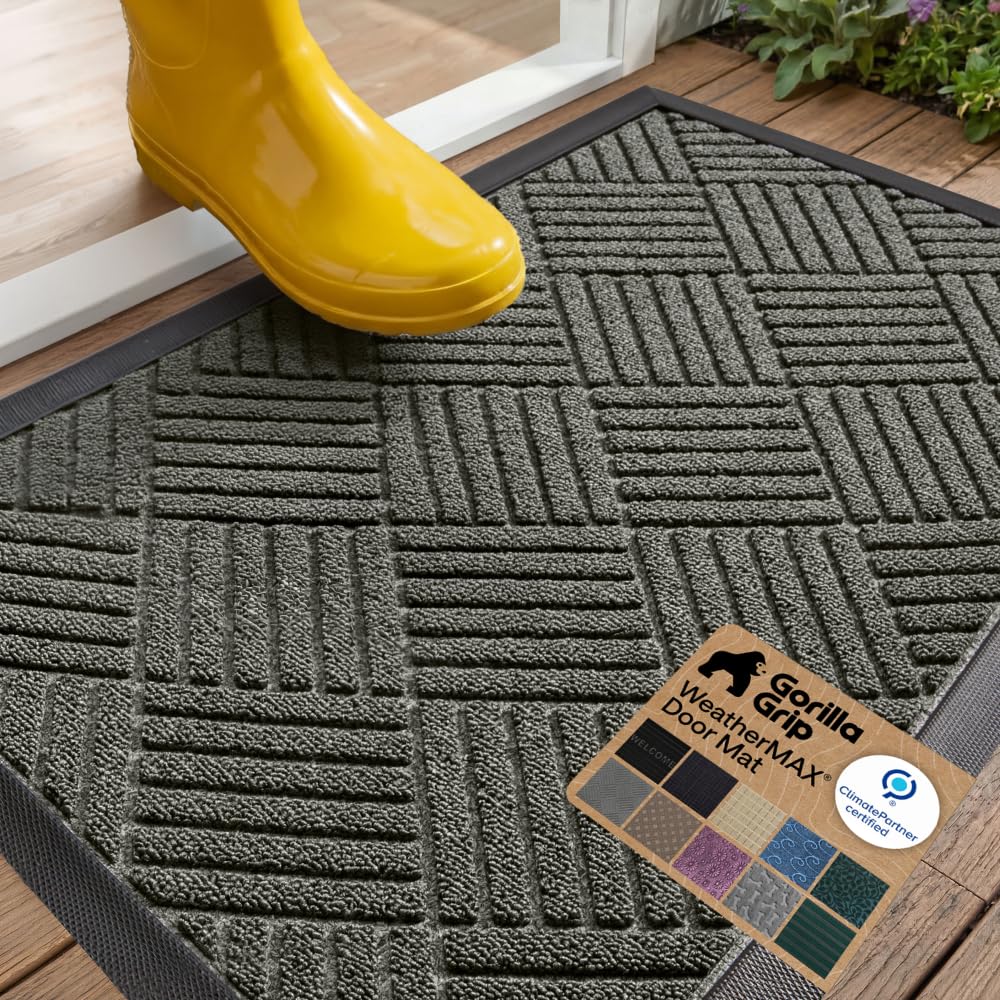
Gorilla Grip WeatherMAX

Gorilla Grip WeatherMAX

8.8/10 Excellent
  • Size: 17 x 29 in
  • Weight: 2.1 lb
  • Material: Polypropylene, rubber backing
  • Thickness: 0.3 in
Check Price on Amazon

Pros

  • Deep grooves scrape mud and grit
  • Rubber back grips concrete and porches
  • Pattern and color hold up outdoors

Cons

  • Can creep on smooth indoor floors
  • Shallow pile leaves slush sitting on top

Some shoppers want the doormat equivalent of a good pair of work boots, and the WeatherMAX is that: a woven polypropylene top with deep grooves, a natural rubber back, and 0.3 inches of thickness that slips under a door without a fight. It is the mat we suggest when someone asks for one that just works and does not want a lecture about fibers.

At its price we expected to find corners cut, and we did not. The grooves scrape a boot clean, the edges are beveled so nothing catches a toe, and the diamond pattern still looks deliberate after a season in the sun. It is not the most absorbent mat here — slush sits on top until it drains — and on a smooth interior floor it can creep a little, though on concrete or a porch it holds. Neither matters much at an exterior door, which is where it belongs.

Where it gives ground to the WaterHog is coverage and depth, and to the DII is standing water. Bring either of those requirements and pay for it; bring ordinary dirt and a standard doorway and this is the sensible buy. What you are not giving up at this price is durability — the top has not shed, faded, or flattened in our time with it.

Bottom Line: A dependable, plain-spoken mat for a standard front door: it scrapes, it stays put, and it does not look cheap. The safe buy when you do not want to think about a doormat.
#4

Best for Wet Boots and Slush

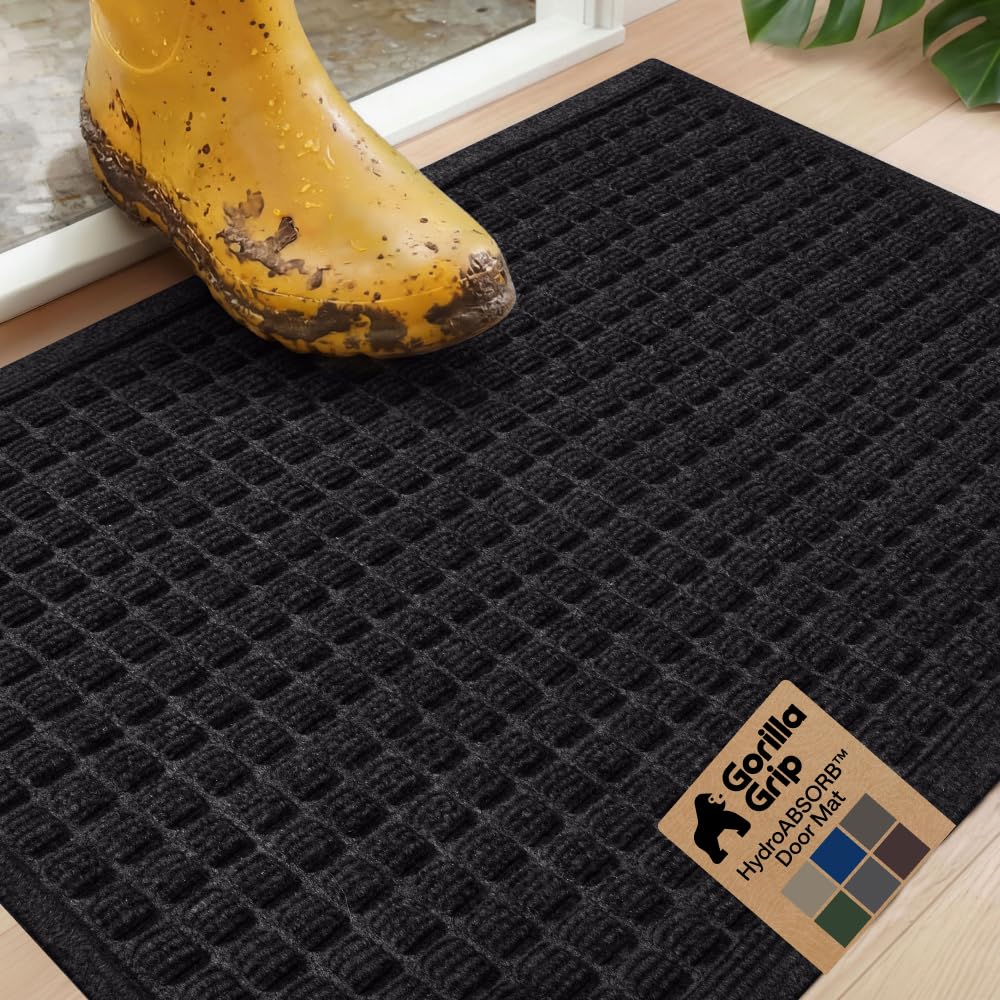
Gorilla Grip HydroABSORB

Gorilla Grip HydroABSORB

9.1/10 Outstanding
  • Size: 17 x 29 in
  • Material: Rubber
  • Thickness: 0.3 in
  • Water Absorption: Up to 1.7 cups
Check Price on Amazon

Pros

  • Absorbs up to 1.7 cups of water
  • Dense face dries wet shoes fast
  • Rubber backing grips hardwood and porches
  • Crush-proof under daily traffic

Cons

  • Hand wash only, no machine cycle
  • Black face shows light debris

Gorilla Grip makes two mats that look like siblings and do opposite jobs. The WeatherMAX scrapes; the HydroABSORB absorbs — up to 1.7 cups of water by the stated figure, which is the number that matters when the boot coming in is wet rather than caked.

The raised square pattern does the first pass, knocking clumps loose, and the dense top takes the rest, so a wet shoe leaves the mat damp instead of the floor. We were surprised how much difference the softness makes: it feels like an anti-fatigue mat underfoot, which is a small thing at a door you cross six times a day and a real one at a door you stand at. The rubber underside is aggressive enough to hold on hardwood and on a porch, and the mat does not wander.

Two things to know. It is an absorber, so heavy mud loads the face and it wants a rinse rather than a shake, and the black surface shows light debris between cleanings. The care instructions also specify hand washing, not a machine cycle. Neither is a problem at a sheltered door, which is exactly where an absorber belongs — just outside a covered entry or just inside a garage door is where it earns its keep.

Bottom Line: For wet boots rather than muddy ones, this is the mat we reach for: the absorbent face soaks up what a scraper leaves behind. Best on a covered porch or just inside the door.
#5

Best Budget Pick

HIYARD Front Door Mat

HIYARD Front Door Mat

9.1/10 Outstanding
  • Size: 17 x 29 in
  • Weight: 2.1 lb
  • Material: Polyester, rubber backing
  • Thickness: 0.3 in
Check Price on Amazon

Pros

  • Rubber backing grips without a gripper
  • Low profile clears dragging doors
  • Machine washable when it gets bad

Cons

  • Thin pile holds less water and grit
  • 29 x 17 is strictly standard sizing

The cheapest of the fabric mats we kept, and the one that surprised us most. The HIYARD is a thin, low-profile mat with a rubber backing that grips properly — it stayed put at a side door through a wet week — and its 0.3-inch height clears a door that drags. Nothing about it feels flimsy: the edges are bound, the pile is dense for the money, and the color options are plain enough to disappear against most porches.

What you give up is capacity. A mat this thin has less pile to hold water and grit, so it is an everyday front-door mat rather than a mud-season one, and it needs shaking out more often than the WaterHog or the HydroABSORB. The 29 x 17 size is exactly standard, no more, so a wide threshold shows bare edges at either side. It does take a machine wash, which most of the rubber-backed mats here do not. For a second door, a rental, or a spot that only sees dry feet, it is all the mat you need.

Bottom Line: The best cheap mat here: it grips, it traps dirt, and it does not look like a compromise on the step. Perfect for a side door, a rental, or a second entrance.
#6

Sheltered side doors

Yimobra Welcome Mat

Yimobra Welcome Mat

9.1/10 Outstanding
  • Size: 29.5 x 17 in
  • Weight: 1.5 lb
  • Material: Polyester, rubber backing
  • Thickness: 0.3 in
Check Price on Amazon

Pros

  • Lightest mat here at 1.5 pounds
  • Machine washable and easy to shake out
  • Natural rubber backing grips the porch
  • Soft grass-like pile underfoot

Cons

  • Light enough to shift in strong wind

At 1.5 pounds, the Yimobra is the lightest mat in this group, and that one figure explains most of what it is like to own. Picking it up to shake out grit takes one hand; hanging it over a rail to dry takes no effort at all; and unlike the heavier rubber mats here, it does not have to be dragged back into place.

The surface is a soft, grass-like pile that scrapes reasonably well and feels good under bare feet, and the natural rubber backing grips a porch properly once the mat is flat. It is rated waterproof, it takes a machine wash, and the colors have held their depth rather than washing out. For a mat at this price, that is more than we expected.

The trade-off is exactly what the weight predicts: on an open, windy porch this mat can lift and slide, where a five-pound rubber mat stays put. On a sheltered step that never comes up, and the lightness becomes the reason to choose it — it is the mat you can clean in a moment and stow without thinking. It is also the one here that goes in the washing machine.

Bottom Line: The lightest mat here, and the easiest to live with: shake it out, hose it, or machine wash it. Just do not leave it loose on an exposed, windy porch.
#7

Doors with sidelights

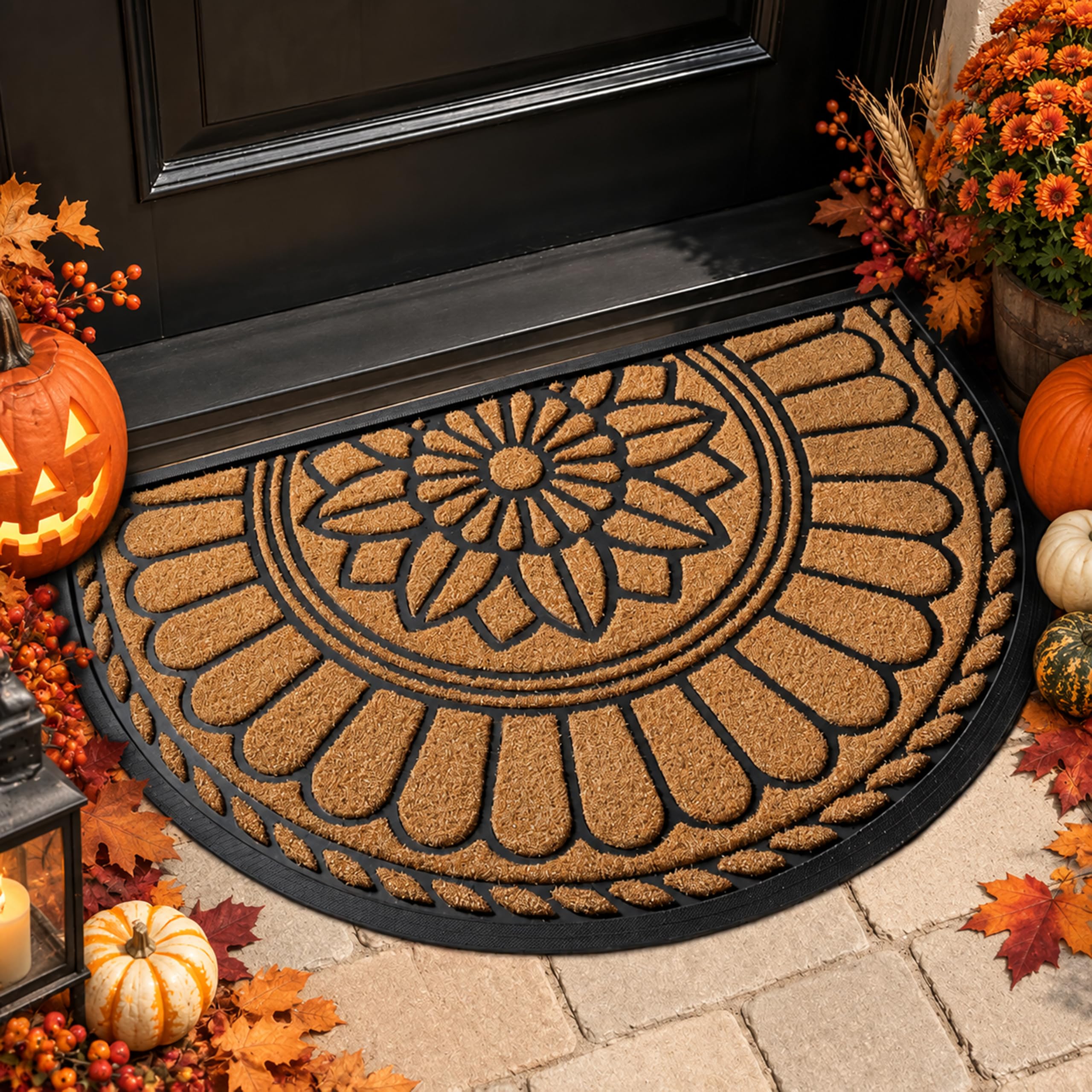
Mibao Half-Round Doormat

Mibao Half-Round Doormat

9.1/10 Outstanding
  • Size: 30 x 17 in
  • Shape: Semicircular
  • Material: Polypropylene, rubber backing
  • Thickness: 0.5 in
Check Price on Amazon

Pros

  • Half-round shape suits doors with sidelights
  • Beveled rubber border traps debris
  • Thick 0.5-inch build with a lifetime warranty
  • Bright pattern that holds its looks

Cons

  • Collects water on an uncovered step
  • Reads smaller than the 30 x 17 arc implies

Half-round mats exist for one layout: a single door with sidelights, or a step where a rectangle leaves two awkward corners of bare stone. The Mibao fills that arc neatly at 30 inches across and 17 deep, and the floral pattern is the first thing anyone sees at the door.

Under the pattern it is a flat-woven polypropylene mat with a beveled rubber border, half an inch thick and heavy enough to lie flat on its own. That border is the design idea: it forms a shallow dam around the edge to hold moisture and debris on the mat instead of letting it run onto the step. It is a good idea in dry weather.

In real rain, the same dam works against it. Water collects in the pile and the mat can stay wet long after the shower passes, which is the one thing we would weigh before ordering; on a freezing night a soaked mat at the door is worth lifting out of the way. The 30 x 17 footprint also reads smaller in person than the arc suggests, so check it against your threshold rather than against the photo.

Put it under a porch roof, in a garage entry, or anywhere rain does not land directly, and it is one of the nicer mats here — sturdy, cheerful, and shaped for a door a rectangle does not fit. Exposed to the sky it is the wrong tool, and the DII or the WaterHog is the better answer.

Bottom Line: A half-round mat that solves a sidelight doorway and looks far better than a plain rectangle. It belongs on a covered porch, not an exposed one.
#8

Covered porches

AMARU Coir Welcome Mat

AMARU Coir Welcome Mat

9.3/10 Outstanding
  • Size: 17 x 29 in
  • Backing: PVC
  • Material: Coir
  • Thickness: 0.6 in
Check Price on Amazon

Pros

  • Stiff coir scrubs dry grit clean
  • Thick 0.6-inch weave with PVC backing
  • Vibrant design that stays cheerful

Cons

  • Not weatherproof
  • Can stain the surface beneath if it stays damp

Coir and rain do not mix, and this mat's own care instructions admit it: keep it shaded, keep it off damp surfaces, and expect staining if it sits wet. For an exposed doorway that ends the conversation, and it is better to say so up front than let you find out in November.

Under a roof, though, it is a pleasure. The coir is thick and tightly woven, 0.6 inches of stiff bristle that scrubs dry grit off a sole in a way the rubber and fiber mats here cannot match, and the PVC backing stops it creeping across a porch. The bird design is genuinely cheerful rather than twee, the colors have held, and the whole thing unrolled flat almost immediately.

This is the mat for a covered front porch in a dry climate, or a spot where an eave does the weatherproofing. It is priced with the mid-range mats here, which is fair for the weave and the thickness, but it is also the shortest-lived choice on this list if water reaches it — coir flattens and stains once it stays wet. Under cover, it earns a front door.

Bottom Line: A cheerful, thick coir mat that scrubs dry grit better than anything else here — and needs a roof over it. Buy it for a covered porch.

How We Tested the Best Outdoor Doormats

We started with every mat we could find that was actually labeled for outdoor use, then cut the list down to 13 by material — coir, molded rubber, recycled plastic, and woven polypropylene — along with whether the maker offered more than one size and whether the price made sense for something that lives in the weather. Each one went down at a real door: a covered front porch, an exposed back step at the bottom of a staircase, and a garage entry where two dogs come in from the yard several times a day. Before anything got stepped on, we measured every mat against the width of the door and noted whether a person could land on it without aiming.

Placement and water were the first things we tracked. We marked the concrete under each mat with tape and checked a week later to see how far it had crept, then again after the first hard rain. To gauge how much water each one could take, we poured a measured cup across the surface and timed how long it stayed visibly wet, then lifted the mat and felt the underside — some backings held a puddle against the porch for hours, which is how you end up with a stained slab and a mildewed mat. Sturdiness got tested the unglamorous way: I scraped muddy boots, shuffling feet, and wet dog paws across each one for weeks and looked for curling corners, cracked rubber, frayed edges, and fading.

Dirt containment came down to what was left on the floor inside. After a muddy weekend we checked the hallway for tracked-in grit, and we cleaned each mat the way a normal person would — shaking it out, vacuuming it, hosing it down — to see whether it recovered or shed fibers everywhere. Appearance held up better on some than others; a few looked sun-bleached and shabby by week ten, while others still looked new. Finally, we weighed cost against size and lifespan, because a mat that costs half as much but needs replacing every year isn't the better value. The picks below are the ones that stayed put, held their shape, and kept the mess outside.

How to Choose Outdoor Doormats

Decide which job your door needs

At an exposed door, a mat is mostly a drainage problem. An open rubber lattice like the DII lets rain fall straight through and never turns into a sponge; a fiber mat like the WaterHog or the HydroABSORB holds water in its pile so it does not reach the floor. Coir is the old-fashioned scraper: superb on dry grit, poor once it gets wet, which is why it belongs under a roof.

So match the surface to your weather before anything else. Wet, driving rain: choose drainage or absorbency. Dry, dusty, snow-brushed: choose bristle or deep grooves. A pretty mat with the wrong surface for your climate is money spent on the wrong problem.

Measure the threshold, not the picture

Most mats sold as standard are 17 x 29 or 18 x 30 inches, which is roughly one pair of shoes wide. At a door two people use at once, or a threshold with sidelights, that leaves bare stone where the second person steps. If your entry is wide, move up to 24 x 36 and check the door swing at the same time.

Thickness is the trap here. Half an inch of mat can catch a door that clears a quarter inch one, and the measurements printed in a listing describe the mat, not your gap. Slide a piece of cardboard the thickness you are considering under the door before you order.

Weight and backing keep it where you put it

Wind, more than traffic, is what moves a doormat. A rubber-backed mat of around two pounds or more mostly stays put on concrete and decking; something closer to one and a half pounds can lift at an exposed corner. Look at how the backing is described, too: natural rubber or TPR grips, while a sprayed coating wears through in a season.

On a sheltered step, weight matters much less, and a lighter mat is easier to shake out and hang over a rail. We would rather have a light mat in a recessed entry than a heavy one everywhere.

Plan the cleaning before you buy

Outdoor mats get cleaned one of two ways: hosed and shaken, or vacuumed. Rubber and open lattices take a hose and do not mind being soaked. Fiber mats want vacuuming between rinses, or the pile packs down with grit. Coir is the fussy one — shake it, never wash it, and keep it off damp surfaces.

Expect two things on arrival regardless: a new-rubber smell for a few days outdoors, and a mat that has been rolled or folded in transit. Both settle. Our advice is to spend the difference on backing and weight rather than on pattern; the pattern is the part that matters least after a month.

Frequently Asked Questions

Final Verdict

Buy the WaterHog if your front door is a working entrance. It covers more of the threshold than the standard sizes here, holds water instead of passing it along, and looks like something you chose deliberately rather than settled for.

If the door is fully exposed to rain, the DII's open lattice is the smarter answer, because draining beats absorbing when the sky is doing the work. And if budget decides it, the WeatherMAX or the HIYARD will handle an ordinary doorway without asking much of you.