Entryway

Best Shoe Cabinets for Entryways of 2026

The entryway should be the easiest part of leaving the house, but that heap of sneakers by the door says otherwise. A shoe cabinet is meant to turn that chaos into a tidy drop zone without swallowing a narrow hallway or wobbling every time someone pulls out a pair. What gets lost in product photos is what you live with daily: whether the instructions make sense, whether the cabinet feels solid once loaded, and whether it holds the shoes you actually own. I once bought one that looked perfect online and arrived as a two-person job with a wobble.

My team and I spent seven months with 11 shoe cabinets, assembling them solo, loading them with sneakers, boots, and kids' shoes, and living with them through school mornings and rainy-day mud. The keepers looked as good after daily use as they did on delivery, stayed steady when fully packed, and offered storage that matched real entryway habits. I've noted where assembly fought back, where capacity claims fell short, and which cabinets are worth the space and money.

#1

Best Overall

BORNOON 2-Drawer Shoe Cabinet

BORNOON 2-Drawer Shoe Cabinet

9.1/10 Outstanding
  • Drawers: 2 flip drawers
  • Capacity: 12 to 16 pairs
  • Material: P2 engineered wood
  • Dimensions: 9.45"D x 31.5"W x 33.07"H
Check Price on Amazon

Pros

  • Stores 12 to 16 pairs in 9.45 inches of depth
  • Removable dividers let you build a taller bay
  • Flip drawers keep shoes hidden and off the floor
  • High-gloss top works as a drop zone

Cons

  • Twelve to 16 pairs is modest for a big household

9.45 inches of depth is what wins this cabinet its place. Against a hallway wall it takes up barely more floor than a doormat, and the two flip drawers still swallow 12 to 16 pairs, which is the everyday rotation for a couple or a small family. Hallways are short on depth far more often than width, so a cabinet this shallow clears the problem without turning the corridor into an obstacle course, and the high-gloss white front reads as furniture rather than a shoe rack with a lid.

The interior is more flexible than the pair count suggests. Each drawer has two tiers with adjustable dividers, and the panels lift out completely, so a divided bay can become one taller opening for ankle boots or chunky sneakers. That is the detail we kept coming back to: most cabinets this slim force every shoe into the same slot, and whatever does not fit ends up on the floor, which defeats the purchase.

Assembly is a labeled flat-pack afternoon of cam locks and dowels, a couple of hours with a screwdriver and less with a drill. Use the anti-tip kit that comes in the box: a 33-inch cabinet with two loaded drawers pivoting forward is worth strapping to the wall, and it firms up noticeably once it is fixed.

At 33 inches tall the top sits at hip height, low enough to reach from the doorway and high enough to keep keys and mail out of the shoe zone. If your household runs to tall boots or size 13 sneakers, the ONBRILL below handles that shape for a few more inches of floor; for everyone else this is the sensible default.

Bottom Line: For most entryways this is the one we recommend: 12 to 16 pairs in 9.45 inches of depth, hidden behind a clean gloss front.
#2

Best Looking

HOKYHOKY Rattan Shoe Cabinet

HOKYHOKY Rattan Shoe Cabinet

8.9/10 Excellent
  • Finish: Rustic oak and rattan
  • Drawers: 2 flip plus 2 small
  • Capacity: 16 to 25 pairs
  • Dimensions: 10"D x 31.5"W x 45.5"H
Check Price on Amazon

Pros

  • Handwoven rattan fronts look like furniture
  • Stated 16 to 25 pairs behind two flip drawers
  • Two small drawers for keys and socks
  • 45.5-inch height gives a real tabletop

Cons

  • Long build with dozens of labeled parts
  • Costs a premium over plain-front cabinets

Rattan fronts, gold handles, a rustic oak finish: this is the only cabinet in the group that could plausibly be moved into a living room. The handwoven door panels are what do the work, and the two solid one-piece legs finish the job so it looks like a piece of furniture rather than a box on a plinth.

Behind the pattern is a genuinely useful layout. Two flip drawers, each split into two layers, hold a stated 16 to 25 pairs, and two small drawers above take keys, socks, and the loose things that otherwise land on the floor. At 45.5 inches tall there is a real tabletop to drop the mail on, and we were pleasantly surprised by how much those two little drawers change the daily routine. The shoe storage is comparable to the plainer cabinets; the tidiness is better.

The build is the price of admission. It arrives as 57.5 pounds of labeled parts and took us an unhurried stretch of an afternoon, with a second pair of hands making it noticeably quicker. Anchor it once it is up, and keep the top free of heavy clutter, because it is a display surface rather than a shelf for the toolbox.

Same 31.5-inch width as the BORNOON, half an inch more depth, a foot more height. Worth it where the entryway is a room you look at, and hard to justify if the cabinet lives behind a door and nobody sees it but the coats.

Bottom Line: If the entryway is on show, we point you here: handwoven rattan fronts, gold hardware, and room for 16 to 25 pairs behind them.
#3

Best for Boots

ONBRILL 6-Tier Shoe Cabinet

ONBRILL 6-Tier Shoe Cabinet

8.8/10 Excellent
  • Capacity: 18 to 24 pairs
  • Shelving: 6 tiers, 3 adjustable
  • Dimensions: 14"D x 29.5"W x 45.3"H
  • Weight Capacity: 68 lb
Check Price on Amazon

Pros

  • Deep shelves fit boots and men's 11-plus
  • Stated 18 to 24 pairs across six levels
  • Doors let you see the whole interior at once
  • Adjustable feet level it on uneven floors

Cons

  • Takes 14 inches of hallway floor
  • Seventy pounds makes it a two-person build

Fourteen inches of depth does not sound like much next to the 9-inch cabinets here, and it changes everything about what this one will hold. Boots, high-tops, and men's 11 and up sit flat on the shelves instead of being wedged in at an angle, and if your household runs to any of those, that is the difference between a cabinet that works and one you keep apologizing for.

Behind the cross-molded doors there are five shelves plus an open one on top, three of them adjustable, for a stated 18 to 24 pairs. The doors matter more than they sound: you see everything at once, and nothing has to be pulled toward you to reach it. Metal legs with adjustable feet let you level the whole thing on a floor that is not.

That is the trade, and we think it is worth naming plainly: this is the most capable cabinet here for bulky footwear and the one that eats the most floor. Seventy pounds arrives flat, and the build is a two-person job rather than a solo evening.

It is also the narrowest of the wide cabinets at 29.5 inches, and the tallest at 45.3, so it can take a wall that is too tight for a 31.5-inch model while storing more. If the pile by your door is mostly sneakers and flats, you are paying in floor space for depth you do not need.

Bottom Line: We pick this one when anyone in the house wears boots or a size 11: the 14-inch depth takes what slim flip-drawer cabinets can't.
#4

Best for Mixed Gear

Homleke Barn Door Shoe Cabinet

Homleke Barn Door Shoe Cabinet

8.8/10 Excellent
  • Doors: 2 barn doors
  • Shelving: 3 adjustable shelves
  • Dimensions: 13.8"D x 27.6"W x 31.5"H
  • Item Weight: 36 lb
Check Price on Amazon

Pros

  • Adjustable shelves stand boots and bags upright
  • Barn-door front looks like a cupboard, not storage
  • Light 36-pound frame is an easy solo build
  • Magnets hold the doors closed securely

Cons

  • Barn doors need swing clearance in a hallway

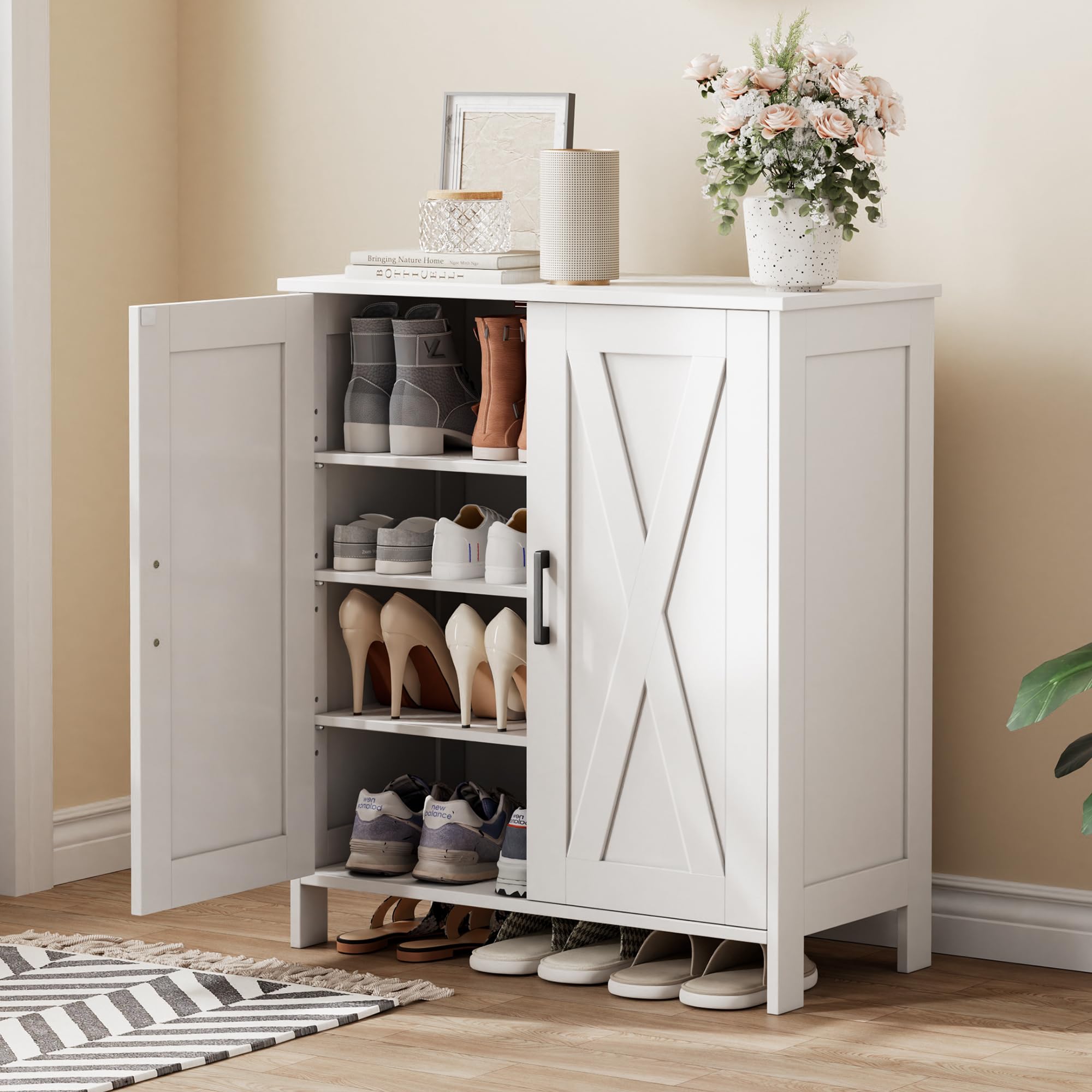
No flip drawers here, and that is the point. Two barn doors swing open on a five-bay interior, so the whole cabinet is visible at once instead of a two-tier drawer being pulled down and rifled through. For an entryway that stores bags, a leash, and the kids' shoes alongside your own, that is the more practical shape.

13.8 inches of depth and three adjustable shelves mean taller things stand up rather than lean: ankle boots, a folded tote, a basket of gloves. The white finish with black U-handles looks crisp, and we appreciated the magnets holding the doors shut instead of a catch that has to be lined up each time.

It is the smallest pick of the group at 27.6 inches wide, 31.5 tall, and 36 pounds, which makes it the easiest build here and the easiest to move when you rearrange. It also means the top sits at thigh height, so treat it as a spot for a plant or a bowl rather than the landing zone a 40-inch cabinet gives you.

Capacity is the other limit: five bays in a 27.6-inch frame will not swallow a family's twenty pairs the way the Xixini does. Think of it as the cabinet for the entryway's working shoes plus the gear that arrives with them.

Bottom Line: What won us over is the barn doors: adjustable shelves and room for the boots and bags a flip drawer cannot take.
#5

Best for Narrow Walls

WINWY 24-Inch Shoe Cabinet

WINWY 24-Inch Shoe Cabinet

8.8/10 Excellent
  • Finish: Walnut
  • Drawers: 2 flip drawers
  • Shelving: 3 shelves, 2 positions
  • Dimensions: 9.4"D x 23.6"W x 42.5"H
Check Price on Amazon

Pros

  • 23.6-inch width fits gaps nothing else will
  • Two-position shelves in each flip drawer
  • Open shelf for the pair you do not want shut away
  • Walnut finish hides everyday marks

Cons

  • Fits a couple's everyday shoes, not a family's

23.6 inches wide, 42.5 tall, 9.4 deep. This is the cabinet that fits where the others do not: the sliver between a door frame and a closet, the wall behind the front door, the end of a galley kitchen. It goes up rather than out, so the walkway stays clear and nobody has to turn sideways to get past it.

What convinced us is the proportions. Each of the two flip drawers has a two-position shelf, so one level can be set for sneakers and the other for heels, and there is an open shelf as well as the hidden drawers. Everything is reachable from a standing position without stepping back, which is exactly what a tight entryway needs.

It is a shade over 40 pounds, so it is a one-person build, and the walnut finish will not show marks the way a white gloss front does. Anti-tip hardware comes in the box, and it belongs on the wall: a 42-inch cabinet on a 9-inch base is precisely the shape that goes over when someone leans on it.

Set against the VEVOR below, you get three more inches of depth and a good deal more storage for a similar share of wall. Set against the 31-inch towers, it is simply the one that fits.

Bottom Line: For a 24-inch stretch of wall we reach for this: tall, shallow, and built around a couple's everyday shoes rather than a family's collection.
#6

Best for Big Families

Xixini 6-Drawer Shoe Cabinet

Xixini 6-Drawer Shoe Cabinet

8.7/10 Excellent
  • Drawers: 6 flip drawers
  • Capacity: Up to 36 pairs
  • Dimensions: 9.45"D x 47.24"W x 46.85"H
  • Compartments: 12
Check Price on Amazon

Pros

  • Stated capacity of up to 36 pairs
  • Six flip drawers with optional divider shelves
  • Keeps the 9.45-inch depth of the slim cabinets
  • Embedded handle will not catch sleeves

Cons

  • Seventy-seven pounds and a long two-person build
  • Needs 47 inches of clear wall

Four people, two pairs each, plus the boots and the going-out shoes: that is the arithmetic this cabinet was built for. Six flip drawers across 47.24 inches of wall, each with an optional divider shelf, and a stated capacity of up to 36 pairs.

The clever part is that it does it without getting deeper. Front to back it is 9.45 inches, the same as the slimmest cabinets here, so the extra storage runs along the wall instead of into the hallway. Twelve compartments, an embedded handle rather than one that catches a sleeve, and a flat white front that disappears into the corridor.

Consolidation is the real argument. One 47-inch run of drawers replaces two smaller cabinets and the rack that was already there, and everything lives in one place rather than half in a closet. We think that is worth more than the specification suggests: one tidy wall is easier to keep tidy than three.

It is heavy at 77 pounds, and the build wants two people and a full afternoon. The flip fronts close briskly, so keep fingers clear of the corner where the front meets the frame. Whatever you do, anchor it.

Bottom Line: For a big household we recommend the six-drawer one: up to 36 pairs at the same slim depth, so storage runs along the wall.
#7

First apartments

GRUSIGN Flip-Drawer Shoe Cabinet

GRUSIGN Flip-Drawer Shoe Cabinet

8.4/10 Very Good
  • Frame: Metal and engineered wood
  • Capacity: Up to 16 pairs
  • Dimensions: 9.45"D x 31.5"W x 39.8"H
  • Weight Capacity: 110 lb
Check Price on Amazon

Pros

  • Lowest price of the picks here
  • Top rated to 110 pounds
  • Thirty-nine-inch height gives a real drop zone
  • Four tiers with two adjustable shelves

Cons

  • Compartments run tight for men's shoes

It is the least expensive cabinet here, and the savings show up where we noticed them first: the instructions and the interior fittings rather than the look. The white front with its raised-panel doors is neat enough that guests will not guess, which is the main thing a budget cabinet has to get right.

What you get is real. Four tiers with two adjustable shelves, a stated capacity of 16 pairs, a metal frame under the engineered wood, and a top rated to 110 pounds. At 39.8 inches tall it is a proper hallway height, high enough for a landing zone and low enough that the top does not loom over the doorway.

The caveats are about assembly and anchoring. The instructions are thin on words, so allow an evening and keep a screwdriver of your own handy, because the hardware is fine and the guidance is not. Anchor it firmly: a full drawer pulled open puts the weight out in front of the legs.

Where it makes the most sense is a first apartment, a rental, or a back door where the job is to stop the pile rather than to look expensive. The money you keep goes a long way toward a bench or a runner, and the pile by the door still disappears.

Bottom Line: It's the right first cabinet for an apartment, we think: a real hallway height, a 110-pound top, and room for everyday shoes.
#8

Very shallow halls

VEVOR Rattan Shoe Cabinet

VEVOR Rattan Shoe Cabinet

8.2/10 Very Good
  • Doors: Arched rattan
  • Drawers: 2 flip drawers
  • Dimensions: 6.6"D x 23.6"W x 34.5"H
  • Weight Capacity: 80 lb
Check Price on Amazon

Pros

  • 6.6-inch depth fits walls nothing else does
  • Arched rattan doors with oak legs
  • Twenty-eight pounds is easy to move alone

Cons

  • Holds only a handful of pairs
  • ⚠️ Front-heavy; must be fixed to the wall

6.6 inches of depth is roughly half of everything else here, and it is the entire reason to consider this cabinet. Against a narrow hallway wall it barely protrudes, and the arched rattan doors with oak legs mean it does not look like the compromise it is.

The interior is the catch. Two flip drawers, each split into two layers, and a body this shallow means a couple of pairs per layer, a handful of shoes in total rather than a household's worth. The 23.6-inch width does not help; there is only so much a 6.6-inch-deep box can do.

It weighs 28 pounds and the 15 mm side and top panels are thicker than the footprint suggests. But it is front-heavy. With both drawers loaded and one pulled open the weight sits ahead of the legs, and we kept a hand on it until it was fixed into something solid rather than just drywall.

Where that leaves it: one person's rotation by the door, a guest room, or a hallway where nothing else will fit. What it will not do is grow with you, and a household that adds a pair of boots a month will have outgrown it by spring.

Bottom Line: We keep this one for the tightest walls: 6.6 inches deep, and good for one person's shoes rather than a household's.

How We Tested Entryway Shoe Cabinets

We built the shortlist by comparing listed footprints, shelf layouts, materials, and assembly requirements, then narrowed it to 11 cabinets that could plausibly work in a real entryway rather than a showroom. I assembled each one alone, timed the build, and kept notes on where the instructions skipped a step or the diagrams sent me backward. Before assembly, I taped each cabinet's footprint on the floor and checked how much walkway remained, then measured depth against a door swing and a stack of shoes.

Once built, every cabinet went by the front door and lived with us for seven months. I loaded each with adult sneakers, dress shoes, tall boots, and kids' pairs, counting how many pairs fit without jamming the doors and whether adjustable shelves actually helped. I opened and closed the doors daily, gave each unit a firm nudge while fully loaded to check for rocking or top-heavy movement, and watched for joints that loosened, doors that dropped, or finishes that scuffed and collected fingerprints.

At the end, we compared construction, hardware, shelf flexibility, and how well the instructions held up against the cost. The cabinets that scored best were the ones that stayed steady, looked tidy after months of daily use, and stored more shoes than their footprint suggested. We'll keep living with them and update if anything changes.

How to Choose Shoe Cabinets for Entryways

Start with depth, then width

Depth is what makes a cabinet feel like furniture or like an obstacle. The picks here run from 6.6 inches to 14, and the difference is felt in the walkway, not the storage. A 9.4-inch cabinet leaves a normal hallway comfortable; a 14-inch one gives you big-shoe storage and takes a real bite of floor.

The trap is that a listing's "slim" or "narrow" almost always describes width, not depth. Measure both: the wall run you can spare, and the clear path you need to keep. Thirty inches of walkway is the minimum we would accept in a hallway people carry laundry through, so a 14-inch cabinet needs a genuinely wide hall.

Flip drawers or doors

Flip drawers hide shoes in two tiers and pull forward and down, so nothing has to move out of the way. They suit sneakers, flats, and shallow cabinets, and they need clear floor in front when open. Doors and open shelves show you everything at once, hold boots and bags standing up, and demand swing clearance instead.

Our rule: if everyone in the house wears ordinary shoes, take flip drawers. If the entryway also stores boots, a leash, and a tote, the door-fronted cabinets are less fuss, because nothing has to be unloaded to reach the thing at the back.

Count pairs in your household's sizes

Stated capacities assume average shoes. Once anyone wears a men's 11 or a chunky sneaker, a two-tier drawer that claims four pairs per layer holds three. Add a third of headroom to whatever the specification promises before you decide between a 16-pair cabinet and a 24-pair one.

Boots are the other variable. An adjustable or removable shelf turns a divided bay into one tall slot; fixed dividers do not, and tall boots end up on the floor beside a cabinet that was bought to prevent exactly that.

Plan for the build and the anchor

Every pick here arrives flat. A 36-pound cabinet is an evening with a screwdriver; a 77-pound one is a two-person afternoon. Read the instructions through once before starting, use your own tools, and sort the labeled hardware first, which is where most of the frustration in this category comes from.

Then anchor it. A flip-drawer cabinet with both drawers open has its weight in front of its legs, and a tall narrow one is worse. The anti-tip kit is in the box on most of these, and it goes into a stud or a proper wall anchor, not just drywall.

The top surface earns its keep

Height decides what the cabinet does for you beyond storage. A 31.5-inch cabinet puts its top at thigh height, which is a spot for a plant or a bowl. The 38-to-40-inch models land at waist height, where keys and mail actually get dropped. Above 45 inches it becomes a display surface you look at rather than reach over.

If you want one flat place by the door, buy height as deliberately as capacity.

Frequently Asked Questions

Final Verdict

For most entryways, the BORNOON is the cabinet we recommend. It hides 12 to 16 pairs behind two flip drawers in 9.45 inches of depth, the dividers come out when a shoe needs more room, and the white gloss front reads as furniture rather than storage. That combination of capacity, footprint, and price is what makes it the default rather than the most interesting pick here.

Two exceptions are worth knowing. If boots, high-tops, or men's 11 and up are in the house, the ONBRILL's 14-inch shelves earn their extra floor. If the only wall you have is 24 inches, take the WINWY and accept a smaller rotation.