Game Room

Best Bar Cabinets of 2026

A bar cabinet is one of those pieces you don't realize you need until you're balancing a bottle of gin on a stack of cookbooks. The right one corrals your bottles, glasses, and tools into a single, good-looking spot—and doubles as a serving station when friends come over. But furniture that holds heavy glass and liquid has to be sturdy, and assembly can make or break the experience.

Over the past eight months, I've assembled and lived with eight bar cabinets, from compact corner models to full-size sideboards. We loaded them with bottles, hosted gatherings, and yes, scrutinized every pre-drilled hole. The biggest surprise? Price doesn't always predict ease of assembly, and a cabinet that looks great online can wobble once it's full. Below are the ones that earned a permanent spot in our homes—and the ones we'd recommend for different spaces and budgets.

#1

Best Overall

GDLF 60.2-Inch Bar Cabinet

GDLF 60.2-Inch Bar Cabinet

9.0/10 Outstanding
  • Fridge Bay: 19.8 W x 20 D x 34.7 H in
  • Serving Top: 60.2 in wide
  • Bottle Storage: 360° lazy susan, 8-10 bottles per tier
  • Lighting And Power: Amber LED; AC, USB, USB-C
Check Price on Amazon

Pros

  • 60-inch top doubles as a serving station
  • Rotating tiers hold 8-10 bottles each
  • Three rows of stemware racks behind glass
  • Fridge bay with AC, USB, and USB-C

Cons

  • Refrigerator is not included
  • 120 pounds, shipped in two boxes

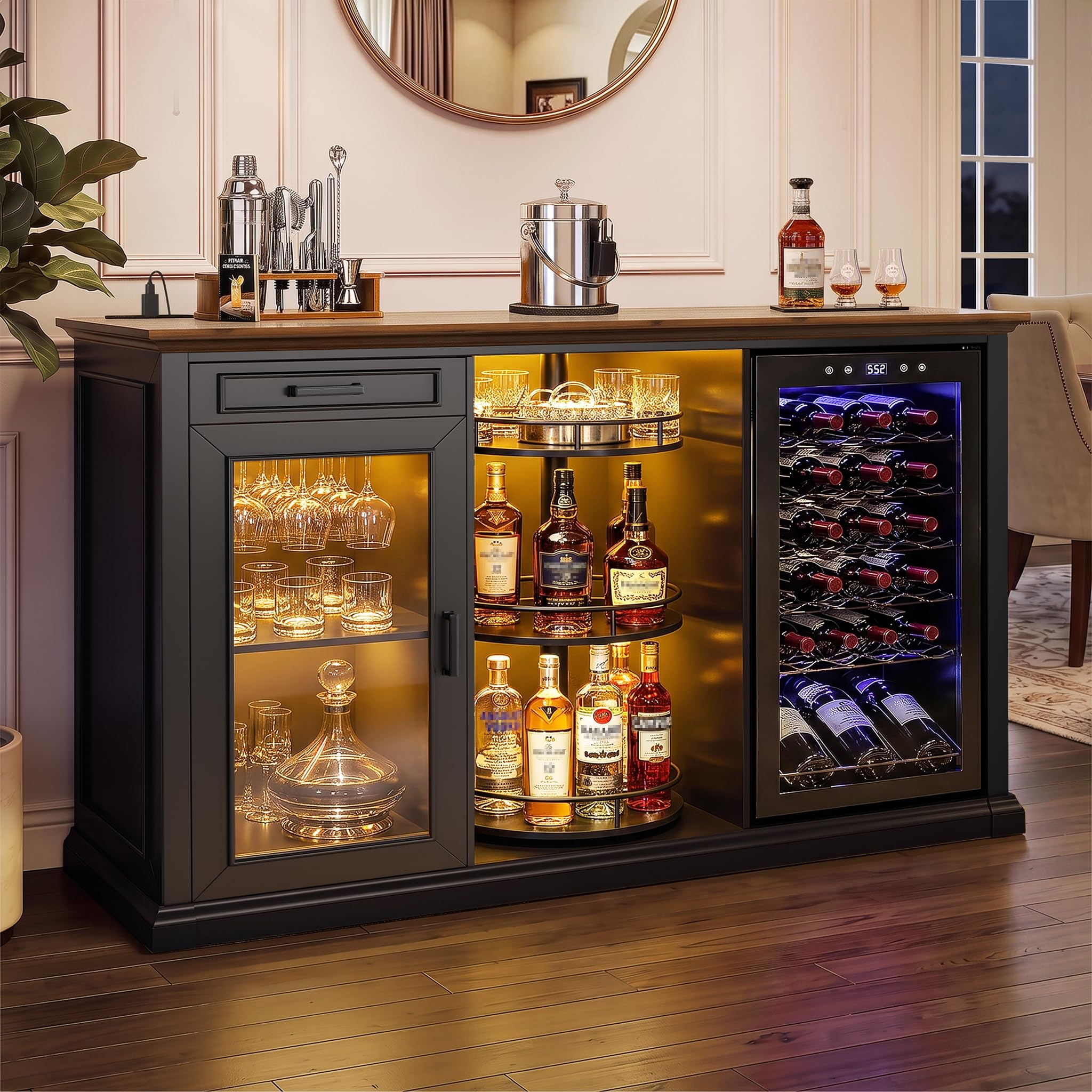
Sixty inches of serving top is more than any other cabinet here offers, and it is the number that settled this pick for us. A tray of glasses, an ice bucket, and a bottle of whiskey sit on the GDLF with room left to work; on a 30-inch cabinet you are shuffling. The top lands at about 40 inches off the floor, close to bar height, so you pour standing up without stooping.

The storage behind it is the part we point friends to. Two lower tiers of the 360-degree lazy susan hold roughly 8 to 10 standard bottles each, and the top tier keeps whiskey glasses where you can reach them — you spin the shelf rather than reaching over a row of bottles. Behind the glass door, three rows of stemware racks plus an interior shelf take wine glasses and decanters, and the accessory drawer swallows openers, stoppers, and the corkscrew that is always missing.

The fridge bay measures 19.8 by 20 by 34.7 inches, and no refrigerator comes with it, so the real outlay is the cabinet plus a compact fridge. Check the fridge's exterior dimensions, hinge and cord clearance included, against that opening before you order. The AC, USB, and Type-C connections at the back keep the blender and the phone charger at the bar, and the amber LED is atmosphere rather than task lighting.

At 120 pounds in two boxes that can arrive on different days, this is a two-person build. Sort the hardware into cups first; the instructions are the weakest part of the package and the pictures carry more information than the text. Once it is square it feels solid, and the 150-pound capacity is generous for bottles and glass — but keep wall anchoring on the list, because a loaded cabinet this tall and this deep is not something to leave free-standing.

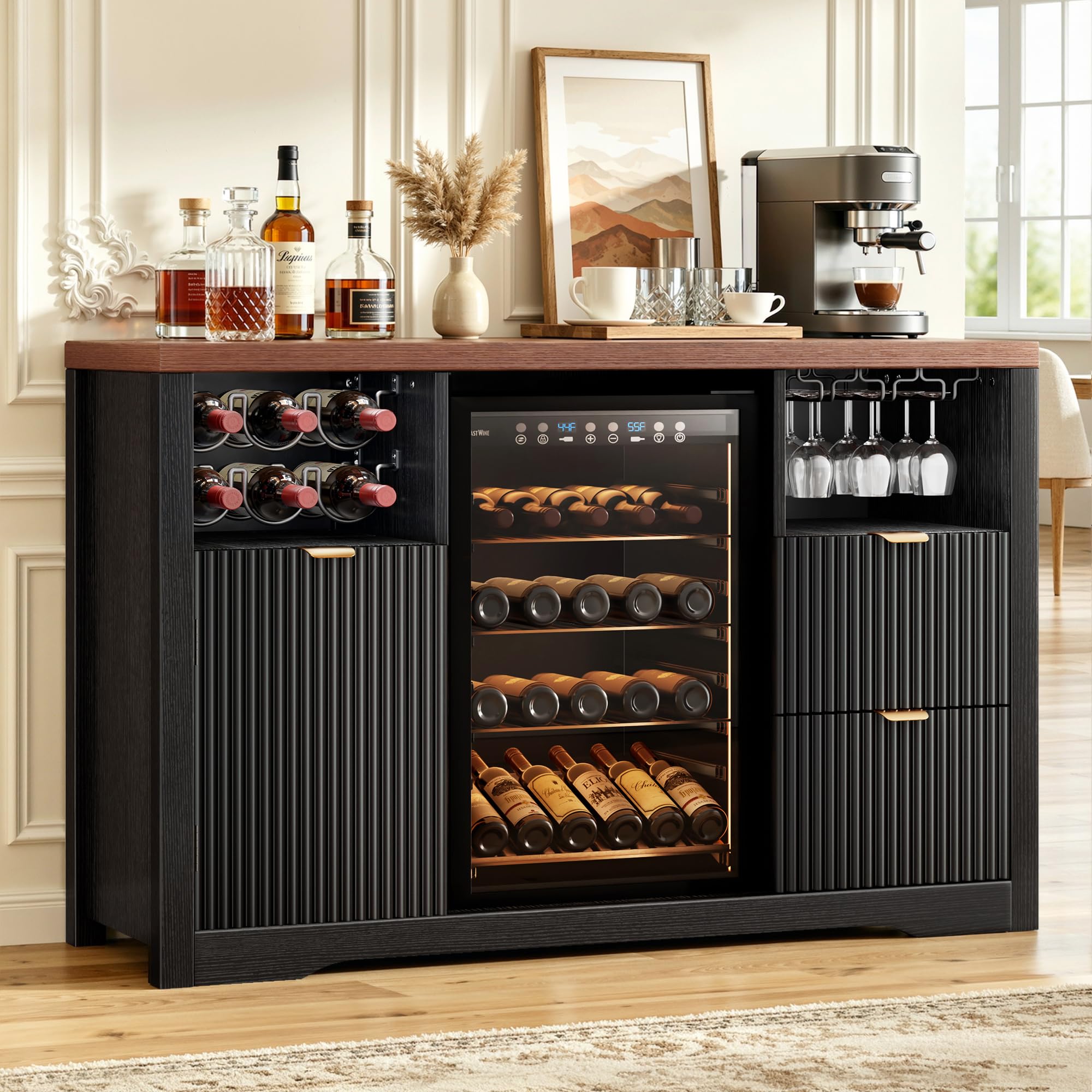
Bottom Line: If you are building a real home bar and have the wall for it, this is the one we buy: rotating bottle storage, stemware racks, a fridge bay, and room to pour.
#2

Best for Small Spaces

ARTPOWER Modern Bar Cabinet

ARTPOWER Modern Bar Cabinet

8.9/10 Excellent
  • Finish: Green with gold hardware
  • Dimensions: 14.96 D x 31.49 W x 37 H in
  • Bottle Storage: Pull-out wine storage
  • Stemware Racks: 3
Check Price on Amazon

Pros

  • Pull-out storage reaches the back row
  • Three stemware racks behind tempered glass
  • 31.5-inch width fits a short wall
  • Green-and-gold finish draws compliments

Cons

  • Parts-heavy assembly with doors to square

Thirty-one and a half inches wide and 14.96 inches deep is the footprint that makes this the apartment pick. It tucks against a dining room wall without stealing the walkway, and at 37 inches tall its top sits at kitchen-counter height — a surface for setting a tray down while you pour, not a bar you stand behind. That combination of small and genuinely useful is why it earns a place here.

What impresses us is how much of that small box is dedicated bar storage rather than shelves you have to organize yourself. Three stemware racks hang glassware where you can see it through the tempered glass doors, the bottle storage pulls out so the back row is reachable, and a single drawer takes the openers, stoppers, and napkins that otherwise colonize the top. For a dozen or so bottles and a set of glasses, nothing is wasted.

The green with gold hardware is the version we noticed first, and it is why people stop at this cabinet; a black finish is available if green is too much for the room. Glass doors do mean your collection is always on display, which is the point and also a reason to keep the back row tidy.

P2-grade MDF on four metal legs is what you are buying, and it does not pretend to be heirloom furniture. Assembly is the real cost: a lot of labeled parts, and the doors and legs take patience to get square. Set aside a quiet evening and grab a second pair of hands for the first stretch, when the frame goes together.

Bottom Line: For a small apartment and a modest collection, this is the bar cabinet we point people to: compact, glass-fronted, and genuinely set up for bottles and stemware.
#3

Best Fridge Bay for Less

Leteuke 53-Inch Fridge Cabinet

Leteuke 53-Inch Fridge Cabinet

9.2/10 Outstanding
  • Countertop: 53.1 x 20.1 in solid wood
  • Fridge Bay: 20 W x 19.8 D x 34.8 H in
  • Wine Storage: 6-bottle rack
  • Glass Storage: 3 rows of stemware holders
Check Price on Amazon

Pros

  • Fridge bay matches our top pick's
  • Solid wood countertop, not veneer
  • Two drawers and three rows of stemware holders
  • Built-in charging station

Cons

  • Six-bottle rack is small for a collection

If the fridge bay on our top pick was the appealing part and the footprint and the outlay were not, start here. The Leteuke takes a compact refrigerator in a 20 by 19.8 by 34.8-inch opening — within a fraction of an inch of the GDLF's bay — in a cabinet 53 inches wide instead of 60, and it does it for a good deal less.

The countertop is where the difference shows. A 53.1 by 20.1-inch solid wood surface is where drinks get made, and it holds a coffee machine, a cutting board, and a tray of glasses at once; the top on our pick is veneer over engineered wood. Behind the fluted doors you get three rows of stemware holders, a six-bottle wine rack, two drawers, and a charging station, so the bar hardware is all present, just in smaller quantities.

Six bottles is a wine suggestion rather than a wine collection, and if you keep a case on hand the rotating rack further up this page does more. The other thing to weigh is a shorter track record than the cabinets above it — nothing we have seen points to a fault, but there is less to go on. Buy this one for the fridge bay and the wood top, not for the wine capacity.

Bottom Line: A solid-topped cabinet with a fridge bay nearly identical to our top pick's, in a narrower body and for less — the smart buy if you own the fridge already.
#4

Best Corner Cabinet

JOINICE 70-Inch Corner Cabinet

JOINICE 70-Inch Corner Cabinet

9.1/10 Outstanding
  • Door: Fluted, single
  • Lighting: Built-in
  • Material: FSC-certified wood
  • Dimensions: 15.7 D x 22.2 W x 70.1 H in
Check Price on Amazon

Pros

  • Fits a corner on 22 inches of floor
  • 70 inches of vertical storage
  • Fluted door and built-in lighting
  • FSC-certified wood

Cons

  • Shelves instead of bottle and glass racks
  • Assembly is a proper build, not a quick job

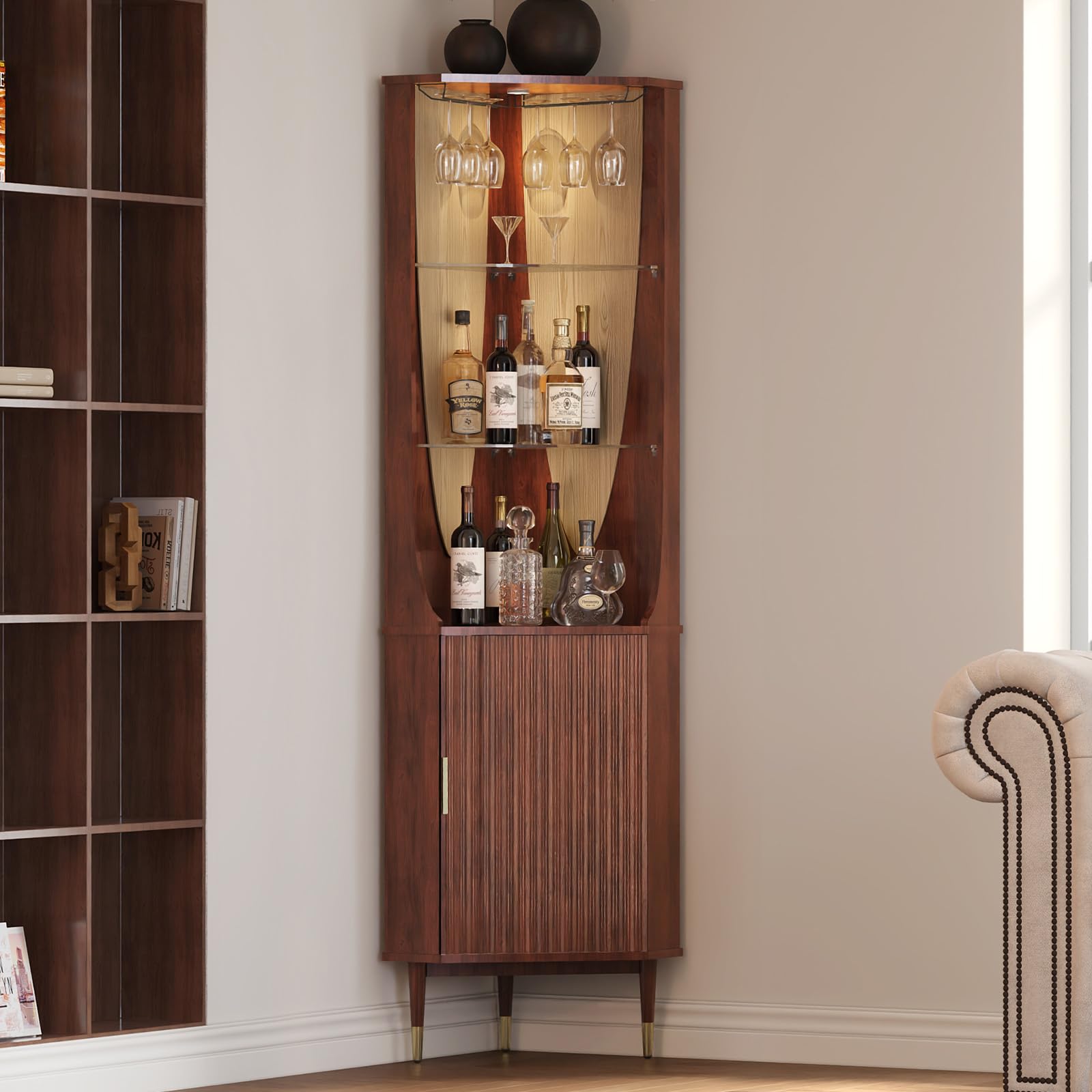
A corner is the hardest space in a room to furnish and the easiest to waste, and this tower is built for it. At 22.2 inches wide and 15.7 inches deep it projects less than a dining chair does, and the 70 inches of height is what makes that narrow base pay off — you get real storage out of a slot that would otherwise hold a plant.

The walnut finish and the fluted door are why it reads as furniture rather than a shelf unit, and the built-in lighting behind the glass shelves does the rest, making glassware and bottles look like display instead of clutter. The wood is FSC-certified, which does not change how it works but is a reasonable thing to want in a piece this size.

Storage is shelves, not hardware. There is no wine cradle and no stemware rack, so bottles stand on glass shelves and glasses go where you put them. For a bourbon collection that is fine; for a mixed bar you are supplying the organization yourself.

Assembly is a proper build rather than a quick win — the instructions are clear, but there are plenty of steps, and one person can finish the job. Where this beats every wide cabinet here is the floor-space arithmetic: 70 inches of storage on 22 inches of floor, in the corner that was empty.

Bottom Line: For an awkward corner and a growing spirits collection, this fluted 70-inch tower turns dead space into the best-looking bar on this list.
#5

Best Tall Narrow Cabinet

Aheaplus 67-Inch Tall Cabinet

Aheaplus 67-Inch Tall Cabinet

8.8/10 Excellent
  • Power: 3 AC outlets, 2 USB
  • Lighting: RGB LED
  • Shelving: 4 open shelves plus closed base
  • Dimensions: 26.9 W x 15.7 D x 66.9 H in
Check Price on Amazon

Pros

  • Three AC outlets plus two USB ports
  • 67-inch height on a 27-inch width
  • Open hutch takes tall bottles
  • Metal frame with adjustable feet

Cons

  • 26.9-inch width fills up fast
  • Long, parts-heavy assembly

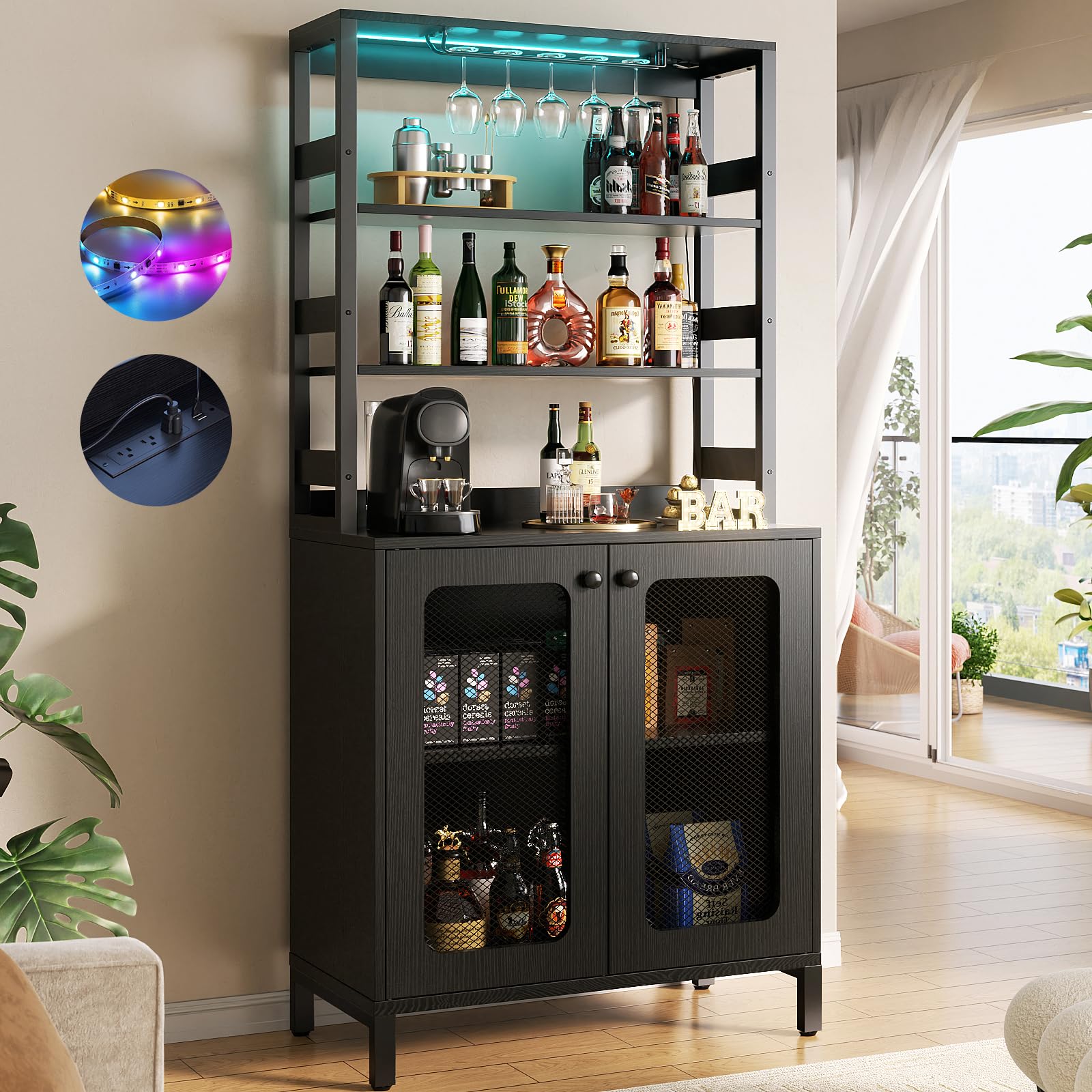
Three AC outlets and two USB ports sound like feature padding until you are plugging in a blender, a kettle, and a phone at the same time. On a 26.9-inch-wide cabinet the power is where the drinks are instead of across the room, and that is the detail that makes this tower useful rather than merely tall.

The layout is open above and closed below. Four open shelves in the upper hutch take bottles standing up, including the tall liquor bottles and decanters a low sideboard cannot accommodate, and two metal doors hide the rest of the collection at the base. At 66.9 inches tall on a 15.7-inch depth it spends height rather than width, which is what a narrow wall wants.

The width is also the limitation. Shelves 26.9 inches across fill faster than a wide sideboard's, and a collection that keeps growing will outgrow it — this is a cabinet for a considered bar, not a cellar. Assembly takes a stretch of time and a lot of pieces, and a power driver shortens it considerably. The RGB lighting is novelty rather than working light, so pick one warm color and leave it.

What keeps this on the list is the ratio of storage to floor space, and the fact that the outlets solve a problem most bar cabinets ignore entirely. If your wall is narrow and your bottles are tall, this is the shape to look for.

Bottom Line: For a narrow wall and a bar that grows upward, this tower gives you power, lighting, and open bottle shelves without taking floor space.
#6

Best Budget Pick

X-cosrack Wine Bar Cabinet

X-cosrack Wine Bar Cabinet

9.2/10 Outstanding
  • Dimensions: 23.6 W x 13.4 D x 31.1 H in
  • Wine Storage: Detachable 5-bottle rack
  • Glass Storage: Detachable stemware holder
  • Weight Capacity: 330 lb
Check Price on Amazon

Pros

  • Detachable rack and glass holder rearrange
  • Smallest footprint in this set
  • 330-pound weight capacity
  • Adjustable feet for uneven floors

Cons

  • Five-bottle wine capacity

This is the least expensive cabinet here, and it does not feel like the compromise that usually implies. At 23.6 inches wide, 13.4 inches deep, and 31.1 inches tall it has the smallest footprint of anything we picked, which makes it the one for a dining room corner, a hallway nook, or the end of a kitchen run.

The removable hardware is the detail that changed our mind about cheap bar furniture. The five-bottle wine rack and the stemware holder lift out, so the cabinet can be a wine rack one month and a plain cupboard with a shelf for a whiskey bottle the next. The mesh door keeps it looking light, the magnetic catch holds it shut, and the adjustable feet handle a floor that is not level. A 330-pound capacity is more than most people will ever load into it.

What it is not is a serving station: the top sits at 31 inches, lower than a kitchen counter, so this is storage with a shelf on top rather than a place to mix four cocktails. But it slides under a window in a way the 70-inch towers cannot, and for a first bar or a rental kitchen it is the least painful way into a proper setup.

Bottom Line: The budget pick that does not feel like one: a real wine rack, a glass holder, and a tiny footprint for the least money on this page.
#7

Dining room sideboard

ONBRILL 55-Inch Fluted Cabinet

ONBRILL 55-Inch Fluted Cabinet

8.9/10 Excellent
  • Charging: Built-in ports
  • Lighting: RGB LED with remote
  • Stemware: 9 glasses, 3 tiers
  • Wine Storage: 12-bottle grid
Check Price on Amazon

Pros

  • Sliding doors need no swing clearance
  • 12-bottle rack plus racks for nine glasses
  • RGB LED and built-in charging ports

Cons

  • Walnut runs darker than the photos
  • Finish marks and scratches easily

Sliding doors are the quiet advantage here. In a dining room where a hinged door swings into a chair, the fluted panels slide past each other and the cabinet stays walkable, and the fluted front is the best-looking panel in this group of otherwise plain boxes.

The inside is shaped like a bar rather than generically shelved. A 12-grid wine rack, three tiers of stemware holders for nine glasses, adjustable shelves, an RGB LED strip with a remote, and charging ports add up to more bottle capacity than the compact cabinets here and more glass storage than anything short of our top pick.

Two things to know before ordering. The walnut runs darker in person than the product photos, which is fine in a dim room and less fine under a bright window, and the finish marks easily — a wet glass left overnight leaves a ring. A tray under the bottles solves most of that.

At 55 inches wide it is a sideboard first and a bar second, which makes it right for a dining room wall and wrong for a hallway. If you want wine storage and stemware racks inside a piece that reads as furniture, this is the one that hides its job best.

Bottom Line: A wide sideboard with real bar hardware inside — the pick for a dining room where the cabinet has to look like furniture first.
#8

Displaying bottles

Loomie LED Display Cabinet

Loomie LED Display Cabinet

8.7/10 Excellent
  • Lighting: RGB, app control
  • Countertop: Illuminated glass
  • Dimensions: 47.24 W x 15.7 D x 42.2 H in
  • Bottle Display: 3 lit tiers
Check Price on Amazon

Pros

  • Three lit tiers for bottle display
  • Illuminated glass countertop
  • App-controlled RGB lighting

Cons

  • Laminate and glass rather than wood

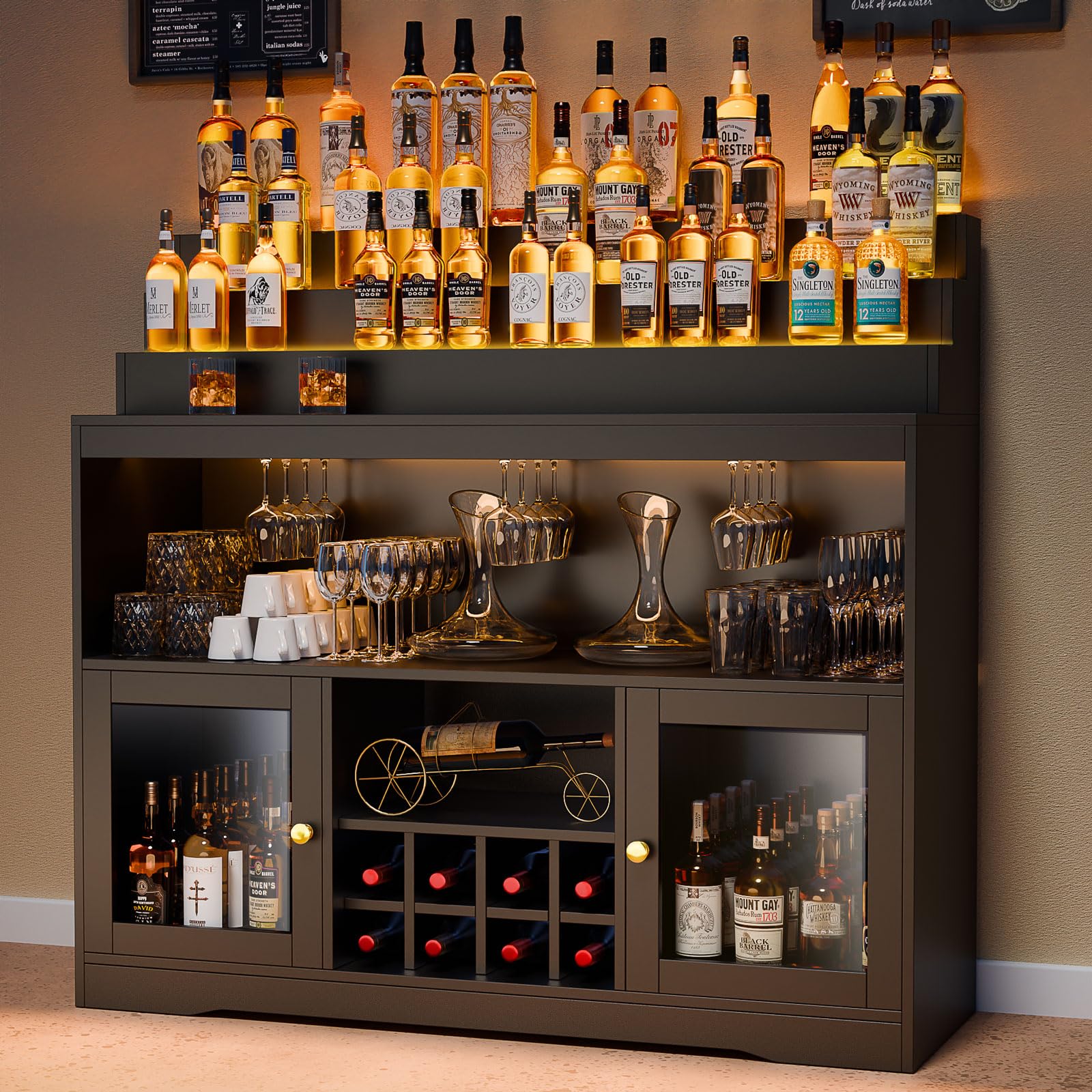
Three lit tiers for bottles and a glass countertop that glows from underneath make this the cabinet for someone who wants the bar to be the decoration. Bottles on stepped, lit shelves read like a back-bar display, and the light through the glass top does most of the work in a dark room.

It measures 47.24 inches wide and 42.2 inches tall, so it is a sideboard you stand at rather than a tower, and there is a closed cabinet for the bottles and glassware you do not want on show. The RGB lighting runs to 16-plus colors on a remote and an app, which is more control than a bar needs and exactly what sells a basement room.

Our reservation is the material. This is commercial-grade laminate with a glass top rather than walnut, and it is the lighting rather than the joinery that earns its place. That is a fair trade in a movie room or a basement bar where the display is the point; in a dining room that has to hold up for a decade, the fluted cabinet above is the safer long-term buy. At 100 pounds it is also a two-person build, and the top is glass, so clear the floor before you start.

Bottom Line: For a basement bar or a room where the bottles are the decor, the lit display shelves make this the most theatrical cabinet here.

How We Tested (and Assembled) the Best Bar Cabinets

We built our shortlist by researching the market and filtering for cabinets that could hold a standard bar setup, came in a range of footprints, and spanned budget to investment pieces. We landed on eight models and brought them into our homes for eight months, assembling each one on a weekend morning and then living with it through dinners, parties, and quiet nights in.

Assembly was a test in itself: we timed how long each took to build solo, noted whether the instructions were clear, and checked every pre-drilled hole for alignment. We flagged any screws that stripped or panels that needed forcing. Then we measured each cabinet against real spaces—living room, dining nook, narrow hallway—and noted door swings and walkway clearance to judge fit.

Once built, we loaded each with a realistic stash: wine bottles, oversized liquor bottles, pint and wine glasses, and bar tools. We opened and closed doors and drawers dozens of times, gave each a gentle shake to check for wobble, and watched for sagging shelves. Over the months, we noted scratches, finish wear, and how the cabinet looked in different lighting. We also weighed hardware quality and joinery against the price to judge value.

How to Choose Bar Cabinets

Start With the Wall, Not the Bottle Count

Width is the first number and depth is the one people forget. A 60-inch cabinet needs a long, uninterrupted wall; a 23-inch cabinet fits a nook but holds a fraction as much. Then look at the doors: a hinged door needs its own width again in clearance, which is part of why wide sideboards like the ONBRILL use sliding panels. Corners are their own category — a 22-inch corner tower stores more than a 40-inch cabinet nobody can walk past. Measure the wall, the walkway, and the door swing before anything else.

Decide How Your Bottles Should Be Stored

Grid racks, pull-outs, rotating shelves, and plain shelves all hold bottles, and the difference shows up on the second drink. A grid rack holds a fixed count and shows labels; a pull-out lets you reach the back row without unloading the front; a lazy susan turns a deep cabinet into a reachable one, which is why our top pick uses one. Count your bottles honestly first — the capacities in this group run from five bottles on the X-cosrack to roughly 8 to 10 per rotating tier on the GDLF.

Fridge Bays: Measure the Fridge, Not the Bay

A fridge-ready cabinet is a good idea with one trap attached. The bay is an interior opening — on the two fridge cabinets here it is about 20 inches wide, 20 inches deep, and just under 35 inches tall — and a compact fridge's exterior dimensions include hinges, a rear vent gap, and a cord. Check the fridge's own spec sheet against the opening before you order either one. A cabinet with an empty bay is a cabinet with a hole in it.

Lighting, Outlets, and What Stops Being a Novelty

Outlets earn their place when a blender, kettle, or ice maker lives at the bar, and they are decoration if you only pour whiskey. Lighting splits the same way. An accent strip makes bottles look good in a dim room, but it will not light the surface where you cut limes. Check where the nearest wall outlet is before the cabinet arrives, because three sockets and a cord that will not reach is worse than no sockets at all.

Assembly, Materials, and What Holds Up

Nearly everything here arrives flat-packed, and assembly is where these cabinets ask the most of you. Sort the hardware, build with two people on anything over 100 pounds, and expect doors and legs to need adjusting at the end. Materials matter most at the top surface: a solid wood counter takes a spill and a cutting board, while veneer over engineered wood wants a coaster. Check the stated top capacity — the cabinets here run from 150 to 360 pounds — and anchor anything tall to the wall.

Frequently Asked Questions

Final Verdict

The GDLF takes the top spot because it is the only cabinet here that handles a whole evening: bottles on a rotating shelf, stemware behind glass, a fridge bay for mixers, and 60 inches of top to work on. If your wall is short, take the ARTPOWER instead, which packs the same bottle-and-glass thinking into 31 inches. The Leteuke is the middle path for anyone set on a fridge bay without the GDLF's footprint.