Game Room

Best Indoor Glider Chairs of 2026

At 3 a.m., the only thing worse than being awake is a chair that creaks every time you shift. I spent a few of those nights in a hand-me-down rocker that groaned like a screen door, and it taught me that a good glider isn't about looks — it's whether the motion stays quiet and even when you're half asleep. The right one glides with a single push of a foot, so you can settle a baby, a book, or just yourself without waking the house.

Over the past seven months, we've lived with eight of them — slim rockers, deep-cushion recliners, and a couple of swivel bases — in nurseries, reading corners, and one long, narrow guest room. Something first-time buyers don't find out until delivery day: a glider that feels effortless on showroom carpet can stutter or creep across hardwood, so check what the base is built for before you fall for the upholstery. The ones that stayed quiet, held their shape, and fit through a doorway are below.

#1

Best Overall

DaVinci Olive Swivel Glider

DaVinci Olive Swivel Glider

8.9/10 Excellent
  • Motion: Glide with 360° swivel
  • Assembly: Arrives assembled
  • Certifications: GREENGUARD Gold, FSC, CertiPUR-US
  • Weight Capacity: 242.5 lb
Check Price on Amazon

Pros

  • Arrives fully assembled, no tools needed
  • 360-degree swivel plus glide for easy exits
  • Storage ottoman swallows nursery clutter
  • GREENGUARD Gold certified for indoor air

Cons

  • Squeak or click can develop in the glide

The Olive arrives in one piece. No bolts, no hex key, no bag of hardware to lose behind the crib — the chair is assembled before it reaches your door, and the only decision left is which corner it occupies. For a nursery you're finishing in the last month of a pregnancy, that is worth more than any single feature on this page, and it is the main reason this is the chair we recommend first.

A 360-degree swivel is the first thing you notice, ahead of the glide. Push back and the chair slides smoothly; turn and you're facing the crib without getting up, which sounds minor until it's the fourth time tonight. The back and the lumbar pillow land well for average-height sitters, and the storage ottoman earns its place — a burp cloth, a phone, and a remote disappear under the lid and stay out of a toddler's reach. One quirk: the ottoman doesn't glide, so you push off the floor with your feet rather than riding it along with the chair. We adjusted in a day, but it changes the rhythm of rocking.

Two things to weigh. The back is shorter than the photos suggest — much past five and a half feet and your head clears the top rather than resting on it. And the frame is narrow, which is exactly why it works in a small nursery and exactly why broader sitters should read the Harkawon entry instead. The polyester is spot-clean only, so keep a cloth handy, and the GREENGUARD Gold certification means the foam and fabric have been screened for the chemical load a new upholstered chair can add to a small, closed room.
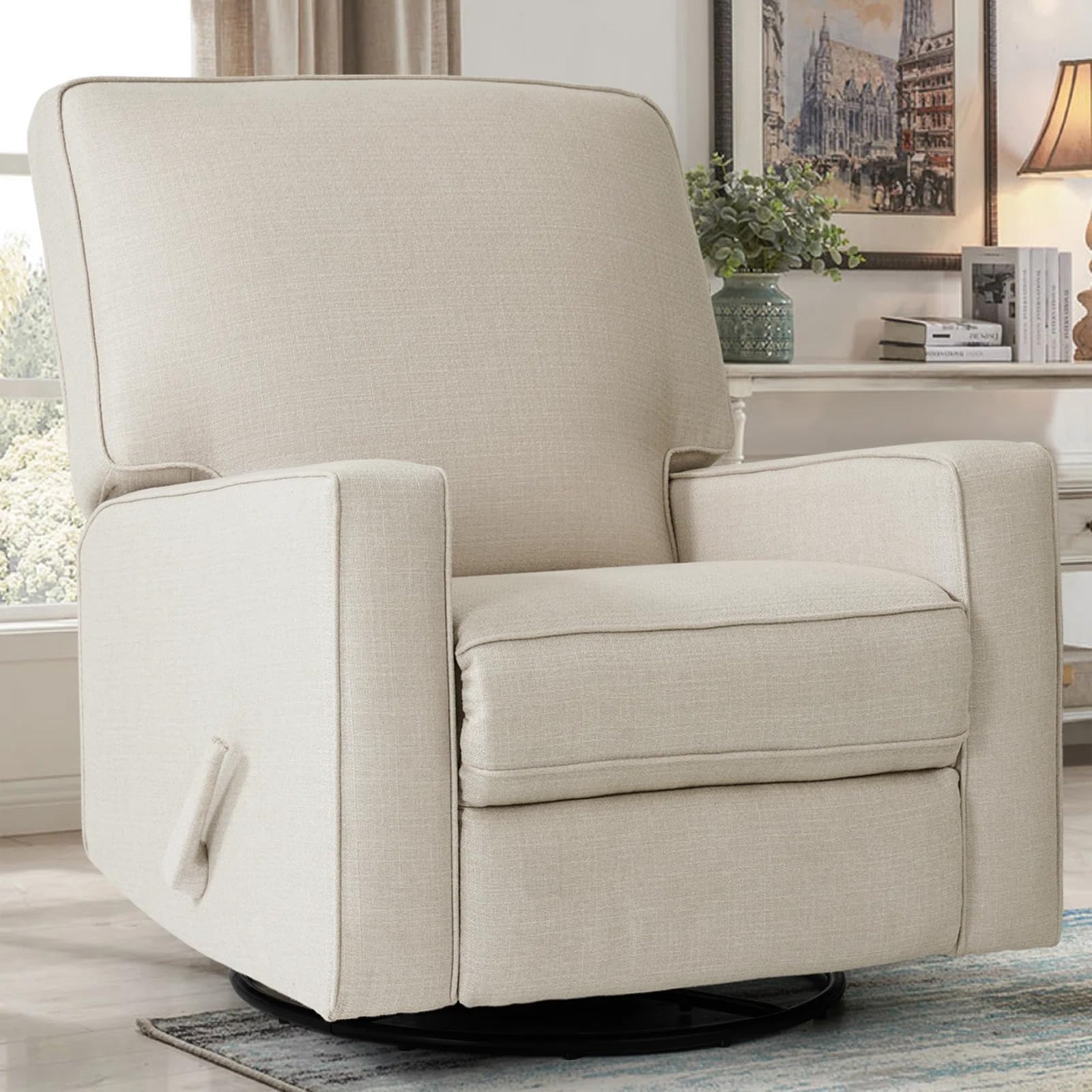
Bottom Line: For most nursery setups this is the chair to buy: it arrives assembled, swivels a full circle, and squeezes into a corner a wider glider can't.
#2

Best for Taller Sitters

Harkawon Swivel Rocker Recliner

Harkawon Swivel Rocker Recliner

8.8/10 Excellent
  • Motion: Swivel, rock, manual recline
  • Dimensions: 39.37"D x 32.67"W x 40.55"H
  • Weight Capacity: 350 lb
  • Recline Positions: 3
Check Price on Amazon

Pros

  • High 30.3-inch back with real head support
  • 350-pound rating and a wide 32.7-inch seat
  • Wall-hugger recline needs little clearance
  • No-tools assembly, two pieces to join

Cons

  • About 100 pounds, so placement is permanent

A 30.3-inch back, a 32.7-inch seat, and a 350-pound rating: the Harkawon is built for the sitter the compact gliders quietly ignore. If you're six feet tall or broad through the shoulders, most nursery chairs leave your head hanging over the top and your hips wedged between the arms. This one doesn't, and that alone makes it the pick for a lot of couples.

It is also the chair here we put in the living room rather than the nursery corner. The frame swivels, rocks, and reclines through a side lever into three positions, and the wall-hugger design needs very little clearance behind it — the detail that decides whether a recliner works in an apartment. The cushions are firm rather than plush, which we prefer for back support across a long feed, and assembly is a two-piece snap with no tools at all.

Be precise about the motion: this is a swivel-and-rock arc, not the straight back-and-forth of a track glider. A gentle rock soothes a baby just as well, so most people won't mind, but if the gliding motion is specifically what you came for, the Olive or the Gabby is the honest answer. What you get in exchange is a chair that fits an adult properly, which is rarer in this category than it should be.

Bottom Line: Buy this one if you're tall, broad, or keeping the chair in the living room after the nursery years — it fits adults the compact gliders don't.
#3

Best High-Back Glider

DaVinci Gabby Pillowback Glider

DaVinci Gabby Pillowback Glider

8.8/10 Excellent
  • Motion: Glide with 360° swivel
  • Back Height: 41.25 inches
  • Certifications: GREENGUARD Gold, FSC, CertiPUR-US
  • Weight Capacity: 300 lb
Check Price on Amazon

Pros

  • Tall 28-inch back panel supports the head
  • 27-inch width fits tight nursery gaps
  • 300-pound rating, highest of the two DaVincis
  • Minimal assembly

Cons

  • Prone to squeaking and creaking over time

Measured against our top pick, the Gabby is a couple of inches taller, three inches narrower, and a fair amount cheaper — and for a small nursery that trade is often the right one. The pillowback tops out at 41.25 inches with a 28-inch back panel, so there is real support behind your head instead of a wooden rail, and the 27-inch frame slips between a crib and a dresser.

Assembly is about as minimal as furniture gets: the base and the back are the only pieces. From there you get the same glide and 360-degree swivel as the Olive, a 300-pound rating that is the more generous of the two DaVinci chairs, and a seat that stays comfortable through a long feed. The polyester wipes clean, which matters more than it sounds in a room with a changing table.

The catch is width. Twenty-seven inches is a chair for one person at a time, and a broad-shouldered sitter will feel the arms. We choose it for the nursery that has to fit a chair into a narrow gap; when the floor plan allows more room, the Olive's swivel-and-ottoman package is the more complete chair.

Bottom Line: A tall pillowback in a narrow frame — the right glider when the chair has to fit between a crib and a wall.
#4

Best Budget

NIOIIKIT Teddy Rocking Chair

NIOIIKIT Teddy Rocking Chair

8.4/10 Very Good
  • Motion: Glide
  • Footrest: Adjustable
  • Dimensions: 28.74"D x 24.8"W x 40.9"H
  • Weight Capacity: 350 lb
Check Price on Amazon

Pros

  • 24.8-inch width fits the tightest corner
  • 350-pound rating at the lowest price tier
  • Teddy fabric feels softer than the price
  • Side pocket and adjustable footrest

Cons

  • Can lean forward and loosen over time

At 24.8 inches wide and 41 pounds, this is the smallest chair in the group — narrow enough to slot between a crib and a wall, light enough to drag across the room when you decide the layout is wrong. The teddy fabric is the other half of the pitch: soft, matte, and warmer than the flat polyester on most budget chairs.

We point tight budgets here first. The back runs 25.9 inches, the high-density foam holds its shape better than the price suggests, and the 350-pound rating equals anything on this page. There is an adjustable footrest, a side pocket sized for a phone and a burp cloth, and no recline at all — this is a chair for rocking and feeding, not for napping.

What you give up at this size is room. The seat is 18.8 inches deep with an 18.5-inch seat height, so a taller sitter ends up folded rather than stretched out, and the rocking arc is shorter than the Harkawon's. Assembly is a fifteen-minute job with the tools in the box.

Bottom Line: The budget glider we recommend without a caveat about the price: small, soft, and rated to 350 pounds, as long as you're not tall.
#5

Certified glider recliner

Evolur Raleigh Glider Recliner

Evolur Raleigh Glider Recliner

8.3/10 Very Good
  • Motion: Glide, rock, 360° swivel, recline
  • Back Height: 39 inches
  • Certifications: GREENGUARD Gold, FSC
  • Weight Capacity: 250 lb
Check Price on Amazon

Pros

  • Soft brushed upholstery over firm foam
  • GREENGUARD Gold and FSC certified
  • 32-inch width suits larger sitters
  • Tool-free assembly

Cons

  • Recline and footrest take a firm push

The fabric is what we noticed first. Evolur's polyester has a soft, brushed hand that feels a step above the flat weave on most mid-priced gliders, and the foam underneath is firm enough to hold you rather than let you sink. For a chair you'll sit in for forty minutes at a time, that counts for a lot.

The chair itself is roomier than the compact DaVincis — 32 inches wide, 31 deep, with a 39-inch backrest and a 250-pound rating. Assembly is tool-free and quick, there's a side pocket for a phone, and it carries GREENGUARD Gold and FSC certification covering indoor-air emissions and wood sourcing.

The recline is the part that asks for patience. A manual lever drops the back and lifts the footrest, and closing it again takes a firm push — the sort of thing that feels fine in a showroom and tiresome at 4 a.m. with a baby on your shoulder. Try the lever before the return window closes if you can.

We still recommend it, with that understood. It is the softest, best-certified chair in the middle of this list, and if you plan to glide and feed more than you plan to recline, the lever will barely come up. If a nightly recline is the point, the Harkawon runs the same three motions without the fight.

Bottom Line: Buy it for the softest upholstery and full certification in the midrange; look elsewhere if you plan to use the recline every night.
#6

Firm back support

CANMOV Swivel Rocker Recliner

CANMOV Swivel Rocker Recliner

8.6/10 Excellent
  • Motion: Swivel, rock, manual recline
  • Dimensions: 37"D x 30"W x 40"H
  • Recline Range: 90-150°
  • Weight Capacity: 300 lb
Check Price on Amazon

Pros

  • Firm foam that supports rather than sinks
  • Swivel, rock, and a 150-degree manual recline
  • 30-inch width fits tighter rooms
  • Pillow-top arms and a 300-pound rating

Cons

  • Footrest needs a hard push to close

Firm is the word for the CANMOV. Sit down and the foam holds you up rather than swallowing you, which is either exactly what an aching back wants or the opposite of the sink-in chair you pictured. We count it in the chair's favor for a nursery, where the job is to get out of the seat with a baby in your arms, not to disappear into it.

The rest of the package is conventional and well executed: a 360-degree swivel, a rocking base, a manual recline from upright to about 150 degrees, pillow-top arms, and a 300-pound rating. At 30 inches wide and 37 deep it sits between the Harkawon and the compact DaVincis, and the white textile wipes clean with a damp cloth.

Value is where it lands. You give up some width and back height against the Harkawon and gain a smaller footprint and a lower asking price; against the Korser you get a roomier, more supportive chair for a little more. For a firm-seat buyer who wants a recliner in a bedroom corner, that's a sensible trade.

Bottom Line: For a firm, supportive seat in a footprint that fits a bedroom, this is the recliner we point to — just budget for a stiff footrest.
#7

Small rooms

Korser Swivel Rocker Recliner

Korser Swivel Rocker Recliner

8.2/10 Very Good
  • Motion: Swivel, rock, recline
  • Upholstery: Chenille
  • Backrest Tilt: Up to 165°
  • Weight Capacity: 299.8 lb
Check Price on Amazon

Pros

  • Small footprint for tight rooms
  • Chenille upholstery feels warmer than the price
  • Swivel, rock, and 165-degree recline
  • Side pockets and quick assembly

Cons

  • Footrest only rises partway

If the room is the constraint, start here. The Korser is a genuinely small recliner — the kind we keep recommending for rooms where a full-size rocker won't fit — and the chenille has a short, dense pile that feels warmer than the flat polyester on the other budget chairs.

A full 360-degree swivel, a rocking base, and a manual recline to about 165 degrees cover the motions, and there are pockets on the side for a remote and a phone. Assembly is a short job with the hardware in the box.

Scale cuts both ways here. This is a chair built for smaller bodies and smaller rooms — the seat and back sit lower than the DaVincis, and much past five foot eight you'll feel it. For a teenager's room, a reading corner, or a nursery where the chair is the second seat rather than the main one, we rate it the value pick of the group.

Bottom Line: A small, warm-feeling recliner for a second seating spot — the value pick as long as the sitter is on the shorter side.

How We Tested Indoor Glider Chairs

We started with more than 40 listings and cut them down to eight by reading through the specs that actually affect daily use: seat depth, armrest height, recline range, footprint, and whether the base was built for carpet or hard floors. We bought every chair at retail so no brand could send us a hand-tuned floor model. Each one was assembled solo in a 10-by-10 room, with a stopwatch running, and we noted whether the hardware came bagged and labeled and whether the instructions matched the parts in the box. We also logged what came included versus what we had to buy separately — a lumbar pillow, a gliding ottoman — so value could be compared like for like.

Then we sat. Every chair got at least two hours of use a day for seven months: 2 a.m. feedings with a 15-pound sandbag standing in for a sleeping baby, weekend reading, and one tester who is 6-foot-2 next to another who is 5-foot-2. We measured seat depth and armrest height against each sitter's elbow and shoulder, worked the recline one-handed with the weight still in our lap, and walked the footprint against a 30-inch doorway.

For noise, we ran each chair at 10 p.m. in an otherwise silent house and recorded the glide with a decibel app on the same phone. Each was tested on carpet and then on hardwood, where we watched for stuttering at the end of the stroke and whether the chair crept across the floor. We also leaned forward and stood up mid-glide to see how quickly it tipped.

At the end of seven months, we went back over every joint for squeaks, pressed the cushions to check for flattening, and spot-cleaned the fabric with dish soap to see how it handled a spilled bottle. Two chairs were already creaking by month two; neither made the list.

How to Choose Indoor Glider Chairs

Choose the motion before the fabric

Gliders slide back and forth on a fixed track; rockers pivot on an arc; a swivel base adds a turn; a recliner adds a footrest and a back that drops. For a nursery we put glide plus swivel at the top of the list, because the glide does the soothing and the swivel lets you turn to the crib without dragging the chair around.

A living room asks a different question. The Harkawon and the CANMOV read as furniture and earn their space long after the baby years. Decide which room the chair lives in first; the motion follows from that.

Quiet is a structural question

Squeaks come from joints, bearings, and flex, and they usually turn up weeks after assembly rather than on day one. A glider that runs on enclosed bearings rather than wood against wood has less to complain about, and a chair rated well above the sitter's weight flexes less in the first place.

Ratings in this group run from 250 to 350 pounds. If two adults share the chair, buy for the heavier one and leave headroom — the creak you hear in an overloaded frame is the frame telling you something.

Measure the footprint and the recline arc

Width is the number people check; depth and clearance are the ones that decide. A glider needs room to travel, and a recliner needs air behind it — a wall-hugger like the Harkawon needs very little, while a conventional recliner wants a clear gap before it drops.

Tape the footprint on the floor, add the reclined depth, and walk the path from crib to chair before you order. In a small nursery, the difference between 24.8 inches of width and 32.7 inches is the difference between a chair that fits the gap and one that doesn't.

Fit the tallest sitter, not the average one

Two adults usually share a nursery chair, and the chair has to work for the bigger one. Seat height decides whether your feet reach the floor — 18 to 19 inches suits most people — and back height decides whether your head is supported or hanging over the top.

Seats here run from 24.8 to 32.7 inches wide, which is the difference between a chair one person fits and one a couple can share. Buy for the broader sitter; the smaller one can always add a cushion.

Treat the recline as a daily-use mechanism

Manual recliners use either a side lever or a push-back backrest, and the difference shows up when you're holding a baby. A lever you can work one-handed is worth more than an extra position on paper, and a footrest that needs a hard kick to close is the flaw to test first.

Sit down, drop the footrest, and put it back up before you buy — or buy from a seller whose return window is wide enough to cover the experiment.

Frequently Asked Questions

Final Verdict

For most nurseries the DaVinci Olive is the chair to buy: it arrives assembled, swivels a full circle, glides smoothly, and its narrow frame fits where a wide glider won't.

If you or your partner are tall, broad through the shoulders, or plan to move the chair into the living room once the nursery years end, the Harkawon is worth the step up — the high back and wide seat are the difference between a chair you use and one you walk past.