Game Room

Best Media Cabinet for a Game Room of 2026

Game night loses its charm fast when the console sits on a wobbling shelf and every controller cable vanishes behind the TV. A good media cabinet for a game room is part storage, part furniture, and part cable wrangler: it has to hold everyday gear, hide the mess, and look good doing it. I’ve lived with cheap cabinets that bowed under a soundbar and backs that made adding a console a full afternoon project. The difference comes down to sturdiness, sensible assembly, and dimensions that actually fit your room and your gear.

Over eight months, we assembled and lived with 12 media cabinets, loading them with consoles, soundbars, routers, and a familiar tangle of HDMI and power cords. Some looked sharp until a too-small cable cutout or vague instructions stalled the setup; others felt solid but were a pain to move into place. The keepers stayed steady, came together without a fight, and made size, weight, quality, and value easy to judge. The picks below are the ones that held up.

#1

Best Overall

ONBRILL 69" Media Console

ONBRILL 69" Media Console

8.9/10 Excellent
  • Power: Built-in outlet
  • Width: 69 in
  • TV Support: Up to 80 in
  • Storage Spaces: 8
Check Price on Amazon

Pros

  • Supports TVs up to 80 inches
  • Built-in power outlet
  • Eight storage spaces with adjustable shelves
  • Six adjustable legs and wall fixers

Cons

  • At 72.8 pounds, moving it takes two people

A built-in outlet and an 80-inch TV rating are the two details that made this our default for a game room. The 69-inch top gives a 65- or 75-inch TV room to breathe, and the outlet puts power where the consoles and a soundbar need it. The eight storage spaces include a drawer, two hidden cubbies, and adjustable shelves, so we could separate controllers and games from the AV gear.

What we liked most is how the hidden storage works with the open bay. Consoles can sit on an adjustable shelf where we can reach them, while the clutter goes behind doors. The six adjustable legs let us level it on an uneven floor, and the two wall fixers are a sensible backup for a tall game-room setup. The open middle bay also gives a soundbar somewhere to live without crowding the screen.

The finish is more mid-century living room than neon game den, which suits a room that has to do double duty. If you want a dedicated gaming look, the HNEBC leans harder into lighting. For most game rooms, though, the ONBRILL gets the practical parts right: big-TV support, a place for everything, and power at the cabinet rather than a strip on the floor.
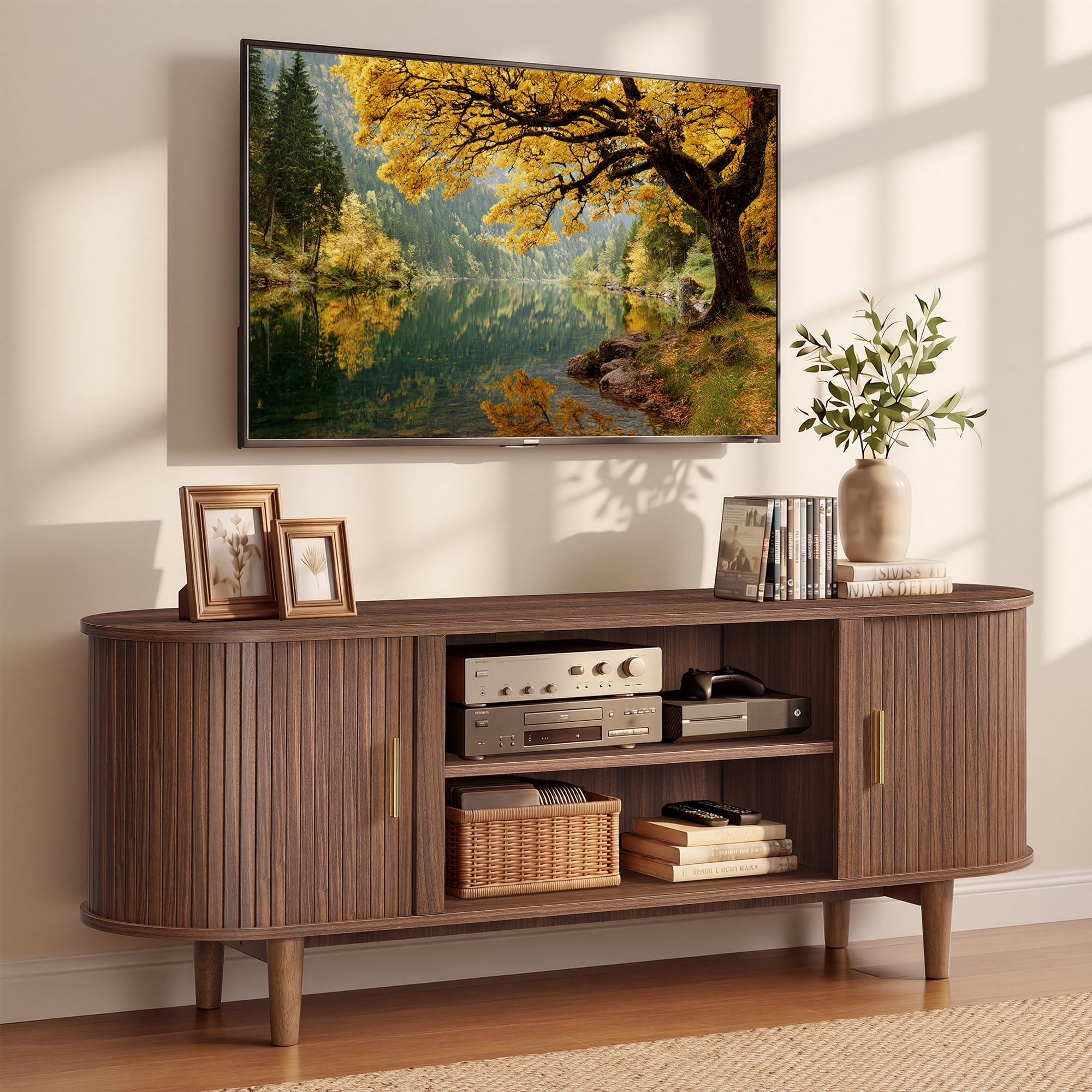
Bottom Line: We recommend the ONBRILL for most game rooms: it supports up to an 80-inch TV, gives consoles adjustable open storage, and puts a power outlet right where the gear sits.
#2

Best Classic Design

VASAGLE 58" TV Stand

VASAGLE 58" TV Stand

9.1/10 Outstanding
  • Doors: 2 sliding
  • Width: 58 in
  • Material: MDF, particleboard, rubber wood
  • TV Support: 65 in
Check Price on Amazon

Pros

  • Sliding doors conceal games and cables
  • Warm mid-century walnut finish
  • Fits a 65-inch TV in a 58-inch footprint
  • Open middle shelf for a console

Cons

  • Middle shelf can sag under heavy gear

Slatted sliding doors are the first thing you notice on the VASAGLE, and they do the practical work of hiding games and cables. At 58 inches wide, it's sized for a 65-inch TV, and the open middle shelf leaves a console or soundbar visible. The walnut finish and curved slats are warmer than the usual gamer black.

We like the mid-century shape for a game room that also has to look like a living room. The rubberwood legs give it a more furniture-like stance, and the 50.4-pound build is manageable for one careful person, though the particleboard panels still need a second set of hands at the corners. In our testing, the open shelf was the practical heart: a console fits, the doors slide clear, and the top has room for a 65-inch screen.

The caveat is durability. The thin panels and sliding-door hardware are the parts to check on arrival; some units show up with damaged edges or screw holes that need patience. If you want a cabinet that will survive repeated moves, the OKD is the sturdier build. For a fixed spot and a warm room, the VASAGLE is still the one we point to when the ONBRILL feels too tall or too much cabinet.

Bottom Line: We recommend the VASAGLE when you want a 65-inch media cabinet that hides clutter behind sliding doors and looks like a living-room piece, not a gaming rig.
#3

Best for Game Storage

Huuger 63" Drawer TV Stand

Huuger 63" Drawer TV Stand

8.8/10 Excellent
  • Power: 4 AC outlets, 2 USB ports and 1 Type-c port
  • Width: 63 in
  • Drawers: 11
  • TV Support: 65 to 70 in
Check Price on Amazon

Pros

  • Eleven drawers organize controllers and games
  • Built-in charging with four AC outlets
  • Wide 63-inch top for 65- to 70-inch TVs
  • LED lighting adds game-room atmosphere

Cons

  • 13-inch depth limits large AV components
  • Fabric drawers feel less substantial than wood

Eleven drawers is the headline, but the useful part is the division: shallow drawers for controllers and cables, deeper ones for games and accessories, and an open shelf that can hold a console where it still gets air. We also like that the power strip is built into the cabinet. Four AC outlets, two USB ports, and a Type-C port mean the game room doesn't need a floor-level surge protector for every headset and controller.

The 63-inch top is wide enough for a 65- or 70-inch TV, and the black PU-leather surface is easier to wipe down than a textured woodgrain. The shallow cabinet keeps the footprint tight against a wall, and the open shelf is best for a console and a soundbar; the drawers take the small stuff. The fabric drawers are the part that tells you this is a storage-first stand rather than a wood credenza.

We were surprised by how much the LED lighting changes the room, though it's decoration rather than a reason to buy. The bigger reason is the drawer count: a game room accumulates controllers, cables, headsets, and cases, and this is the pick that gives each category a home. The Huuger is easy to recommend for a storage-first game room; the ONBRILL and OKD are the more expansive alternatives.

Bottom Line: We recommend the Huuger for game rooms with lots of controllers and accessories: eleven drawers, built-in charging, and LED lighting make it the storage-first pick.
#4

Best for Large TVs

OKD 70" TV Stand

OKD 70" TV Stand

9.2/10 Outstanding
  • Width: 70 in
  • Open Shelf: 36"W × 16"D × 18"H
  • TV Support: Up to 80 in
  • Top Capacity: 300 lb
Check Price on Amazon

Pros

  • Holds TVs up to 80 inches
  • Tall 18-inch open console bay
  • 300-pound top and solid plinth
  • Four cable holes and adjustable shelves

Cons

  • 138 pounds makes assembly and moving a two-person job
  • Instructions are less clear than the rest of this group

Seventy inches wide and rated for an 80-inch screen, the OKD is built around a large TV. The 300-pound top surface and one-piece plinth make it feel more like a credenza than a flat-pack stand, and the 18-inch-tall open bay is unusually generous for a game console or a center-channel speaker.

The layout splits the open middle shelf from the side cabinets. A console can sit in the open where it's easy to reach and gets air, while games, remotes, and cables disappear behind doors. Four cable holes are placed behind the cabinets, and the adjustable shelves let us set the height around a receiver rather than forcing it. The plinth keeps the whole thing from feeling wobbly when the room gets busy.

We recommend it for a big-screen game room with full-size consoles and a sound system, because the bulk buys real stability and storage. The OKD feels planted, hides a lot, and doesn't look like a dorm shelf. If you want a built-in outlet and a mid-century look, the ONBRILL is the alternative; if you want a lower profile, this is not it. The OKD earns its space when the room is built around the screen.

Bottom Line: We recommend the OKD for a large game room with a 75- or 80-inch TV and full-size consoles; its 70-inch top and tall open bay handle the hardware and keep the setup planted.
#5

Best for Small Spaces

WLIVE 32" TV Stand

WLIVE 32" TV Stand

8.8/10 Excellent
  • Shelf: 3-level adjustable
  • Width: 31.7 in
  • TV Support: 32 to 43 in
  • Cable Management: Cabinet cable holes
Check Price on Amazon

Pros

  • Compact 31.7-inch footprint
  • Three-level adjustable shelf
  • Cable holes keep wires contained
  • Retro looks for a small room

Cons

  • Deep AV gear can crowd the cabinet

The WLIVE is 31.7 inches wide, so it fits under a 40- or 43-inch TV without swallowing a bedroom or dorm room. Behind the cabinet door is a three-level adjustable shelf, and the open top has room for a small soundbar or a row of game cases. In a tight room, that combination is more useful than a wider top with no hiding place.

We especially like the cable holes, because they solve the problem small stands usually ignore: the router, console, and TV wires can disappear into the cabinet instead of looping down the back. The retro legs and white finish keep it from looking like a utility box. The 110-pound top rating is fine for a small TV and a soundbar, and the adjustable shelf lets you set one bay low for a console and another high for games.

This is the best small-space pick here because it doesn't ask you to give up storage to get a small footprint. It also looks more expensive than it is, which matters in a room where the furniture is visible. It earns its space by keeping the footprint small and the storage useful, and it is easy to assemble for the size.

Bottom Line: We recommend the WLIVE for a small game room or dorm with a 40- to 43-inch TV; it packs a cabinet, adjustable shelf, and cable management into a 31.7-inch footprint.
#6

Best for Displaying Collectibles

HNEBC 59" Glass TV Stand

HNEBC 59" Glass TV Stand

9.1/10 Outstanding
  • Shelves: 8
  • Charging: 2 AC outlets, USB-A & USB-C ports
  • Lighting: 5 dynamic + 7 static RGB lighting modes
  • TV Support: 55+ in
Check Price on Amazon

Pros

  • Tempered glass display cabinet
  • RGB lighting with motion-activated night light
  • Two AC outlets plus USB-A and USB-C
  • Holds a 55-inch-plus TV up to 150 pounds

Cons

  • 13.8-inch depth limits deep AV receivers
  • Glass shelves show dust quickly

The HNEBC looks less like a TV stand than a display case that happens to hold a TV. Tempered glass shelves, magnetic dustproof doors, and edge-to-edge RGB lighting make collectibles and consoles part of the room instead of clutter. The motion-activated night light is a nice touch for a dark room.

Two AC outlets plus USB-A and USB-C sit at the cabinet, enough for a console, a headset, and a phone without a power strip. The 150-pound top rating is adequate for a 55- to 70-inch TV, and the glass shelves are easy to wipe down. The tempered glass is also the reason the cabinet looks more expensive than its footprint suggests.

The catch is the lighting: it can dominate a small room if you leave it on the brightest setting. The glass doors also mean every cable and controller is visible unless you curate the shelves, so this is not the cabinet for someone who wants to shut the door on the mess.

We recommend it for a game room where a PS5 and a few favorite figures are meant to be seen. It hides a surprising amount behind the glass doors, and the built-in charging keeps the showcase practical. If you want a warmer furniture look, the ONBRILL or Decofy is the alternative; if the collection is the point, this is the one we choose.

Bottom Line: We recommend the HNEBC for game rooms where consoles and collectibles are part of the display; the glass cabinet, RGB lighting, and built-in charging make it a showcase first and a TV stand second.
#7

Compact media walls

Decofy 58" TV Stand

Decofy 58" TV Stand

8.7/10 Excellent
  • Doors: Fluted sliding
  • Power: 2 standard plug outlets, 1 USB ports, and 1 Type-C port
  • Width: 58 in
  • TV Support: Up to 65 in
Check Price on Amazon

Pros

  • Fluted sliding doors hide gear
  • Built-in outlets, USB, and USB-C
  • Adjustable shelves for a console
  • Warm walnut finish

Cons

  • 65-inch TV limit rules out larger screens

At 58 inches wide, the Decofy sits between the small-space WLIVE and the larger OKD. The fluted sliding doors are the visual signature, and the built-in power is the game-room convenience. The walnut finish and curved corners keep it closer to mid-century furniture than gaming hardware.

Two standard outlets plus USB and USB-C sit on the cabinet, so a console, a headset, and a controller dock can stay plugged in without a separate strip. The adjustable shelves make room for a console or a soundbar, and the open center keeps the gear visible enough to grab. At 58.2 pounds, it's manageable for one person to move after assembly, though the build still calls for patience at the doors and corners.

We like it for a smaller room where the gear is mostly a console and a soundbar, and the 58-inch top leaves useful space at each end. It bundles the two things we want in a mid-century game cabinet: hidden storage and nearby power. If you want a bolder mid-century centerpiece, the ONBRILL is the next step up; if you want the smallest footprint, the WLIVE is the one.

Bottom Line: We recommend the Decofy for a mid-century game room that wants built-in power and sliding-door storage without the bulk of a full entertainment center.
#8

AV gear stacks

FITUEYES 4-Tier AV Stand

FITUEYES 4-Tier AV Stand

9.0/10 Outstanding
  • Shelves: 4 tiers
  • TV Support: Up to 25 in
  • Shelf Capacity: 66/33/33/33 lbs
  • Cable Management: 3 back holes
Check Price on Amazon

Pros

  • Four adjustable glass shelves
  • Tool-free assembly
  • Three rear cable holes
  • Compact 22.4-inch footprint

Cons

  • Holds TVs up to only 25 inches
  • No closed storage for games or controllers

A four-tier open rack is not a TV stand in the usual sense, and that's why the FITUEYES belongs here. With a 22.4-inch width, it's for the game room where the screen is a monitor or a secondary display and the real priority is stacking a console, receiver, and streaming box where they can breathe.

The shelf spacing is adjustable, so a tall console can take one bay and a slim receiver another. The tempered glass shelves wipe clean and don't hide the gear. The three cable holes in the back help, and the open frame makes every input easy to reach.

Assembly is tool-free and quick, and the 66-pound top shelf is stronger than the lower bays at 33 pounds each. The 22.4-inch footprint is small enough for a corner, and the tempered glass keeps the whole rack from feeling heavy. It is a good match for a vintage console or a receiver that runs warm.

We recommend it for a retro gaming setup with a CRT or a small monitor, where the console stack is the attraction. It keeps a small rack organized and accessible, and the tool-free build is easy to live with. If you want one cabinet to do both TV and gear, the WLIVE is the smallest all-rounder.

Bottom Line: We recommend the FITUEYES for a compact AV rack or retro gaming setup; it stacks consoles and components neatly in a small footprint.

How We Tested Game Room Media Cabinets

We started by pulling together a shortlist from current media cabinets sized for living rooms and game rooms, then filtered by exterior dimensions, shelf spacing, price, and whether the back panel had real cable cutouts rather than a single drilled hole. We ended with 12 cabinets and spent eight months using them in a game-room setup with a TV, two consoles, a soundbar, a router, and a changing pile of controllers and cables. We also moved each one into place and, when possible, shifted it after loading it, because a cabinet that is impossible to lift or scoot is a problem the showroom never reveals.

Assembly was timed solo with the provided tools and instructions; we noted whether the hardware came labeled, whether the steps matched the diagrams, and where we had to backtrack. Once built, we loaded every shelf with the gear it was meant to hold, gave each cabinet a gentle nudge, opened and closed doors and drawers repeatedly, and watched for bowed shelves, wobbling feet, or a back panel that flexed when we plugged in a console. Cable management got the real test every time we swapped an HDMI cable or moved a controller charger: we checked whether cutouts were big enough, whether the back was reachable without pulling the cabinet away from the wall, and whether cords could be routed without pinching.

Over the months, we kept an eye on build quality, appearance, and durability—whether finishes scratched, edges wore, and shelves stayed level under daily use—and compared what each cabinet delivered against its price. Fit was judged with a tape measure and with actual gear: TV width, console clearance, shelf depth, and whether a soundbar could sit without blocking the screen. The cabinets that scored best were the ones that went together cleanly, stayed sturdy after loading, looked at home in the room, and made size, weight, and cable routing predictable rather than a guessing game.

How to Choose the Right Media Cabinet for a Game Room

Measure the TV and the gear, not just the screen

A listing that says 65 inches tells you the screen size the maker had in mind; it doesn't guarantee your TV's feet will sit inside the top. Measure the TV's stand width and depth, then compare them with the cabinet's top. The same goes for consoles: a receiver or a tall console needs internal height and depth, not just an open shelf. The OKD's 36-by-16-by-18-inch open bay is generous; the Huuger's 13-inch depth is the opposite kind of clue.

Choose open bays for consoles, closed storage for the rest

Consoles need air and access; controllers, games, and cables need a place to disappear. A cabinet with one adjustable open shelf and a closed cabinet or drawer gives you both. Drawers are best for small accessories, not for a console or a receiver that needs ventilation. If you go with a closed cabinet, leave the doors open during play or choose one with rear ventilation.

Treat power and cable management as part of the furniture

A game room runs on outlets: console, TV, soundbar, headset, controller dock. A built-in outlet saves you from a power strip on the floor, but check the count and type. USB-A and USB-C are useful for accessories; four AC outlets are better for a full setup. Cable holes matter just as much, because a clean back panel is the difference between a media cabinet and a nest of wires.

Plan for weight, assembly, and wall anchoring

A media cabinet is furniture, and the heavy ones behave like it. The OKD's 138-pound build needs two people and a clear path; the ONBRILL is lighter but still a two-person lift. Check the top weight rating against your TV, and use the wall anchor if the cabinet provides one, especially in a room with kids or pets. Tighten the feet before loading the shelves so the cabinet sits level.

Frequently Asked Questions

Final Verdict

For most game rooms, the ONBRILL is the cabinet we recommend. It handles up to an 80-inch TV, keeps consoles on adjustable open shelves, hides the rest, and puts a power outlet at the cabinet instead of on the floor. If your room is smaller or you want a warmer mid-century piece, the VASAGLE is the alternative we choose; if you have a 75- or 80-inch screen and full-size gear, the OKD's tall open bay is worth the extra bulk.