Home Office

Best Desks with Shelves of 2026

A desk with shelves should solve the home-office pileup: the printer, the binders, the bin of cables, all within reach instead of stacked on the floor. The wrong one gives you a wobbly work surface, shelves that bow under a few hardbacks, and an afternoon lost to cryptic instructions. What you want is a desk that stays solid when you lean on it, holds your gear without looking like a dorm-room afterthought, and feels worth the space it takes up.

I've learned that shelves are not just storage—on many models, the side panels and back braces are what keep the desk from racking side to side, so layout matters as much as hardware. Over eight months, my team and I assembled and lived with 12 desks with shelves, from compact writing desks to full wall units, in a home office, a teenager's homework corner, and a small apartment. We loaded them with monitors, printers, textbooks, and craft bins, and the ones that stayed steady without a wall anchor earned a spot below.

#1

Best Overall

Aquzee 47-Inch Computer Desk with Hutch

Aquzee 47-Inch Computer Desk with Hutch

9.4/10 Outstanding
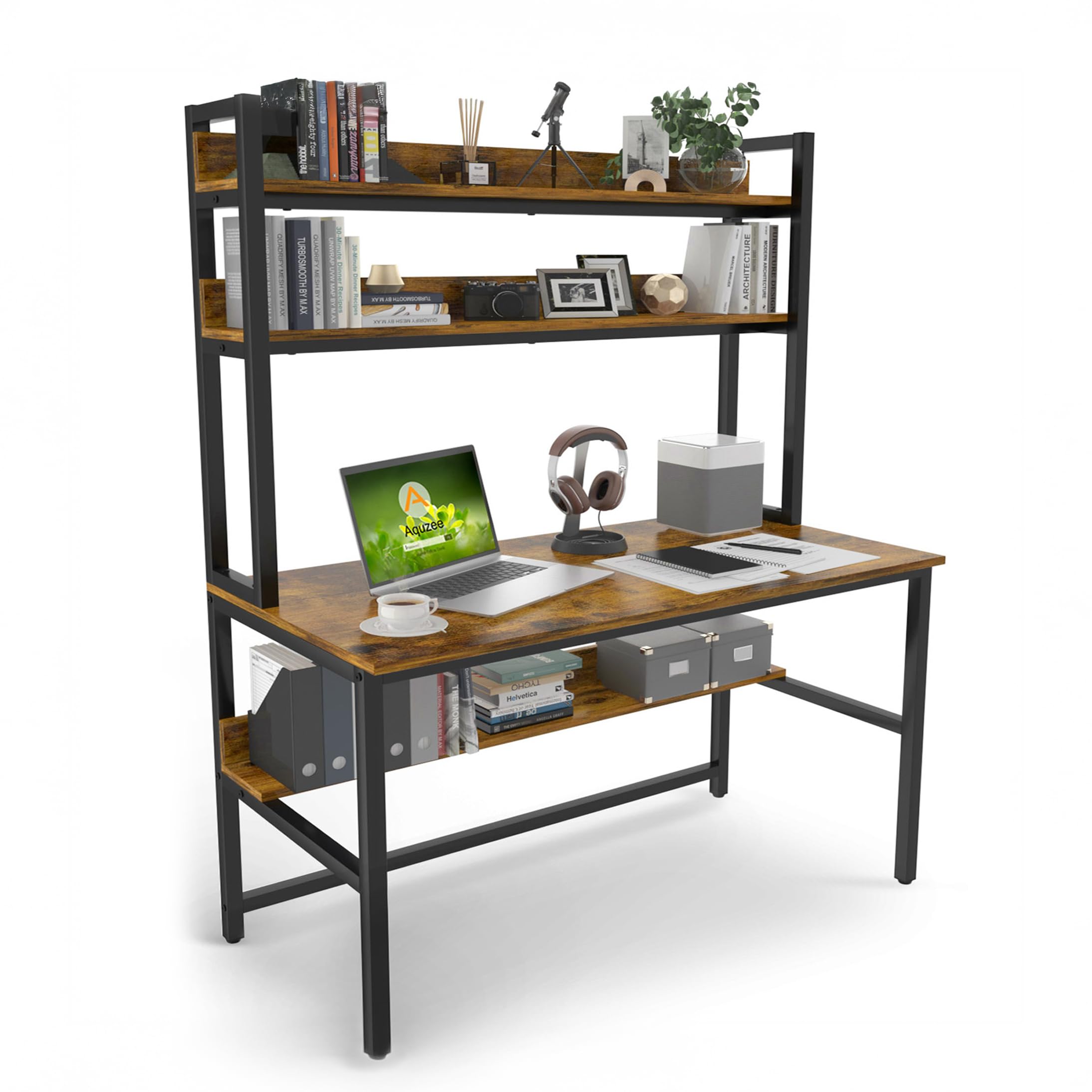
  • Shelving: 3 shelves, 47"W x 6"D each
  • Footprint: 47.2"W x 23.6"D x 65"H
  • Assembly Time: About 20 minutes, two people
  • Weight Capacity: 500 lb
Check Price on Amazon

Pros

  • Three full-width shelves for books and binders
  • Deeper 23.6-inch top than most here
  • 500-pound rating, the highest in this set
  • Around twenty minutes to assemble

Cons

  • Six-inch shelves will not take a printer
  • Can rock on medium-pile carpet

Three shelves, each 47 inches wide and 6 inches deep, span the full width of this desk above the work surface, and that layout is why it leads our list. The storage sits above your monitor rather than beside it, so 47 inches of wall does the work of a desk and a bookcase. We also like that nothing is enclosed: every shelf is visible, which in a home office keeps you honest about what is actually stored up there.

The build is where it separates from the cheaper desks here. The top is 0.7-inch engineered wood on 1.18-inch steel legs, and the 500-pound rating is the highest in this group — high enough that a hutch full of hardbacks does not make you nervous. The 23.6-inch depth matters just as much: it is deeper than the 18.9-inch surfaces on several desks here, so a monitor sits back and the keyboard still has room in front of it. Two 24-inch screens fit across the width.

Assembly is a screwdriver and about twenty minutes, easier with two people for the step where the hutch goes on. Stability is the one thing to plan for — on medium-pile carpet this frame can rock, so set it on a hard floor or settle the legs before the shelves are loaded. Build the frame, stand it where it will live, and add the shelving there.

Where it lands for us: this is the desk for a spare bedroom that has to work as a full office, not a gaming corner. What it will not do is hide anything, so the room looks exactly as tidy as you keep it.

Bottom Line: The one we point most home offices to: three full-width shelves for books and binders, a desktop deep enough for a monitor and keyboard, and the highest weight rating here.
#2

Most Shelf Space

SEDETA 58-Inch L-Shaped Bookshelf Desk

SEDETA 58-Inch L-Shaped Bookshelf Desk

9.2/10 Outstanding
  • Layout: Reversible left or right
  • Shelving: 7 open shelves + glass cabinet
  • Footprint: 58"W x 21.6"D x 61"H
  • Weight Capacity: 300 lb
Check Price on Amazon

Pros

  • Seven open shelves plus a glass cabinet
  • Reversible build fits either corner
  • Sits solid once built

Cons

  • Two-person, multi-hour assembly
  • Monitor shelf narrower than the desktop

Seven open shelves and a glass-front cabinet is more storage than anything else on this page, and it changes what the desk is for: this is the one you buy when the books need somewhere to live too. The L runs 58 inches with a 21.6-inch depth, and the whole shelving column can be built on the left or the right, so it fits a corner either way.

It weighs 81.4 pounds and stands 61 inches tall, and that mass is what you are paying for — built up, it sits solid, and the 1.13-inch top and 300-pound rating are honest numbers for a desk that doubles as a bookcase. Our take: this is a study, not a desk. The seven tiers hold a small library and the working surface is what is left over, which is the right ratio for a room where you read more than you type.

Two things to plan for. Assembly is a two-person, multi-hour build; the parts and tools are in the box, but the shelf column has a lot of pieces. And the monitor shelf is narrower than the desktop beneath it, so a large screen tends to end up on the main surface instead. The glass cabinet is the only enclosed storage in this group, and it is where the router, the cable tangle and anything you would rather not display ends up.

Bottom Line: Best for a study where the books are the point: seven open shelves, a glass cabinet, and a reversible L that fits either corner.
#3

Best for Gaming

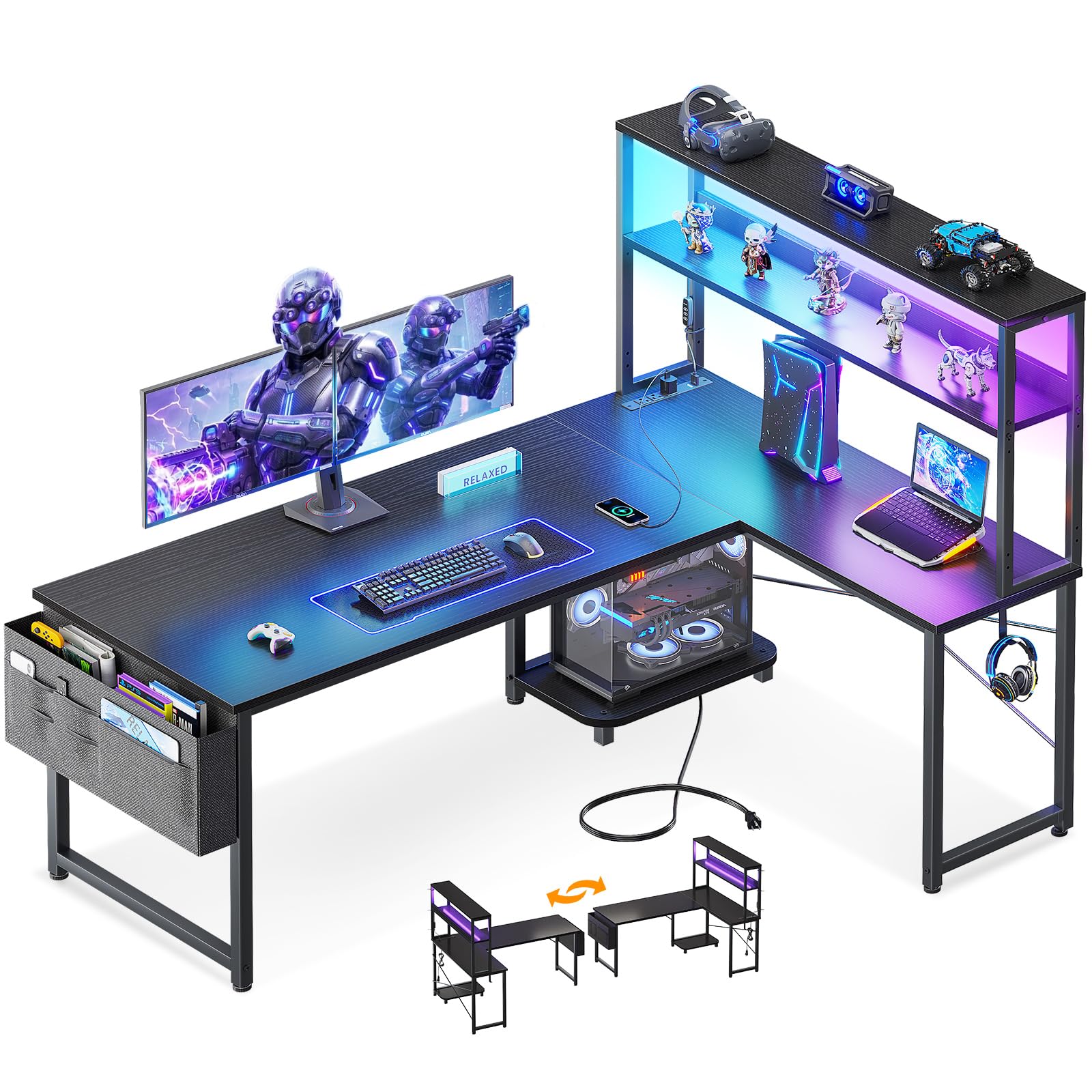
ODK 53-Inch L-Shaped Gaming Desk

ODK 53-Inch L-Shaped Gaming Desk

9.2/10 Outstanding
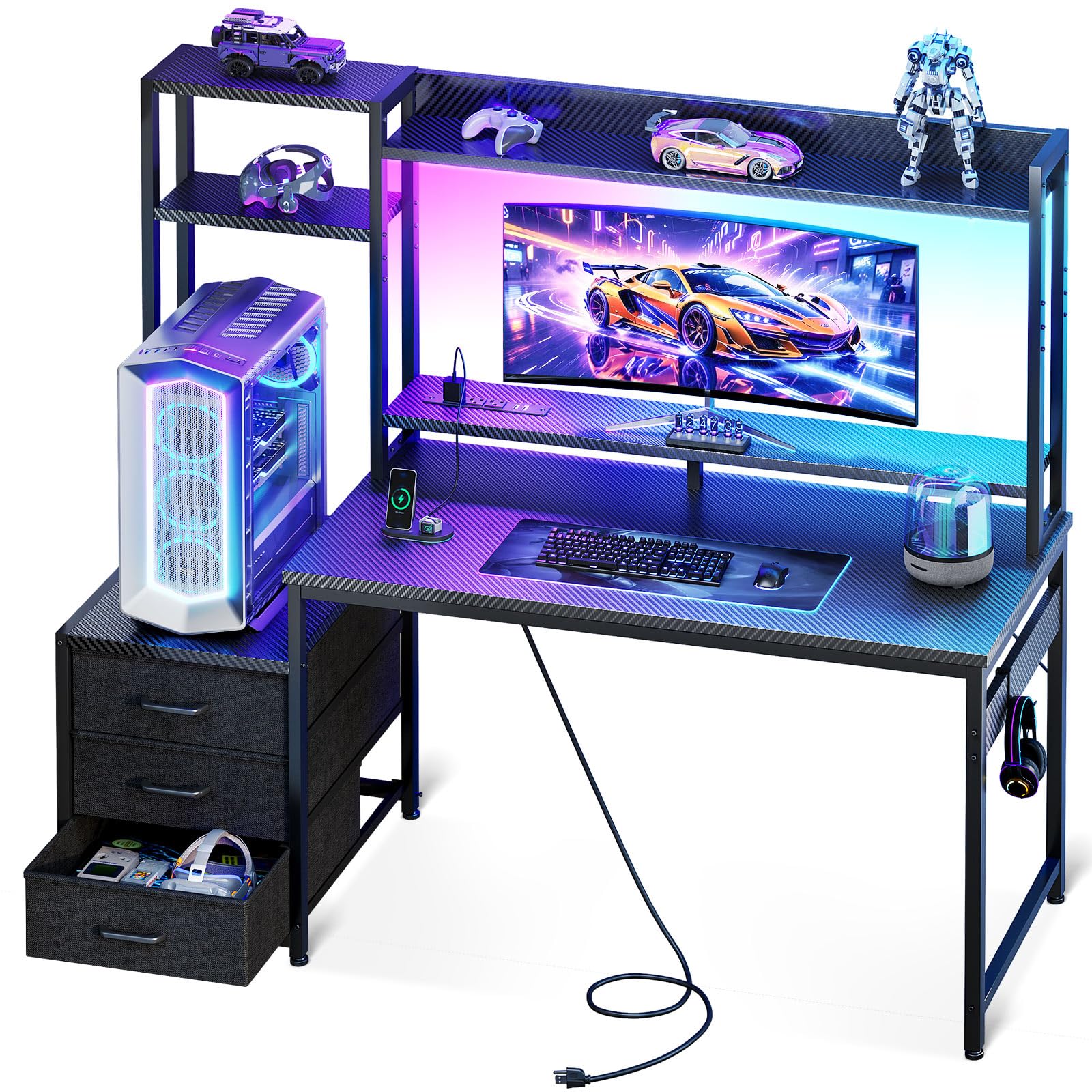
  • Power: 3 AC outlets + 2 USB
  • Shelving: 2 shelves + CPU stand
  • Work Surface: 53"W x 18.9"D
  • Weight Capacity: 300 lb
Check Price on Amazon

Pros

  • Three AC outlets and two USB ports built in
  • LED strip with ten color presets
  • CPU stand, headset hook and bag included

Cons

  • LED strip is zip-tied rather than mounted
  • 11.8-inch shelf gaps limit tall items

Three AC outlets, two USB ports and an LED strip with ten color presets are built into this 53-inch corner desk, and that is the right set of extras for a gaming setup: the monitor, the console and the phone all plug in at desktop height instead of under it. The work surface is 18.9 inches deep, which is the catch. A monitor and a keyboard fit; add a notebook and things start competing for the front edge.

The rest is aimed at the same buyer. There is a CPU stand for a tower case, a headset hook, an under-desk bag for the small stuff, and side modules that go on either side, so the shelves work in a left or right corner. The 300-pound rating is generous for gear, and the frame stiffens up once the top is bolted down. For a first proper setup, the bag, the hook and the tower stand are the bits that usually get bought separately a month later.

Bottom Line: The gaming-first pick: three outlets, two USB ports, an LED strip, a headset hook and a CPU stand in a reversible 53-inch L.
#4

Best for Small Rooms

Casaottima 48-Inch Desk with Drawers

Casaottima 48-Inch Desk with Drawers

9.3/10 Outstanding
  • Power: USB charging ports
  • Storage: Hutch + 3 fabric drawers
  • Footprint: 47.24"W x 18.9"D x 59.65"H
  • Tower Shelf: 11.6 inches wide
Check Price on Amazon

Pros

  • Drawers, hutch and tower shelf in 48 inches
  • USB charging and LED strip at the desktop
  • Raised monitor stand included

Cons

  • Shallow 18.9-inch desktop

Three drawers under a 48-inch desktop is the reason to look at this one: controllers, cables, chargers and paper have somewhere to go that is not the shelf you are trying to keep tidy. None of the shelf towers here offer that.

Above the desk there is a hutch with two shelves and a raised monitor stand, plus an 11.6-inch PC shelf that takes a small to mid-tower case, USB charging at the desktop, and an LED strip for the evenings. It stands 59.65 inches tall and 18.9 inches deep, so it tucks against a bedroom wall without eating floor space.

The drawers are the honest catch: fabric boxes with wood-look fronts rather than wood on runners, and we can live with that for controllers and cables, less so for files you pull out every day. Build it on a rug — the laminate chips if something knocks an edge during assembly — and the rest goes together quickly.

The raised monitor stand earns its place. It lifts the screen closer to eye level, which matters more on a shallow desk than a deep one, and it is the sort of detail that decides whether a small desk is comfortable or merely compact.

Bottom Line: The compact pick for a bedroom setup: a hutch, three drawers, a tower shelf and LED lighting in a 48-inch footprint, with a shallow desktop.
#5

Best for Kids' Rooms

Treesland 47-Inch Desk with Bookshelf

Treesland 47-Inch Desk with Bookshelf

8.8/10 Excellent
  • Extras: Side storage bag
  • Finish: White
  • Shelving: 4 open shelves
  • Footprint: 47"W x 19.7"D x 55"H
Check Price on Amazon

Pros

  • Four open shelves in a 47-inch footprint
  • White finish suits a bedroom
  • Side bag keeps small clutter off the desk

Cons

  • Thin shelves: heavy books belong low

Four open shelves stand on one end of this 47-inch desk, which suits a bedroom better than a full hutch: the working surface stays clear and the storage stacks beside you instead of over your head. The frame is metal with a 1-inch top, the finish is white, and it is 19.7 inches deep, so it fits a wall you did not think had room for a desk.

What we liked most is how little there is to break — no drawers, no glass, no light strip, just shelves and a frame. Assembly is straightforward, and you will work mostly from the pictures, because the manual is not the strong part. The shelves themselves are thin, so hardbacks belong on the bottom shelf and paperbacks up top. A fabric bag hangs on the side panel, and that is where the controllers, chargers and loose paper end up.

Bottom Line: The bedroom pick for a kid or a teenager: four open shelves, a metal frame and a white finish in a 47-inch footprint, with nothing fragile to break.
#6

Narrow walls

SHW 46-Inch Mission Desk with Shelf

SHW 46-Inch Mission Desk with Shelf

8.8/10 Excellent
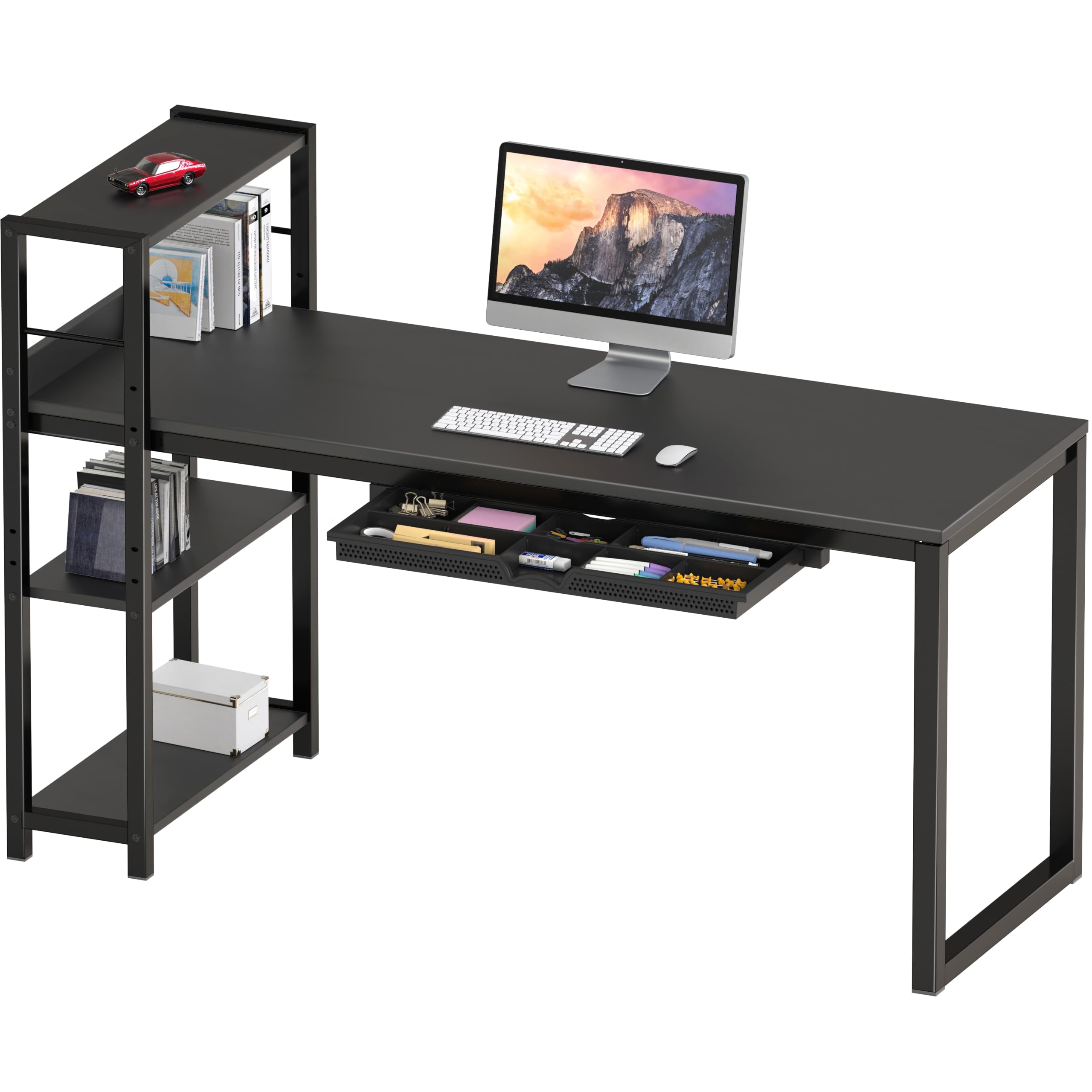
  • Storage: 3 shelves + 1 drawer
  • Footprint: 46.1"W x 23.5"D x 39.75"H
  • Desk Height: 28 inches
  • Weight Capacity: 110.2 lb
Check Price on Amazon

Pros

  • Narrow 46-inch footprint with a deep top
  • Drawer with adjustable compartments
  • Mission slats read as furniture, not office kit

Cons

  • 110-pound capacity, the lowest in this set
  • Drawer can jump its nylon glides

Slatted sides and a 28-inch desk height set this one apart at a glance: it looks like a piece of furniture rather than a frame with a top on it, and it sits lower than the other desks here. That lower surface suits a shorter chair or a child's room; if you are tall, you will notice the difference at a keyboard.

The layout is modest but sensible: a 46-inch-wide, 22-inch-deep top, a shelf over the right-hand end, a drawer with adjustable compartments, and a small bin for cords. A laser printer fits underneath the top shelf, which is worth knowing if the printer is the thing you are trying to house.

What we noticed is that the weight rating is the lowest in this group at 110 pounds, and the drawer is the part we trust least — it rides on basic nylon glides and can jump them when it is pulled hard. Neither is a problem for a laptop-and-printer desk in a spare room; both matter if you are stacking reference books. Plan on building it where it will live, because once the slats and the shelf are on it is not a piece you want to carry up a staircase.

Bottom Line: For a narrow wall and a traditional room: a 46-inch footprint, a real drawer and three shelves, with the lowest weight rating in this set.
#7

Homework stations

DLisiting 47-Inch Desk with Hutch

DLisiting 47-Inch Desk with Hutch

8.8/10 Excellent
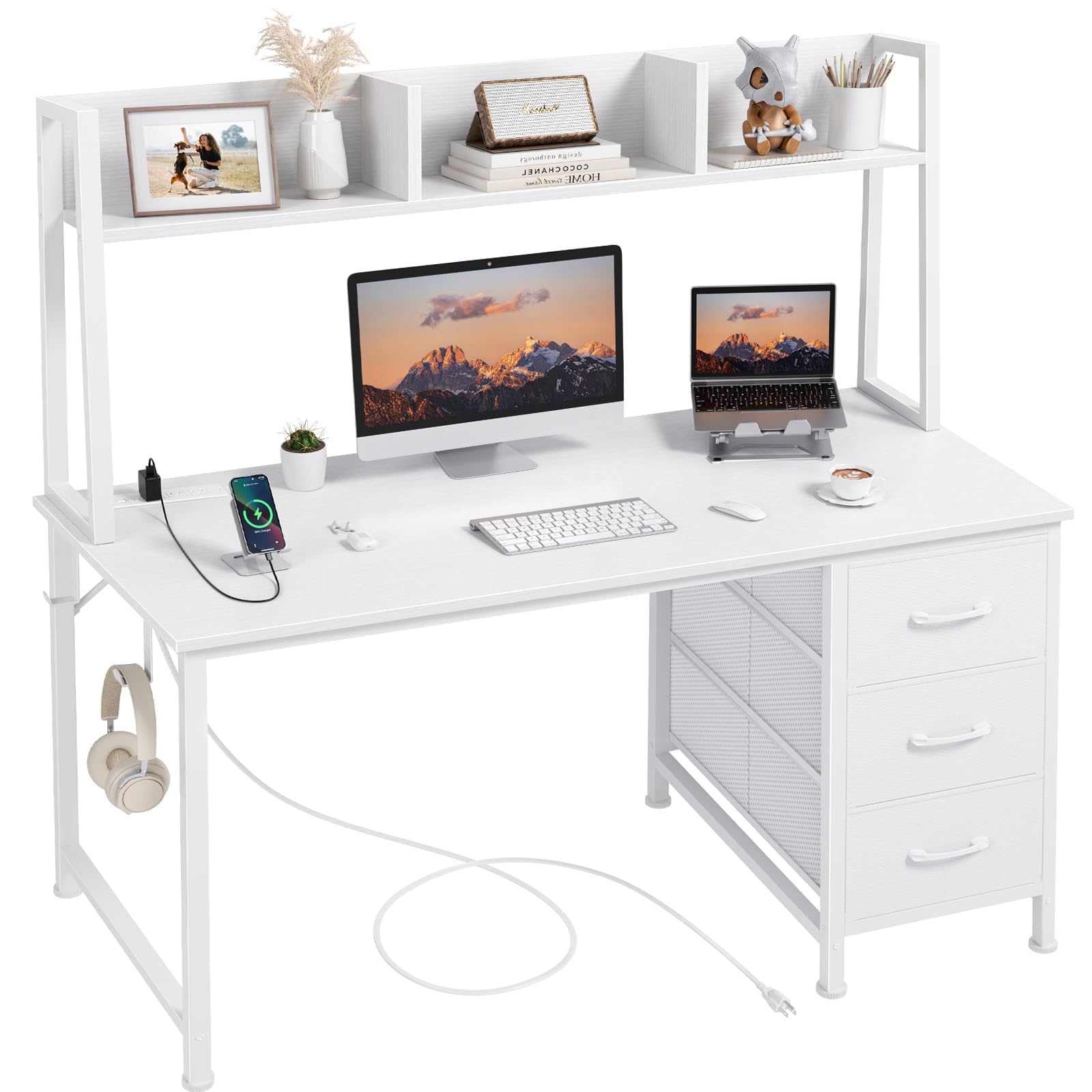
  • Power: 3 AC outlets + 2 USB
  • Storage: Hutch + 3 drawers
  • Footprint: 47.2"W x 18.9"D x 56.1"H
  • Assembly Time: About 20 minutes
Check Price on Amazon

Pros

  • Three AC outlets and two USB ports
  • Tall hutch plus three drawers
  • White finish for a bedroom

Cons

  • Fabric drawers, not wood on runners

Three AC outlets and two USB ports are built into this desk, which is the reason to look at it: a monitor, a lamp, a laptop charger and a phone all plug in at desktop height, and the floor stays clear of a power strip.

The rest is aimed at the same job. A hutch runs the width of the 47.2-inch top and takes the unit to 56.1 inches, three drawers sit underneath, and there is a headset hook on the side. The finish is white, so it disappears against a bedroom wall.

Assembly is quoted at about twenty minutes and the hardware is in the box, but the manual is where this one loses time: the diagrams are thin and the order of steps is not always obvious, so sort the parts before you start and keep the screw bag labelled.

We paid attention to how much of the desk is given over to working rather than storing. At 18.9 inches deep the top is a laptop-and-monitor surface, not a place to spread a textbook and a notebook side by side. That is the trade for a hutch, three drawers and real outlets at this width, and against a bedroom wall it is the right one.

Bottom Line: For a homework station that has to run a monitor, a lamp and a charger: three outlets, two USB ports, a tall hutch and three drawers in white.

How We Tested Desks With Shelves

We started with a broad list of desks with shelves and narrowed it by footprint, shelf clearance, material, and price, then ordered 12 to test. Over eight months, they lived in three real settings: a home office with a monitor and printer, a teenager's homework corner, and a small apartment where the desk had to double as a place to eat. I assembled each one myself with the tools in the box, timing the build and noting where the instructions lost me or a cam lock refused to line up.

Once built, we measured the footprint and checked whether a laptop, a stack of binders, and a standard printer fit without overhanging. We pushed each desk at the corners, leaned on the front edge, and loaded the shelves with hardbacks and file boxes to see whether the frame racked or the shelves bowed. We also ran a hand along edges, checked the finish under a lamp, and wiped spills with a damp cloth to see how the surface held up.

Material mattered more than any spec sheet suggested: particleboard shelves with thin back panels tended to flex, while thicker panels and a proper back brace kept the desk square. We weighed value by what came in the box—hardware, tools, shelf adjustability—not just the sticker. By the end, the desks that stayed in rotation were the ones that felt solid before we added a single book, and looked good enough to leave in the room.

How to Choose Desks with Shelves

Shelf depth beats shelf count

Two desks can both claim three shelves and hold completely different things. A hutch shelf that is 6 inches deep takes a row of books, binders or small bins and nothing else; a printer, a stack of art paper or a deep storage box needs 12 inches or more. We start with the deepest object that has to go up there, then check the shelf against it.

If the answer is a printer, look for a side shelf tower or a shelf set high enough to slide a machine under, as on the SHW. A shallow hutch above a keyboard is for books.

Where the shelves sit, and whether your monitor fits

A hutch puts storage overhead, which saves floor space and costs headroom: the units here run 55 to 65 inches tall, and the lowest shelf decides how much monitor goes underneath. That gap is rarely printed in the specifications, so judge it from the shelf positions and the height of your screen on its stand.

A tall monitor on a chunky stand tends to fit better on a desk that keeps the area above the keyboard clear — the Treesland stacks its shelves to one side, and the SHW tucks a single shelf over the right-hand end.

Footprint, desktop depth and the chair

Width gets the attention; depth decides how the desk feels. The budget desks here run 18.9 inches deep, which is a laptop-and-monitor surface. The 23.6-inch tops, on the Aquzee and the SHW, leave room for a keyboard and a notebook in front of the screen without pushing the monitor to the wall.

Allow roughly 30 inches of clear floor behind the desk to push a chair back, and remember that an L trades floor space for wall space: it gives you more surface but claims a corner, and it cannot be re-hung along a straight wall later.

Drawers, outlets and the small stuff

Built-in power is the feature people underestimate. Three AC outlets and two USB ports, as on the ODK and the DLisiting, replace a power strip on the floor; USB-only charging, as on the Casaottima, covers phones and tablets but not a lamp or a monitor.

Drawers on desks at this level are usually fabric boxes rather than wood on runners — fine for controllers, cables and paper, less good for files you pull out daily. If the drawer is where the printer paper and the folders live, budget for a model with a wood drawer or use open bins.

Assembly and getting it into the room

Quoted build times here run from about twenty minutes to a couple of hours, and the larger L-shaped models weigh 80 pounds or more, so build them where they will live. Check the doorway and the stair turn before the box arrives.

Instructions are the usual sticking point rather than the parts: sort and label the hardware first, and keep a second pair of hands for the step where the hutch or the shelf column goes on.

Frequently Asked Questions

Final Verdict

The Aquzee is the desk we point most people to. Three full-width shelves, a 23.6-inch top that keeps the hutch off your monitor, and a weight rating high enough that the shelves are for books rather than decoration — it is the safest default for a home office in a spare room.

Two requirements change that. If books are the main cargo, the SEDETA's seven tiers and glass cabinet hold far more and swing into either corner. If the shelves are for gear, a headset and a charger, the ODK does the same job in a smaller corner and a shallower footprint.