Home Office

Best Drawing Tables of 2026

A flat desk will hold a sketchbook, but it won’t meet you where your hand wants to work. The right drawing table tilts to an angle you can actually draw on, locks there without slipping, and rises high enough that you’re not curled over the page. Over the past eight months, my team and I assembled and worked at 12 drawing tables, and the differences showed up fast: some wobbled at the slightest pressure, while others felt solid enough to lean on.

Assembly was the first reality check: a few tables went together in under half an hour with one tool, while others needed two people and a free afternoon. Since most of us don’t have a dedicated studio, appearance matters too—these tables often end up in a bedroom or living room, so we noted which finishes looked convincing up close. We also weighed value, because a drawing table should earn its price in stability and material quality, not just a tilting top. The picks below are the ones I’d keep using, whether you adjust the surface daily or just need to wheel it out of the way.

#1

Best Overall

Yaheetech Tilting Drafting Table

Yaheetech Tilting Drafting Table

9.2/10 Outstanding
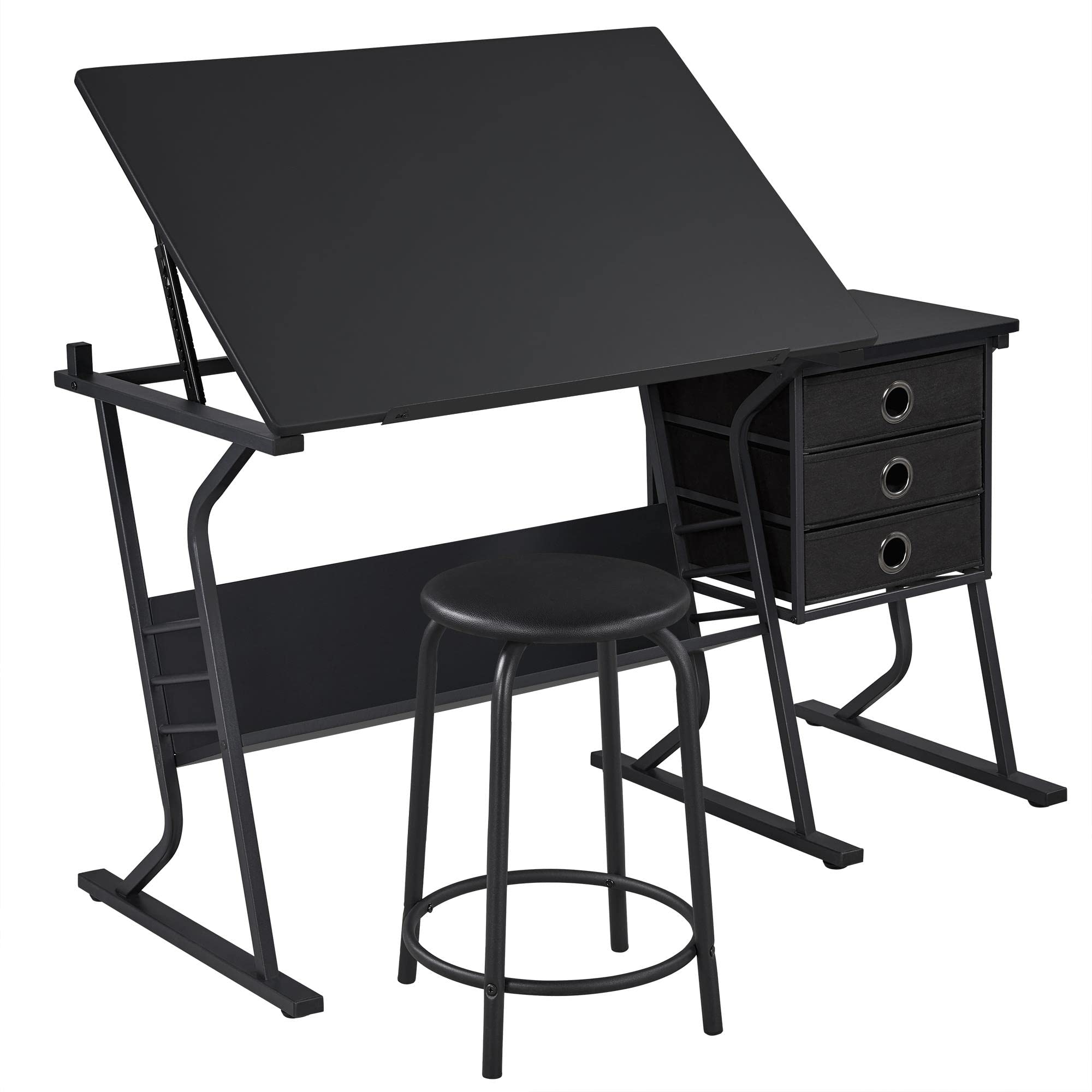
  • Storage: 3 fabric drawers, side counter
  • Tilt Range: 0-40 degrees
  • Work Surface: 35.4 x 23.6 in
  • Height Settings: 10 positions
Check Price on Amazon

Pros

  • Compact footprint for small rooms
  • Ten height settings plus 40-degree tilt
  • Three drawers and a side counter
  • Steel frame with six levelers

Cons

  • Included stool is uncomfortable for long sessions

The first thing that matters in a small studio is footprint. At 35.4 inches wide and 23.6 inches deep, this Yaheetech leaves room to turn around without shrinking the work surface to a sketchbook. The top tilts from flat to 40 degrees, and the height adjusts through ten settings, so you can bring the page toward you instead of folding yourself over it.

We think the height range is the underrated part. A tilt gets the page up toward your eyes; the height setting is what lets you sit square to the work. The three fabric drawers and side counter behave like a compact taboret—pencils, references, and a lamp stay within reach without crowding the board. The drawers are for light supplies; heavy paint jars belong on the lower shelf.

The steel frame and six screw-in levelers matter more than they sound on an old floor, where a desk that rocks will ruin a line. The compact top is not the largest in this group, but it is the one that fits a spare room without making the drawing surface feel like an afterthought. That balance is what we keep coming back to.
Bottom Line: We recommend the Yaheetech tilting table as the best all-round drawing table here: compact, sturdy, ten height settings, and storage that keeps supplies off the work surface.
#2

Best for Painting

Yaheetech Glass Drafting Table

Yaheetech Glass Drafting Table

9.0/10 Outstanding
  • Tilt Range: 0-40 degrees
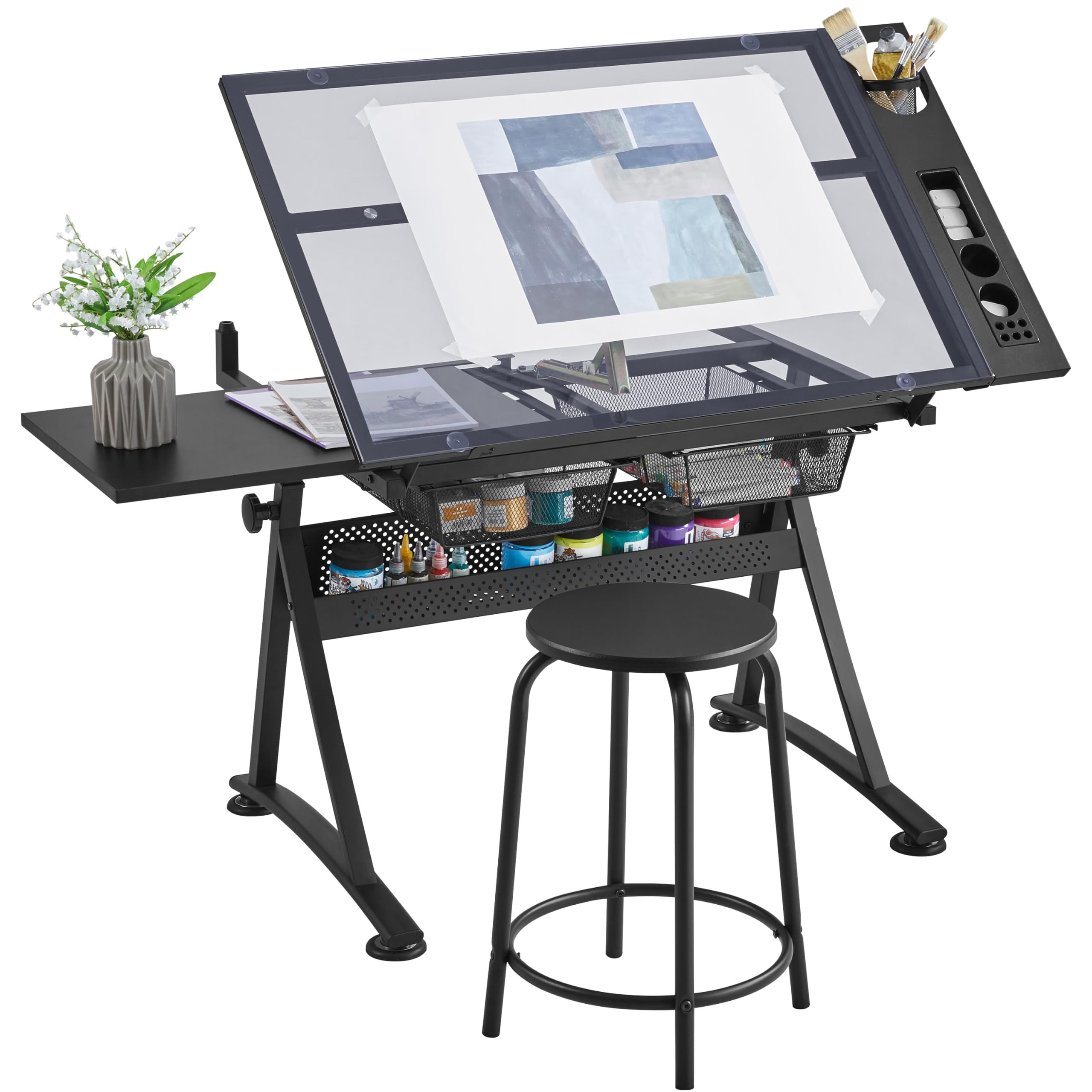
  • Top Material: Tempered glass
  • Work Surface: 35.4 x 23.6 in
  • Height Settings: 5 positions
Check Price on Amazon

Pros

  • Tempered glass wipes clean easily
  • Forty-degree tilt and five height settings
  • Two mesh drawers and a side counter
  • Substantial steel frame with levelers

Cons

  • Shows fingerprints and smudges
  • Drawers can stick when loaded

Glass is the detail that decides this table for us. The tempered top wipes clean after paint, ink, and coffee, and you do not have to baby it the way you might a raw MDF surface. It tilts from flat to 40 degrees and locks at five height positions, with a 35.4-by-23.6-inch work area that is generous enough for a large sketchbook and a reference sheet.

We like the glass for messy media, and the two mesh drawers and side counter give brushes, pencils, and a lamp a place to live. The steel frame feels substantial, and the levelers help on uneven floors. The drawers are better for brushes than heavy bottles; a paint caddy or the lower shelf takes the weight.

Assembly is the part to plan for: this is a heavier table, and the glass top is easier to place with a second person. The payoff is a surface that stays clean and a top that moves through useful angles. If your work is watercolor, acrylics, or anything that drips, the glass is the reason to choose this one; if you mostly draw with graphite and want a warmer surface, the Studio Designs wood top in this guide will feel more natural.

Bottom Line: We choose the glass-top Yaheetech for painting and mixed media: the tempered surface wipes clean, and the tilting top handles messy sessions.
#3

Best for Traditional Studios

Studio Designs Vintage Drafting Table

Studio Designs Vintage Drafting Table

8.8/10 Excellent
  • Frame: Solid poplar wood
  • Tilt Range: 0-90 degrees
  • Work Surface: 36 x 24 in
  • Height Adjustment: Fixed height
Check Price on Amazon

Pros

  • Solid poplar frame and rustic oak finish
  • Tilts to a full 90 degrees
  • Generous 36-by-24-inch work surface
  • Built-in pencil groove and ledge

Cons

  • Fixed height with no up-and-down adjustment
  • Tilt changes can be stiff

There is a point where a tilt stops being a convenience and becomes the reason to own the table. This Studio Designs top goes from flat to 23, 46, 70, and 90 degrees, so you can bring a drawing almost upright for charcoal, pastel, or a long session on a large sheet. The 36-by-24-inch surface is the largest in this group, and the built-in pencil groove and 24-inch ledge keep tools from rolling off.

The wood is the other draw. A solid poplar frame and turned legs give it a furniture presence that the steel-and-MDF tables here cannot match, and the rustic oak finish belongs in a living room or guest room as readily as a studio. We appreciate the solid-wood frame for the way it softens the room; this is the one that looks like furniture rather than equipment.

Assembly is straightforward for a wood table, though the frame is easier to square with a second person. Four floor levelers are a small but welcome detail in an older room, letting you settle the frame instead of shimming a leg. Against the steel tables in this guide, the Studio Designs is the one that asks for a dedicated spot and rewards it with presence.

Bottom Line: We point to the Studio Designs when you want solid wood, a 90-degree tilt, and furniture looks; it is not the pick for adjustable height.

How We Chose and Tested Drawing Tables

To build the shortlist, I started with tables sold for drawing and drafting rather than general desks, then narrowed by tabletop size, tilt range, height adjustment, frame material, and price. I ruled out anything with vague specs or a top too small for an 18-by-24-inch pad. That left 12 tables, which we assembled and used for eight months in home offices, a spare bedroom, and one very patient living room.

We timed every build solo with the included tools, noted whether the instructions matched the hardware, and checked whether the frame stayed square after assembly. During daily use, we tilted each top from flat to its steepest angle and back, raised and lowered the height mid-sketch, and pressed down on the far edge while drawing long hatch marks to see if the surface flexed or the legs rocked. We also did messy work—eraser crumbs, ink lines, marker tests on scrap paper—and checked how the surface cleaned up and whether pencil pressure left dents.

Because these tables tend to live in shared rooms, we looked at them in daylight and at night, checking finish consistency, exposed hardware, and whether the edges looked sealed rather than raw. For mobility, we rolled or carried each one across a rug, through a doorway, and into a corner, then adjusted the tilt with one hand to see whether the mechanism held. Value was the last filter: we compared what each table’s frame, top, and adjustment hardware actually delivered against the rest of the group. The tables that scored best were the ones that stayed still while we worked and were simple enough to assemble without a second set of hands.

How to Choose Drawing Tables

Start With the Footprint and the Work Surface

Measure the assembled footprint, not the box. A 35- to 36-inch-wide by 24-inch-deep top is enough for most sketchbooks, laptops, and reference sheets while still fitting a spare bedroom. Leave clearance behind the table for the top to tilt back; a surface that looks compact online can still need a few inches of air behind it. The compact Yaheetech and the Studio Designs sit in that range, with the Studio Designs giving up a little more floor space for its larger 36-by-24-inch top.

Tilt and Height Are Separate Decisions

Tilt changes the angle of the page; height changes the distance from your chair to the work. A 0-40-degree top covers most drawing and painting positions, while a 60- or 90-degree range is useful for charcoal, pastel, or display work. The more important question is whether the table also adjusts up and down. A fixed-height desk can be fine if your chair already puts you at the right level, but the two Yaheetech picks here offer ten and five height positions, while the Studio Designs relies on chair choice. Check both before you buy.

Match the Surface to Your Medium

Glass is the easiest surface to wipe clean after paint or ink, but it shows fingerprints and can feel slick under paper; keep a microfiber cloth nearby and use a cutting mat if you work with blades. Sealed MDF and solid wood feel warmer and hold taped paper better, though spills need quicker attention. The glass-top Yaheetech is the obvious choice for wet media, the Studio Designs for a traditional wood surface, and the standard Yaheetech for a middle ground. Choose the surface you can live with, not just the one that looks best in photos.

Storage, Assembly, and the Chair You Actually Need

Fabric drawers keep costs down and work well for pencils, brushes, and paper; heavy jars of paint belong on a shelf. A side counter is more useful than a deep drawer bank in a small room because it holds a laptop or reference sheet without stealing legroom. Assembly varies from a one-person job on the compact Yaheetech to a two-person lift for the glass table, so plan the delivery and the build. When a stool is included, treat it as a spare rather than long-session seating. Budget for a chair that matches the table height.

Frequently Asked Questions

Final Verdict

We recommend the Yaheetech tilting drafting table for most home studios. It combines a 35.4-inch work surface, ten height settings, a 40-degree tilt, and storage that keeps supplies off the board without turning the room into a studio.

If you paint with wet media, choose the glass-top Yaheetech and keep a cloth nearby. If you want solid wood and a 90-degree tilt, the Studio Designs is the better piece of furniture—but only if a fixed height suits your chair.