Home Office

Best Executive Desks of 2026

An executive desk has to do two jobs at once: look in charge of the room and hold up to how you actually work. The wrong one is a beautiful slab that swallows the space, wobbles when you lean on it, or arrives with instructions that read like a riddle. I want a work surface that fits a monitor, lamp, and paperwork without a game of Tetris, plus drawers that glide rather than shove. A good executive desk fixes that: it gives you room to spread out, a stable surface, and storage that keeps clutter out of sight.

These are heavy pieces, so delivery and assembly can take an afternoon or a second set of hands. Over the past nine months, my team and I have lived with seven executive desks, judging each on quality, value, appearance, size, sturdiness, and fit. We also noted whether the instructions made sense, how the finish held up, whether drawers tracked straight, and how much each desk weighed once in place. The picks below earned their footprint.

#1

Best Overall

SEDETA Farmhouse L-Shaped Desk

SEDETA Farmhouse L-Shaped Desk

8.8/10 Excellent
  • Built-in Power: 4 AC outlets and 2 USB ports
  • Drawers And Files: Three drawers, one for hanging files
  • Overall Dimensions: 45.3"D x 61"W x 31.3"H
  • Tabletop Thickness: 2 inches
Check Price on Amazon

Pros

  • Two-inch top that won't flex under a monitor clamp
  • File drawer takes letter, legal, and A4 folders
  • Four outlets and two USB ports on the desktop
  • Return adds a genuine second work surface

Cons

  • Part-heavy assembly that needs two people

Two inches of tabletop and 97 pounds of finished furniture are the numbers that decided this one for us. An L-shaped desk in the right corner stops being a table you sit at and becomes the room you work in, and this SEDETA has the mass to feel like that — a top thick enough to take a monitor-arm clamp without a backer board, and a drawer bank that includes a file drawer sized for letter, legal, and A4 hanging folders. That last part is rarer than it should be.

The layout runs 61 inches along one leg and 45.3 along the other, so the return is a real second surface for a printer or a stack of binders rather than a decorative ledge. Four AC outlets and two USB ports sit on the desktop with their own on/off switch, which we prefer to a power strip zip-tied to the frame: you can reach the switch from your chair. Two open shelves under the return take the books that would otherwise colonize the working surface.

The build is the price of entry. It's a flat pack with a lot of numbered panels, and the honest read is that two people get it done in an afternoon with an hour of frustration in the middle. Lay every piece out, keep the cams loose until the frame is square, and assemble it where it will live — at 97 pounds with drawers loaded, you won't want to move it twice.

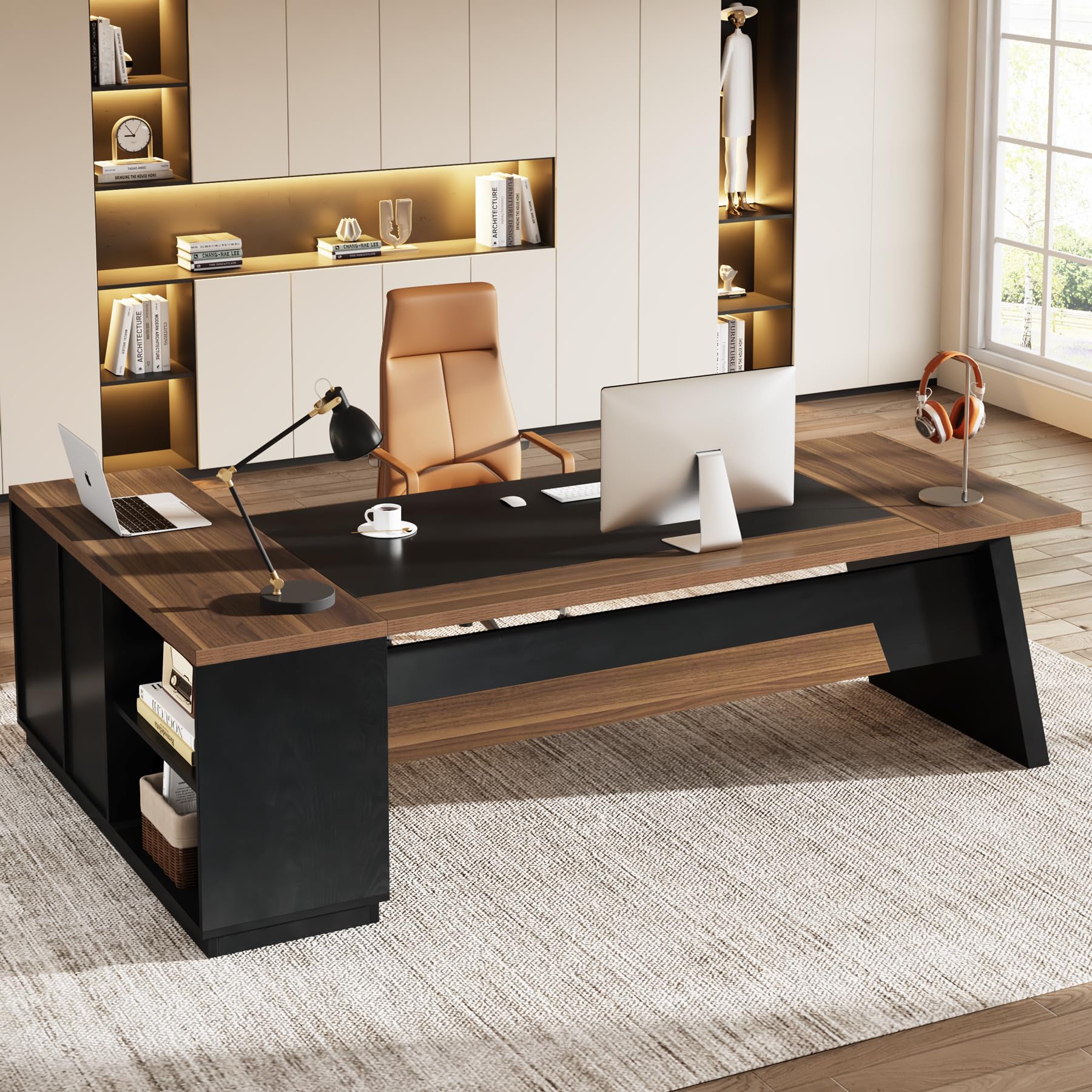
Bottom Line: The one we point most people to: a two-inch top, a file drawer that takes letter and legal folders, and six outlets in a corner layout.
#2

Best with a Rolling File Cabinet

SEDETA 71-Inch Desk with File Cabinet

SEDETA 71-Inch Desk with File Cabinet

8.7/10 Excellent
  • Item Weight: 126 lb
  • Built-in Power: 4 AC outlets and 2 USB ports
  • Drawers And Files: Two drawers plus rolling file cabinet
  • Overall Dimensions: 63"D x 70.9"W x 29.5"H
Check Price on Amazon

Pros

  • Rolling cabinet doubles as a printer stand
  • Six-device charging with a master on/off switch
  • Pegboard, shelves, and CPU stand included
  • 70.9-inch desktop holds several monitors

Cons

  • Heaviest here at 126 pounds, shipped in several boxes
  • Assembly runs to hours with two people

The rolling file cabinet is the reason to pick this one. It measures 31.5 by 15.7 inches, runs on casters, and slides under the return or out into the room — which gives you the thing a big desk usually can't: somewhere to put a printer that isn't the work surface. Wheel it beside your chair to file, push it back when you want the legroom.

The desktop is 70.9 by 31.5 inches in an L, and with the cabinet, the open shelves, the pegboard and its four hooks, and the CPU stand, the whole thing is closer to a small office than a table. We were pleasantly surprised by how much of that is genuinely useful rather than decorative: the pegboard takes a headset and a couple of tools, the shelves hold binders upright, and the outlet block charges six devices with a master switch so nothing trickles overnight.

It's the heaviest desk we're recommending at 126 pounds, shipped across more than one box, so plan the delivery day around a second person. Assembly is the long part. Two people, a few hours, and patience with numbered panels get it done, and the reward is a station where the printer, the files, and the charging all sit within arm's reach while the floor underneath stays clear.

Bottom Line: A desk plus a wheeled file cabinet, wired for six devices: the pick when printing and filing happen at the same station.
#3

Largest Corner Workspace

Tribesigns 78-Inch L-Shaped Desk

Tribesigns 78-Inch L-Shaped Desk

8.6/10 Excellent
  • Load Rating: 300 lb
  • Drawers And Files: Three drawers, one for files
  • Overall Dimensions: 55.11"D x 78.74"W x 29.53"H
  • Tabletop Thickness: 1.18 inches
Check Price on Amazon

Pros

  • Largest work surface in this group
  • File drawer plus four open shelves
  • 300-pound rating on a 1.18-inch top

Cons

  • Two heavy boxes; check panels for shipping damage
  • Long two-person assembly and a big corner required

Seventy-eight inches one way and 55 the other: nothing else in this group puts down this much surface. It reads as an executive suite rather than a home-office desk, and the 1.18-inch top carries a 300-pound rating, so a dual-monitor arm and a printer aren't a question.

Storage is where the extra money goes. Two standard drawers and a file drawer sit in the return, backed by four open shelves, so paper, archive boxes, and cables all have a home off the desktop. The drawers ride on roller glides — ordinary hardware, fine for files, not the soft-close joinery of a furniture-store piece.

On presence and on surface for the money, it sits near the top of this set; the smaller L-shaped desk here only wins if the corner is tight. Two things to plan for. It arrives in two heavy boxes, and the panels are worth unwrapping and checking before you start, because chipped or scratched edges are the problem that shows up against this model. And it takes an afternoon for two people. Build it in the room, on a blanket, and don't tighten anything until the two halves of the top line up.

Bottom Line: The most desk here: a 78-inch L with three drawers including a file drawer, for an office where the desk sets the room.
#4

Best for a Clean, Quick Build

Tribesigns 63-Inch Walnut Desk

Tribesigns 63-Inch Walnut Desk

8.7/10 Excellent
  • Item Weight: 69.5 lb
  • Load Rating: 300 lb
  • Overall Dimensions: 31.5"D x 63"W x 29.53"H
  • Tabletop Thickness: 1.57 inches
Check Price on Amazon

Pros

  • Thick 1.57-inch top with a 300-pound rating
  • Quickest, least fiddly build of the group
  • Stable legs that don't wobble once built

Cons

  • No drawers, so file storage is a separate buy

Flat-pack desks usually arrive as a hundred labeled panels and a bag of cam locks, and the build is the part nobody warns you about properly. This Tribesigns gave us the least trouble of the group: the panels went together square, the hardware bag came with spares, and the steps made sense the first time through. For a one-person build in an afternoon, that counts for more than it sounds.

The top is 1.57 inches of MDF in a walnut finish on a trapezoid leg base, rated to 300 pounds, and at 63 by 31.5 inches it holds two monitors and a laptop with room left for paperwork. Legs are the part that usually lets a desk at this level down; these stay planted. At 69.5 pounds it's a two-person lift out of the box and a one-person build once the panels are upstairs.

The trade is storage: there are no drawers here, so a filing cabinet is a separate purchase, and that's why it costs less than the L-shaped desks that carry the drawer banks. What you get instead is the thickest top in this group and the shortest build. If the same desk has to seat four people for a review meeting, the 63-inch top handles it.

Bottom Line: The simplest build in this group and the thickest top: a 63-inch walnut desk for anyone who'd rather file elsewhere than build a drawer bank.
#5

Small rooms

Bestier 59-Inch Desk with 4 Drawers

Bestier 59-Inch Desk with 4 Drawers

8.2/10 Very Good
  • Load Rating: 200 lb
  • Keyboard Tray: Included
  • Drawers And Files: Four drawers, two for hanging files
  • Overall Dimensions: 21.65"D x 59"W x 30"H
Check Price on Amazon

Pros

  • Two of the four drawers take hanging files
  • 59-inch top fits two monitors side by side
  • Keyboard tray and two cable grommets

Cons

  • 0.63-inch top in three panels, with a center seam
  • 200-pound rating is the lowest in this group

Twenty-two inches of depth is the number that matters here. Most executive desks run 29 to 31 inches deep, and that difference is what lets this Bestier sit against a bedroom wall without eating the floor. It's 59 inches wide, so two monitors fit side by side, and both pedestals carry drawers, which puts the storage under the surface instead of beside it.

We think of it as the desk for someone who wants executive-desk storage in a room that won't take an executive desk. Two of the four drawers are sized for letter, A4, and legal hanging files; the other two take supplies, and two open compartments hold whatever you want within reach. The keyboard tray is a proper tray rather than a shelf, and the twin grommets keep the cables from becoming a nest behind the monitors.

What it isn't is heavy furniture: treat it as a desk rather than a workbench, and assemble it where it will live, because at 98 pounds with four loaded drawers you won't want to drag it across a carpet. For a home office that shares a room with a guest bed, four drawers, a file drawer, and a keyboard tray at this footprint is a trade worth taking.

Bottom Line: Four drawers and a keyboard tray in a footprint that fits a bedroom wall — the pick when the room, not the workload, sets the size.

How We Tested Seven Executive Desks in Real Home Offices

I started with a shortlist of desks that looked the part but did not all cost the same, then filtered by footprint, storage layout, material, and the realistic weight of getting one into a home office. We ruled out anything with vague dimensions or assembly notes that sounded like an afterthought. The final seven arrived flat-packed or in two or three heavy boxes; we noted the condition of every carton and every finished edge before assembly.

Setup happened in a spare room and a corner office, with one person working alone where possible and a second person on call for the lift-and-flip steps. We timed how long each build took, followed the instructions in order, and marked the moments where the diagrams skipped a step or the hardware came up short. Then we lived with each desk for nine months: weekday mornings with a monitor, laptop, lamp, and stacked files; afternoon bill-paying with the keyboard pulled forward; and the ordinary abuse of a chair bumping the legs and a knee knocking a drawer front.

Sturdiness showed up in small tests: leaning a forearm on the front edge while writing, pushing the desk gently side to side, and watching whether the top and legs stayed square after a few weeks. We opened and closed every drawer dozens of times, loaded them with files and office supplies, and noted whether they ran straight, stopped cleanly, or needed a shoulder to close. Appearance and quality were judged up close — how the finish met the edge, whether fingerprints showed, whether seams stayed tight — and we compared that against what each desk asked us to spend. Size and fit came down to whether the desk swallowed a room or left enough clearance for a chair, cables, and a wastebasket.

How to Choose Executive Desks

Measure the corner and the route in

Straight or L is the first fork. A straight desk needs one wall; an L-shaped desk claims a corner and hands back a second surface, but the return is deep — the two L-shapes here run 45 and 55 inches along the short leg, so the corner has to be genuinely empty rather than merely available. Before ordering, walk the delivery route. These desks weigh 69 to 126 pounds and several arrive in two boxes, and a tight stair turn is the usual reason a desk goes back.

Decide what the drawers actually hold

Count your hanging files before you count drawers. Two shallow supply drawers are handy; a file drawer sized for letter, legal, and A4 folders is the difference between a desk and a filing system, and only some of these models have one. Roller glides are the norm in this range and they're fine for folders, but a drawer that isn't sized for hanging files will not become one later. If you keep more than a shelf of archives, buy a desk with a file drawer or budget for a separate cabinet.

Top thickness, load ratings, and finish wear

The tops here run from 0.63 inches to 2 inches, and the difference isn't cosmetic: a thicker top resists flex, takes a monitor-arm clamp without a backer plate, and absorbs the knocks of a working day. A 200 to 300 pound rating describes a static load spread across the surface, not somewhere to sit. Engineered wood with a laminate finish will scratch, and surface wear is the most common long-term complaint about desks at this level — put a mat under the printer and lift rather than drag.

Built-in power and the assembly afternoon

A powered outlet block in the desktop is worth paying for if a laptop, a phone, and a monitor charge at the same station; the switched versions let you kill the draw without unplugging anything. Assembly is the hidden cost on every desk in this group. Anything over 90 pounds is a two-person job, and the desks with the most parts take longest. Sort the hardware into cups, leave every fastener loose until the frame is square, and build it in the room where it will live.

Frequently Asked Questions

Final Verdict

The SEDETA farmhouse L-shaped desk earns the default recommendation: a two-inch top, a file drawer that takes hanging folders, and six outlets in a corner layout that turns dead space into a second surface. If the room can't spare a corner, the Tribesigns 63-inch walnut desk is the strongest straight-run alternative — thicker top, quicker build, and storage you add yourself.

Corner or wall, drawers or clean surface: that's the decision, and either desk ends it well.