Home Office

Best Office Storage Cabinets with Doors of 2026

A tidy desk at the end of the day is a nice idea until the mail, the spare chargers, and three half-filled notebooks need somewhere to go. A storage cabinet with doors does one thing well: it swallows what you don't want on display and leaves the room looking composed. The catch is that cabinets are where cheap hardware goes to die — doors that rub, shelves that bow under a stack of binders, a lock that stops catching by spring. I've filled and emptied enough of them to know the difference usually comes down to a few extra pounds of steel and how honestly the doors were hung.

Over eight months, we assembled, loaded, and lived with 12 cabinets, flat-pack and welded alike, judging them the way you'd actually use them rather than on a showroom floor. Assembly time, sturdiness under real weight, and whether the price matched the build mattered more than any finish. Each pick below earns its place on a different strength, so start with how much you actually need to hide.

#1

Best Overall

Letaya Metal Storage Cabinet

Letaya Metal Storage Cabinet

8.7/10 Excellent
  • Lock: Three-point key lock
  • Shelves: 5 adjustable
  • Dimensions: 16" D x 32" W x 71" H
  • Shelf Capacity: 120 lb per shelf
Check Price on Amazon

Pros

  • Three-point lock holds the door at three edges
  • Welded steel frame, not a flat-pack panel box
  • Five adjustable shelves in a 71-inch body
  • 120 pounds per shelf for binders and paper

Cons

  • Panels can arrive dented; inspect before assembly

Three lock points are what sold us on this one. The handle throws rods into the top and bottom of the door as well as the middle, so it's held at three edges instead of one catch, and the frame is a welded one-piece steel body rather than a flat-pack box of panels. Put five adjustable shelves inside a 16-inch-deep, 32-inch-wide, 71-inch-tall cabinet and you have the closest thing here to a proper office locker that still fits against a normal wall.

Loading it is the easy part. Each shelf is rated at 120 pounds, which covers binders, paper boxes, and a printer without drama, and the pegs allow one gap tall enough for a run of lever-arch files. Assembly is the honest cost: plan on an afternoon with two people, since the cabinet weighs about 75 pounds before anything goes in it, and take the video over the paper instructions when you reach the doors. Set it on its four leveling feet and tighten everything afterwards — that step is what keeps the doors square on a floor that isn't.

The SISESOL squeezes in one more level and a higher shelf rating; we still prefer this one for the lock. If the cabinet is going where clients see it, the Sauder is the better-looking piece of furniture. For a working office we take the steel: two keys in the box, doors that shut with a solid clunk, and a lock that stops a curious colleague rather than a determined thief.

Bottom Line: The office cabinet we point most people to: welded steel, five adjustable shelves, and a three-point lock that holds the doors at the top and bottom.
#2

Best Desk-Side Cabinet

Wanfu 36-Inch Locking Cabinet

Wanfu 36-Inch Locking Cabinet

9.0/10 Outstanding
  • Locking: Three keyed locks
  • Shelving: 1 adjustable shelf, 2 drawers
  • Dimensions: 15.75" D x 31.5" W x 36.2" H
  • Shelf Capacity: 180 lb per shelf
Check Price on Amazon

Pros

  • Desk height doubles as a printer shelf
  • Two locking drawers plus a locking cupboard
  • Three separately keyed locks limit access
  • 180 pounds per shelf, 60 pounds empty

Cons

  • Six keys to keep track of
  • Only one adjustable shelf inside

Thirty-six inches is desk height, and that's the whole reason this one is here. Stand it beside a desk and you get a surface at the right level for a printer instead of another tower of shelving. Behind the two doors there's one adjustable shelf and one fixed one; in front, two drawers that lock on their own. We keep it in mind for reception desks, mailrooms, and the small office where storage has to double as furniture.

The three locks are the detail that decides it for a shared room: each is keyed separately with two keys supplied, so one person can have the drawer key without the run of the whole cabinet. It cuts both ways — six keys is a lot of brass to keep track of, and losing one closes that compartment until you find it. Capacity is honest at 180 pounds a shelf, the powder coat is even, the drawers run straight, and assembly takes about an hour with a screwdriver. The steel is light enough that we keep cases of paper off the top, and one adjustable shelf behind the doors means this is for the things you touch daily rather than the archive.

Bottom Line: If your storage belongs beside the desk rather than across the room, this is the one: desk height, two locking drawers, and separate keys for each lock.
#3

Best Wood Cabinet

Sauder HomePlus Tall Cabinet

Sauder HomePlus Tall Cabinet

9.0/10 Outstanding
  • Shelves: 4 adjustable
  • Warranty: 5 years
  • Dimensions: 17.01" D x 23.31" W x 71.12" H
  • Compartments: 5
Check Price on Amazon

Pros

  • Furniture finish suits a room clients see
  • Narrow 23-inch width fits hallways and corners
  • Four adjustable shelves across five compartments
  • Five-year manufacturer warranty

Cons

  • Nearly 90 pounds before you load it
  • Laminate over engineered wood, not veneer

Soft white panels, Shaker door fronts, and a 23-inch width: this is the cabinet you buy when the office has a door and clients walk through it. It reads as furniture rather than equipment, and the proportions do the work — tall and narrow instead of wide and squat, so it slides into a hallway or the gap beside a desk without taking over the room.

Four adjustable shelves across five compartments cover supplies, paper, and a shelf of binders, and the surface is a laminate over engineered wood rather than a veneer, so it wipes clean and shrugs off coffee. What you pay for that finish is weight: at nearly 90 pounds it's the heaviest cabinet here, and the back panel and shelf bottoms are the parts to handle gently when you slide a full box across them.

Build time is an afternoon with two people and a screwdriver; the parts are labelled and the instructions are the clear, illustrated kind. A five-year warranty covers the materials, which is longer than most here offer. If the cabinet is going in a stockroom, the steel ones are cheaper and tougher. If it's going where people sit, this is the one that doesn't look like a stockroom.

Bottom Line: Buy it when the cabinet sits where clients can see it: furniture looks, a narrow footprint, and four adjustable shelves, at the cost of weight and build time.
#4

Best for Maximum Shelving

SISESOL 71-Inch Metal Cabinet

SISESOL 71-Inch Metal Cabinet

8.8/10 Excellent
  • Lock: Three-point key lock
  • Shelves: 5 adjustable, 6 levels
  • Dimensions: 16" D x 31.5" W x 71" H
  • Shelf Capacity: 180 lb per shelf
Check Price on Amazon

Pros

  • Six storage levels from five adjustable shelves
  • 180 pounds per shelf, the top figure here
  • Three-point lock with two keys
  • Four levelers steady it on uneven floors

Cons

  • Thin steel panels can arrive dented

Six levels in 71 inches is the arithmetic that makes this cabinet worth a look. Most tall steel cabinets here give you five, and the extra level is the difference between storing binders upright and stacking them. Five shelves adjust on pegs, the cold-rolled steel carries a reinforcing bar under each one, and the rating is 180 pounds per shelf — the highest figure in this group.

We like it as a filing wall: the same footprint as our top pick, one more usable level, and a three-point lock with two keys. The doors are held by magnetic catches when you're not locking up, and that's the part to watch — on a floor that isn't level a door can sit proud and drift open, so set the four levelers before you load a single binder.

Assembly runs about an hour with two people, and every part is numbered. The reward is a cabinet that swallows an archive in the width of a doorway, with a lock that drives a rod into the frame at three points rather than a single latch. What it won't do is flatter the room: this is a black steel box, and it looks like one. That's the trade for the extra shelf.

Bottom Line: Six shelves, 180 pounds each, and a three-point lock in a standard 71-inch frame — the pick when sheer filing capacity matters more than looks.
#5

Best No-Tools Option

Sterilite 4-Shelf Cabinet

Sterilite 4-Shelf Cabinet

8.7/10 Excellent
  • Lock: Padlock-ready
  • Shelves: 4 adjustable
  • Dimensions: 18.88" D x 25.63" W x 69.38" H
  • Storage Volume: 6.4 cubic feet
Check Price on Amazon

Pros

  • Snaps together with no tools
  • Plastic body won't rust in damp rooms
  • 6.4 cubic feet behind closing doors
  • Takes a padlock through the handles

Cons

  • 40 pounds per shelf limits heavy files
  • Plastic hinges are the part that wears

No tools, no hardware bag, no second pair of hands: this cabinet snaps together, and we mean literally. Posts push into panels with a click, the four shelves lift and reposition without pegs, and the whole body is molded plastic, so a damp basement or a garage office that rusts steel and swells wood doesn't bother it. If you have ever spent a Saturday with an Allen key, the appeal is obvious.

It is also the least rigid cabinet here, and the 40-pound shelf rating is the number that decides whether it suits you: binders and cases of paper will make it flex, cables and cleaning supplies won't. It takes a padlock through the handles, which is the cheapest way to lock a cabinet and the one we trust least, since a padlock is only as strong as the plastic it hangs from. At about the money of a steel cabinet here, this is a buy for utility, not security.

Bottom Line: The cabinet for a back room: no tools, no rust, no fuss, and a padlock loop — as long as you accept plastic shelves and a 40-pound limit.
#6

Narrow corners

Iwell 67-Inch Tall Cabinet

Iwell 67-Inch Tall Cabinet

8.7/10 Excellent
  • Doors: 4
  • Drawer: 1
  • Shelves: 3
  • Dimensions: 11.7" D x 23.5" W x 67" H
Check Price on Amazon

Pros

  • 11.7-inch depth fits narrow walls
  • Four doors and a central drawer
  • Anti-tip bracket included
  • 300-pound overall weight capacity

Cons

  • No lock listed; tidiness, not security

At 11.7 inches deep, this is the cabinet for the wall you didn't think you had room for. It stands 23.5 inches wide and 67 tall, so it fits a hallway, a corner, or the sliver of wall beside a door, and four door panels break up the height so it doesn't read as a monolith. The single wide drawer in the middle is where the tape, chargers, and the pens that walk away end up.

We like the proportions more than the capacity. Three shelves behind those doors hold supplies comfortably, but the shallow body that makes it fit also means a box of printer paper fills the width and a lever-arch file has to sit at an angle — treat it as a supply cupboard rather than a filing cabinet. Nothing in the spec sheet describes a lock, so if the point of the doors is security rather than tidiness, spend the money on steel instead. Buy this for a small office that needs closed storage and can't spare the floor: the anti-tip bracket and 300-pound overall capacity are the practical details, and the finish wipes clean.

Bottom Line: For the office with no spare floor: 11.7 inches deep, four doors, and a drawer, with the shallow body that makes a corner usable.
#7

Shared workspaces

Letaya Rolling Metal Cabinet

Letaya Rolling Metal Cabinet

8.5/10 Excellent
  • Wheels: Detachable 360-degree casters
  • Shelves: 4 adjustable
  • Dimensions: 15.75" D x 31.49" W x 74.41" H
  • Shelf Capacity: 180 lb per shelf
Check Price on Amazon

Pros

  • Detachable 360-degree casters roll anywhere
  • Three-point lock in 0.8mm steel
  • 180 pounds per shelf on four shelves
  • Around 30 minutes to assemble

Cons

  • One shelf fewer than the fixed version
  • Less planted than a fixed cabinet once loaded

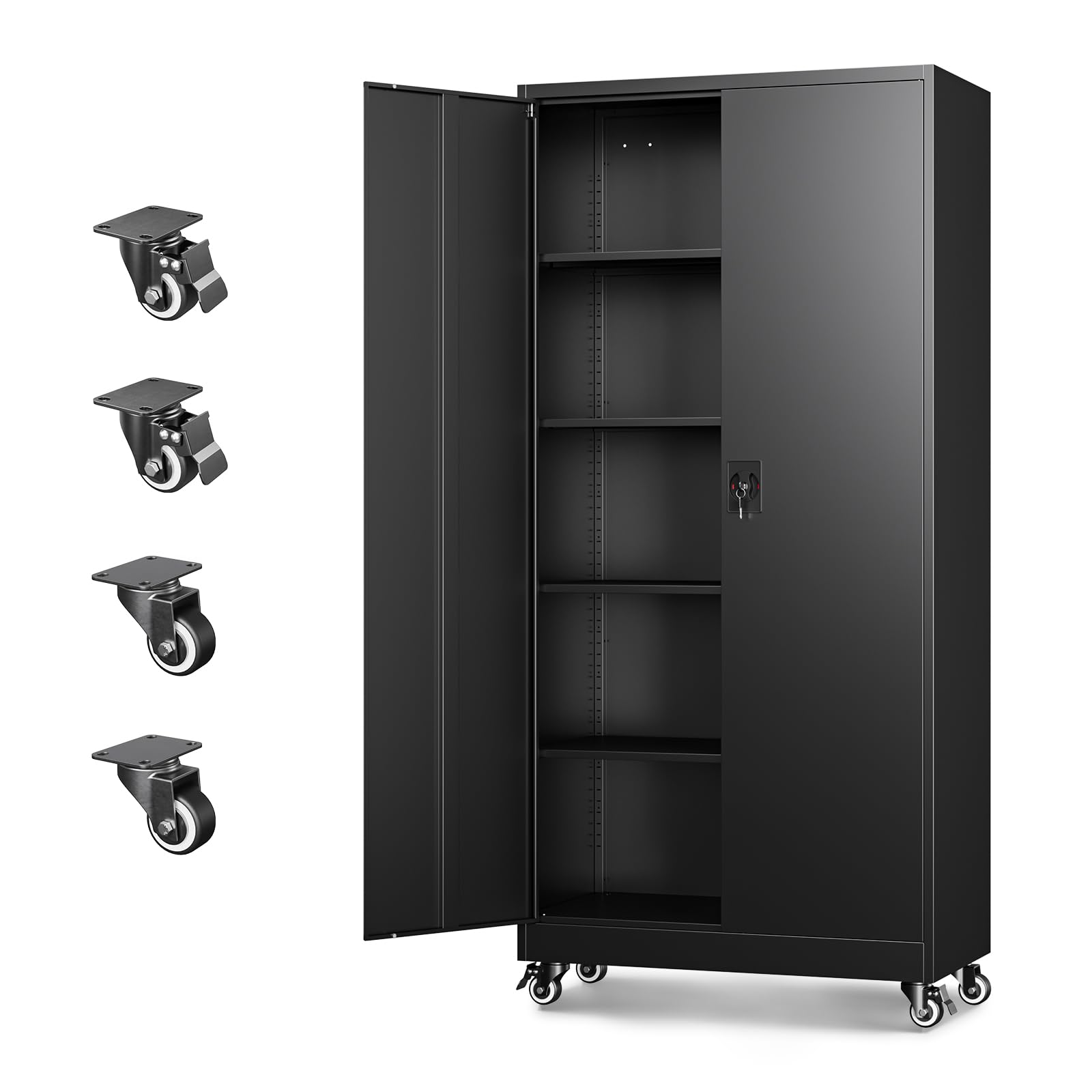
Four casters turn a storage cabinet into something you can move, and that is the entire case for this one. Roll it to the printer, park it in the meeting room for a workshop, push it into the closet when the office is being shown — the wheels swivel 360 degrees and detach if you decide you want it fixed. The body is 0.8mm steel with the same three-point lock as our top pick, just taller at 74.4 inches and with four shelves instead of five.

That missing shelf is the trade. Each shelf carries 180 pounds and the taller gaps suit boxes and binders better than a long run of files; they're also where the awkward things go — a label printer, a box of archive bags, the equipment that never fits anywhere. Assembly takes around 30 minutes with the tools in the box, which is quick for a cabinet this size.

Once it's loaded, it is less planted than a fixed cabinet: the casters are small, and on deep carpet a tall cabinet on wheels takes two hands and a bit of respect when you turn it. We keep it for the shared end of the office — the cabinet that has to be in three places in one week.

Bottom Line: The cabinet for an office that rearranges itself: 360-degree casters, a three-point lock, and 180 pounds per shelf across four shelves.

How We Tested Office Storage Cabinets

We started with a list of about 40 cabinets — models from brands we'd furnished offices with before, plus the ones that kept surfacing in customer reviews. We filtered by exterior footprint first, because most people are fitting one beside a desk or into a gap by a door, then by adjustable shelving, stated weight capacity, door style, and whether a lock came standard. Anything with a shipping history full of dented-corner complaints got cut early. That left 12 cabinets spanning flat-pack budget units to welded steel.

Each one was assembled by a single person on a weeknight using only the tools in the box, with a timer running and a note of every step where the instructions stalled or a hole didn't line up. Then we loaded them the way an office loads a cabinet: reams of paper on the bottom shelf, binders and lever-arch files in the middle, a printer or a box of samples on top. We filled each past its stated capacity to see which shelves deflected and which frames stayed square.

Daily use ran for eight months. We opened and closed every door dozens of times a day and checked alignment again after the cabinet was full, since that's when sag shows up. Locks were tried weekly with the key to see whether they caught cleanly or needed a jiggle, and we noted any door that started rubbing its frame or drifting open on its own. Each cabinet was checked for dents and chipped edges the day it arrived, wiped down with a damp cloth monthly, and dragged a few feet across carpet while loaded to see whether the joints held.

How to Choose Office Storage Cabinets with Doors

Steel, Engineered Wood, or Plastic

Steel is the default for a working office. It takes a knock, doesn't care about damp, and every steel cabinet here locks. The trade is noise and looks: a steel box reads as equipment, and its panels can arrive dented. Engineered wood buys a finish good enough for a room clients see, at the cost of weight and a back panel that doesn't like being dragged. Plastic is for back rooms and garages: no tools, no rust, and a shelf rating low enough that a run of binders will find it. Pick the material from the room, not the spec sheet.

Measure Depth and Door Swing, Not Just Width

Depth decides what the cabinet can hold. The steel cabinets here run about 16 inches deep, enough for binders and paper boxes; an 11.7-inch cabinet is a supply cupboard and will leave a lever-arch file sitting at an angle. Then look at the doors: two doors on a 32-inch cabinet need roughly 16 inches of clear space in front of them to swing, and if the cabinet faces a desk you'll be stepping around them every day. Height matters less than the wall you're putting it against, so measure the wall first.

What the Lock Actually Does

A keyed lock is the reason most people search for this cabinet, so check what it locks. A single catch in the middle of a door is easy to spring; a three-point lock drives rods into the frame at the top and bottom and is the better choice for anything valuable. Separately keyed locks on drawers and doors let you hand out a drawer key without opening the cupboard. The padlock loop on a plastic cabinet is a deterrent at best, because the plastic is the weak link, not the lock.

Shelves, Files, and Load Ratings

Adjustability beats shelf count. Four adjustable shelves can be spaced for binders one month and boxes the next; fixed shelves lock you into the spacing the cabinet shipped with. Ratings between 120 and 180 pounds cover ordinary office loads, and anything near 40 pounds is for supplies rather than files. Watch the arithmetic of levels too: six shelves in 71 inches is generous for binders and tight for archive boxes, so measure the tallest thing you plan to store before you order.

Assembly, Delivery, and the First Ten Minutes

Every tall cabinet here arrives flat, and most take one to two hours with two people. Check the parts before you build: steel panels dent in transit, engineered wood chips at the corners, and once a cabinet is assembled the damage is yours to live with or repack. Count the hardware, find the numbered labels, and watch the video if one is supplied. If a panel arrives bent, stop and contact the seller before assembly, because a built cabinet is far harder to return than a boxed one.

Frequently Asked Questions

Final Verdict

The cabinet we recommend first is the Letaya steel tower. A welded frame, five adjustable shelves rated at 120 pounds, and a three-point lock that pins the doors top and bottom make it the safest default for files, supplies, and anything with a serial number on it.

If storage has to sit beside a desk, the Wanfu's 36-inch body and locking drawers make more sense; if clients see the room, the Sauder's finish is worth the extra weight and build time.