Kids & Nursery

Best Kids Bookcases of 2026

Kid bookcases are supposed to make the nightly story easy, but the wrong one gives a toddler a climbing structure. The trick is a shelf low enough for a 3-year-old to reach, shallow enough that board books don’t disappear into a pocket, and sturdy enough that grabbing one book doesn’t bring the whole thing down. Over six months, we tested 12 kids bookcases in playrooms and bedrooms, from slim front-facing displays to wide cubby units, and the same issues kept surfacing.

Assembly was the first divider: some units went together in 20 minutes with clear hardware, while others left visible screws and a wobble that no amount of tightening fixed. We loaded each shelf with board books, picture books, and a few heavier hardcovers, then watched what happened when a kid yanked one out. Capacity is only useful if the books fit upright and within reach; stability is only proven when someone leans on the bottom shelf. The picks below are the ones worth the money—solid joints, wipeable finishes, and no hardware poking out at eye level.

#1

Best Overall

Humble Crew 4-Tier Kids Bookshelf

Humble Crew 4-Tier Kids Bookshelf

9.2/10 Outstanding
  • Weight: 7 lb
  • Dimensions: 10.6"D x 25"W x 23.5"H
  • Book Display: 4 front-facing fabric tiers
  • Shelf Capacity: 12.6 lb
Check Price on Amazon

Pros

  • Face-out pockets make covers easy to spot
  • Low 23.5-inch height suits toddlers
  • Compact 25-inch width saves floor space
  • Light 7-pound frame is easy to move

Cons

  • Best suited to a nursery-sized collection

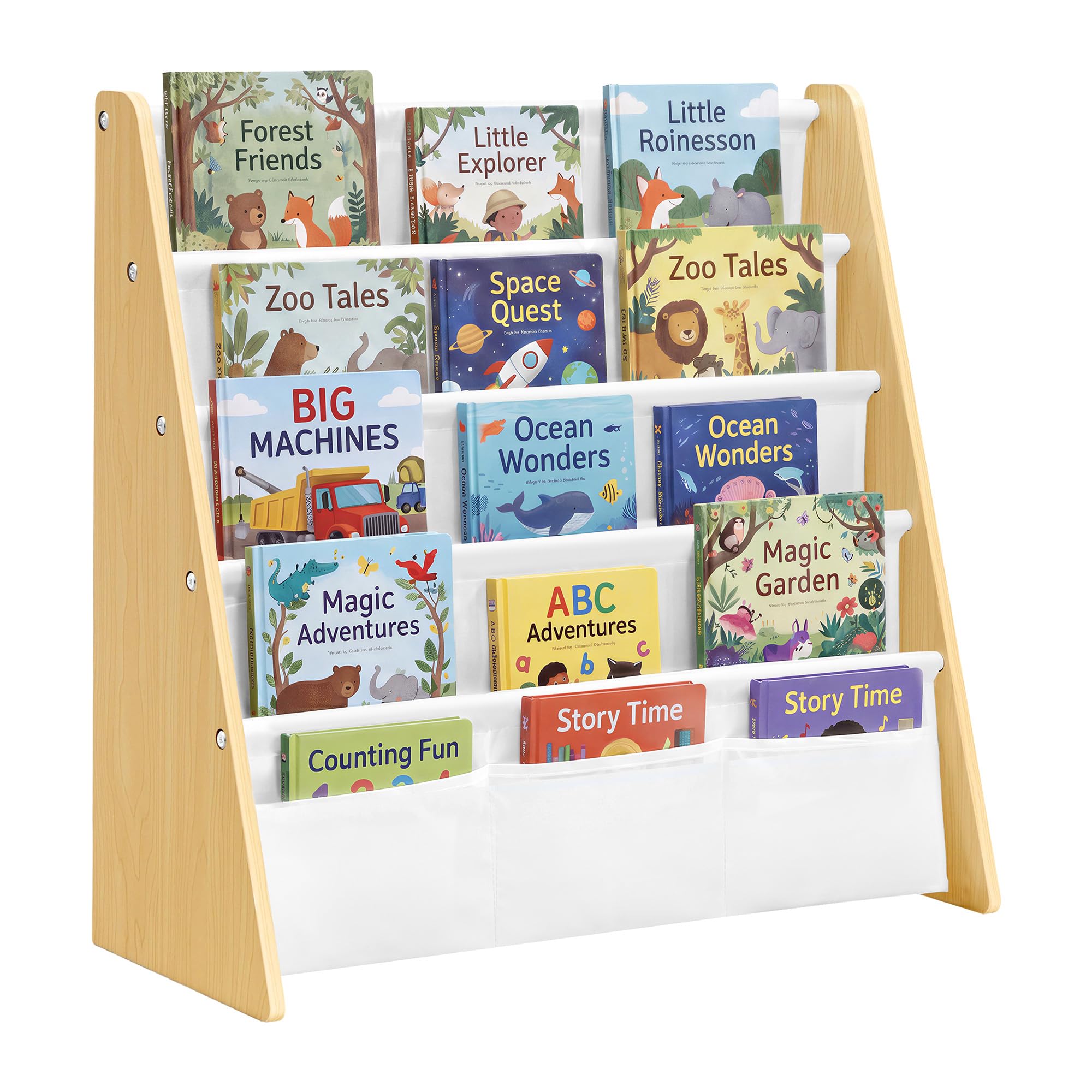
The first thing we noticed about the Humble Crew is how low it sits. At 23.5 inches tall, the top tier is still within reach of a toddler who has just started pulling up, and the four fabric pockets put covers face-out instead of spine-out. That is the whole argument for this shelf: a child can see a book, choose it, and put it back without an adult rearranging a stack. In a small nursery, the 25-inch width makes it feel like a reading corner rather than a wall of storage.

The four tiers take board books, picture books, and a rotating set of favorites, and the 12.6-pound shelf capacity is a useful guide for keeping heavy hardbacks low. The seven-pound frame is light enough to move when the room gets rearranged; anchor it to the wall and it stays put when a toddler leans on it. We kept the heaviest books on the bottom tier and the current favorites at the top, where they are easiest to spot.

Assembly is straightforward, and the low frame makes it easy to hand books to a child who is still sitting. What surprised us is how much the compact size changes the room: it leaves floor space for a rug or a toy basket instead of consuming the whole wall. For a first bookcase, that balance is why it leads this group.

Bottom Line: For most toddlers, this is the bookcase we point to first: the face-out tiers sit low enough for independent browsing, and the compact frame fits a nursery corner.
#2

Best for Older Kids

Delta Children Sling Book Rack

Delta Children Sling Book Rack

9.1/10 Outstanding
  • Storage: 4 fabric sling pockets
  • Dimensions: 11.6"D x 24.25"W x 28"H
  • Frame Material: Wood
  • Recommended Age: 3+
Check Price on Amazon

Pros

  • Deep pockets hold magazines and coloring books
  • Open top makes re-shelving easy
  • Wood frame keeps pockets upright

Cons

  • Deep pockets can hide thin board books

The Delta Sling is built around four deep fabric pockets rather than flat shelves, and that shape tells you what it is good at. A child can slide a magazine, coloring book, or thick picture book into a pocket and pull it back out without disturbing the row. The 28-inch height keeps the top pocket within reach of a preschooler, while the 24.25-inch width leaves room for a chair or a basket beside it.

We like this rack for the in-between years, when board books are giving way to longer stories and project books. The wood frame gives the pockets enough structure to stay open, and the open top means a child does not have to line up a spine to put something away. It is a forgiving piece of furniture, which matters in a room where cleanup happens in a hurry.

Delta recommends it for ages 3 and up, and that feels right. A toddler who still mouths books or pulls up hard on furniture is better served by a lower rack with a wider base. For a five- or six-year-old, though, the sling pockets are a practical way to keep current favorites visible. The best trick is that re-shelving takes one push, not a balancing act.

Bottom Line: This is our pick for older readers: deep fabric pockets hold picture books, magazines, and coloring books at a height a preschooler can reach.
#3

Best Book-and-Toy Storage

HOOBRO Kids Bookshelf with Toy Storage

HOOBRO Kids Bookshelf with Toy Storage

9.2/10 Outstanding
  • Weight: 34.8 lb
  • Storage: 3 open cubbies, 2 tiltable boxes
  • Anti-tip: Device included
  • Dimensions: 11.8"D x 35.4"W x 29.5"H
Check Price on Amazon

Pros

  • Cubbies and tilt boxes separate books and toys
  • Anti-tip device is included
  • Wide top holds books and displays

Cons

  • Heavy at 15.8 kg to move alone

A bookcase that also stores toys usually ends up doing neither job well. The HOOBRO avoids that by giving each task a different shape: three open cubbies across the top and two tilt-out boxes below. The split is obvious to a child, and that is why it works. Books go where they can be seen; small toys go where they can be dropped.

At 35.4 inches wide and 29.5 inches tall, it is broad enough to anchor a playroom wall but low enough for a four-year-old to reach the top cubby. The two tilt-out boxes take stuffed animals, building sets, or the small pieces that otherwise end up underfoot. We appreciate that the anti-tip device is included rather than treated as an optional extra; on a wide floor unit in a child's room, that is not a small detail.

The white engineered-wood finish wipes clean, and assembly is manageable with the labeled parts and included tools. We found the open cubbies best for books and baskets, not for a jumble of loose toys. A couple of fabric bins hide the mess without making the shelf harder for a child to use. The result is a playroom piece that still reads as a bookcase.

Bottom Line: When books share space with toys, the HOOBRO earns its place: three cubbies and two tilt-out boxes make cleanup one motion, with an anti-tip strap included.
#4

Best Natural Wood Look

SpaceAid Scalloped 3-Tier Bookshelf

SpaceAid Scalloped 3-Tier Bookshelf

9.0/10 Outstanding
  • Weight: 16.6 lb
  • Material: Wood
  • Dimensions: 10.7"D x 29.6"W x 27.6"H
  • Shelf Style: 3 scalloped front-facing tiers
Check Price on Amazon

Pros

  • Scalloped wood frame looks like furniture
  • Three face-out tiers at toddler height
  • Natural finish suits calm nurseries

Cons

  • Some units arrive with cracked or splintered panels

Scalloped side panels, a natural finish, and three tiers define the SpaceAid. The shape is softer than the cubby units, and at 27.6 inches tall it sits at a toddler's level. In a nursery where the bookcase is visible from the doorway, that matters more than another inch of capacity.

What makes it worth choosing over a cheaper sling rack is the wood. The frame feels like furniture, the rounded edges are gentle on small hands, and the three face-out tiers keep covers visible without turning the wall into a rainbow of plastic. We think it earns its place when the room has a calm, natural palette and you want the bookcase to belong to it.

It holds a useful nursery library, but not an entire childhood of books, and the 29.6-inch width needs a real wall segment. Assembly is straightforward, and the wood feels substantial in the hand. In the right room, the scalloped profile is the detail you notice every day, not just on delivery day.

Bottom Line: This is the one we choose when the bookcase has to look good in a nursery: scalloped wood edges, three face-out tiers, and a calm natural finish.
#5

Best Statement Piece

Delta Children Tree Bookcase

Delta Children Tree Bookcase

9.0/10 Outstanding
  • Weight: 41.8 lb
  • Shelves: 5
  • Dimensions: 13.25"D x 44"W x 49.75"H
  • Certification: GREENGUARD Gold
Check Price on Amazon

Pros

  • Five varied shelves hold books and keepsakes
  • GREENGUARD Gold certified
  • Sturdy build with tipover restraint

Cons

  • Premium price for a child's room

The Delta Tree does not look like storage, which is the point. The tree silhouette gives it five shelves of different sizes, so picture books, keepsakes, and a few small toys can share the frame without looking like a cubby unit. In a woodland or garden-themed nursery, it does half the decorating before a single book is placed.

At 44 inches wide and 49.75 inches tall, it is a substantial piece. The 41.8-pound weight and wall-mount design mean you should plan for two people and a stud finder rather than a quick solo assembly. The payoff is a bookcase that feels built into the room, with deep shelves that hold more than the tree shape suggests.

We think it earns its footprint when the bookcase is meant to be a long-term anchor, not a temporary nursery fix. GREENGUARD Gold certification is the detail that matters most for a child's room: it speaks to chemical emissions in a way that a pretty finish does not. The varied shelf sizes are also genuinely useful, not just decorative.

It leaves fewer low, face-out spots than a sling rack, so it suits a child who already handles books rather than a baby learning to choose one. That is the trade-off: a statement piece first, a toddler browsing rack second. If you want both, put a low basket of board books beside it and keep the tree for picture books and treasures.

Bottom Line: For a themed nursery that needs a focal point, the Delta Tree delivers: five varied shelves, GREENGUARD Gold certification, and a build that feels meant to stay.
#6

Best Wide Playroom Unit

B1 Kids Bookshelf & Toy Storage

B1 Kids Bookshelf & Toy Storage

9.3/10 Outstanding
  • Weight: 17.2 lb
  • Storage: 3 wood shelves, 3 sling pockets
  • Anti-tip: 2 straps included
  • Dimensions: 11.8"D x 48.9"W x 29.5"H
Check Price on Amazon

Pros

  • Three shelf types in one unit
  • Two anti-tip straps included
  • Low 29.5-inch height keeps books reachable

Cons

  • Needs almost 49 inches of clear wall

At 48.9 inches wide, the B1 solves a different problem from the compact racks: it gives a shared playroom one long wall of storage instead of three small pieces. The top is three wood shelves, the middle is three Oxford sling pockets, and the base has room for stuffed animals or bins. It looks more like a system than a bookcase, which is the point.

The 29.5-inch height keeps books reachable for a child who is past the pulling-up stage. We like that the wood shelves can take baskets or stacked puzzles, while the sling pockets give coloring books a home that is not the floor. Two anti-tipping straps are included, and the metal frame with particleboard shelves feels more rigid than its 17.2-pound weight suggests. The leveling feet are a small but welcome detail on an uneven playroom floor.

Assembly is manageable, though the long span means you need clear floor space while you work. The payoff is a single cleanup zone: books on top, thin activity books in the slings, soft toys below. In a room where three separate organizers would crowd the walls, that consolidation is the real advantage.

Where the B1 makes the most sense is a playroom shared by more than one child, or a room that has to absorb both reading and toy storage without looking like a daycare. It is not a bedroom heirloom, but it is a practical, good-looking workhorse. The sling row is the part we miss most when we go back to a plain shelf.

Bottom Line: For a shared playroom wall, the B1 gives you shelves, sling pockets, and stuffed-animal space in one long, low unit.
#7

Best Wall-Mounted

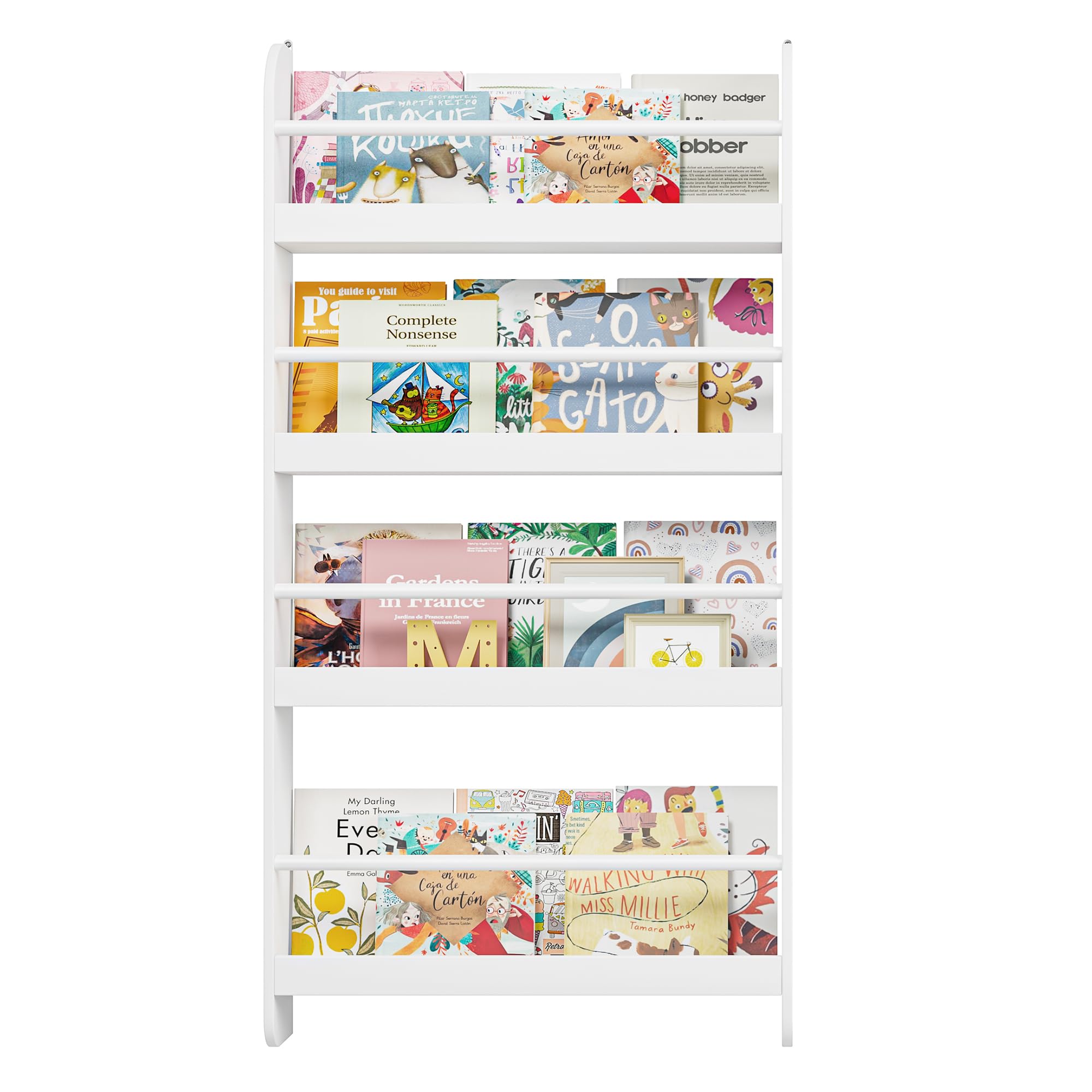
FOTOSOK Wall-Mount Kids Bookshelf

FOTOSOK Wall-Mount Kids Bookshelf

9.0/10 Outstanding
  • Mounting: Wall mount
  • Dimensions: 4.72"D x 22.4"W x 43.9"H
  • Book Capacity: Up to 30 kids' books
  • Weight Capacity: 34.2 lb
Check Price on Amazon

Pros

  • Only 4.72 inches deep
  • Four tiers at 43.9 inches high
  • Four anti-tip anchors included

Cons

  • Visible screws on the sides
  • Some panels arrive chipped

When the floor is already spoken for, the FOTOSOK changes the arithmetic. It mounts to the wall, projects only 4.72 inches, and stacks four tiers up to 43.9 inches high. In a small nursery, that can be the difference between a bookcase and no bookcase.

The 22.4-inch width gives you a narrow column of storage rather than a wall-wide unit. We like that for a reading nook carved out of a closet or a slim strip beside a door. Four anti-tip anchors are included, and because this one is wall-mounted, getting those anchors into studs matters more than the finish. The white engineered-wood frame is best suited to a tidy row of books, not a child hanging on the shelves.

What the FOTOSOK buys you is floor space, and it buys a lot of it. The trade-off is a more utilitarian look and a shallower shelf that needs books arranged with some care. We think it makes the most sense in a nursery or a small apartment, where the bookcase has to work around the room rather than dominate it. It is not the piece for a child who wants furniture to climb.

Bottom Line: The FOTOSOK is our wall-mounted answer for small rooms: it keeps books off the floor without consuming the floor space a freestanding shelf needs.
#8

Slim budget corners

SONGMICS 4-Tier Toddler Bookcase

SONGMICS 4-Tier Toddler Bookcase

8.8/10 Excellent
  • Weight: 4.85 lb
  • Dimensions: 24.6 x 9.8 x 23.6 inches
  • Shelf Style: 4 fabric sling tiers
  • Weight Capacity: 44.1 lb
Check Price on Amazon

Pros

  • Very light 2.2 kg frame
  • Four sling tiers hold picture books
  • Compact footprint for tight corners

Cons

  • Best suited to picture books, not heavy hardbacks

The SONGMICS is almost aggressively slim: four fabric slings, a steel and MDF frame, and a 2.2-kilogram body that one adult can move with a knee. That is the appeal. It slips into the gap beside a bed or the end of a hallway and turns a few feet of wall into a browsing station.

The listed 20-kilogram weight capacity is generous for a nursery library, and the slings hold picture books and thin activity books without complaint. The 24.6 x 9.8 x 23.6-inch frame keeps the whole thing low and out of the way. We found it happiest when the books were arranged loosely rather than crammed into every pocket.

Stability is the part to manage. The light frame can feel mobile when a child pulls a book out, so use the wall anchor and keep the heaviest titles on the bottom tier. Once tied in, it feels calmer under a full load. Assembly is quick, and the beech-and-white finish is neutral enough to disappear into a hallway or a corner.

For a first reading corner, a rental, or a grandparent's house, the low commitment is the point. It does not pretend to be heirloom furniture, but it puts covers at a child's eye level and costs very little floor space. If you need a bookcase that can survive being climbed on, look at the wood picks instead.

Bottom Line: For a tight reading corner on a small budget, the SONGMICS is easy to live with: four sling tiers, a very light frame, and a narrow footprint.
#9

Low display corners

ZICOTO Montessori Bookshelf

ZICOTO Montessori Bookshelf

9.0/10 Outstanding
  • Material: Wood and polyester fabric
  • Shelf Style: 3-tier display
  • Book Capacity: Up to 20 books
  • Weight Capacity: 20 lb
Check Price on Amazon

Pros

  • Low three-tier display suits toddlers
  • Holds up to 20 books
  • Sage finish works outside a playroom

Cons

  • Deep pockets can hide thin board books

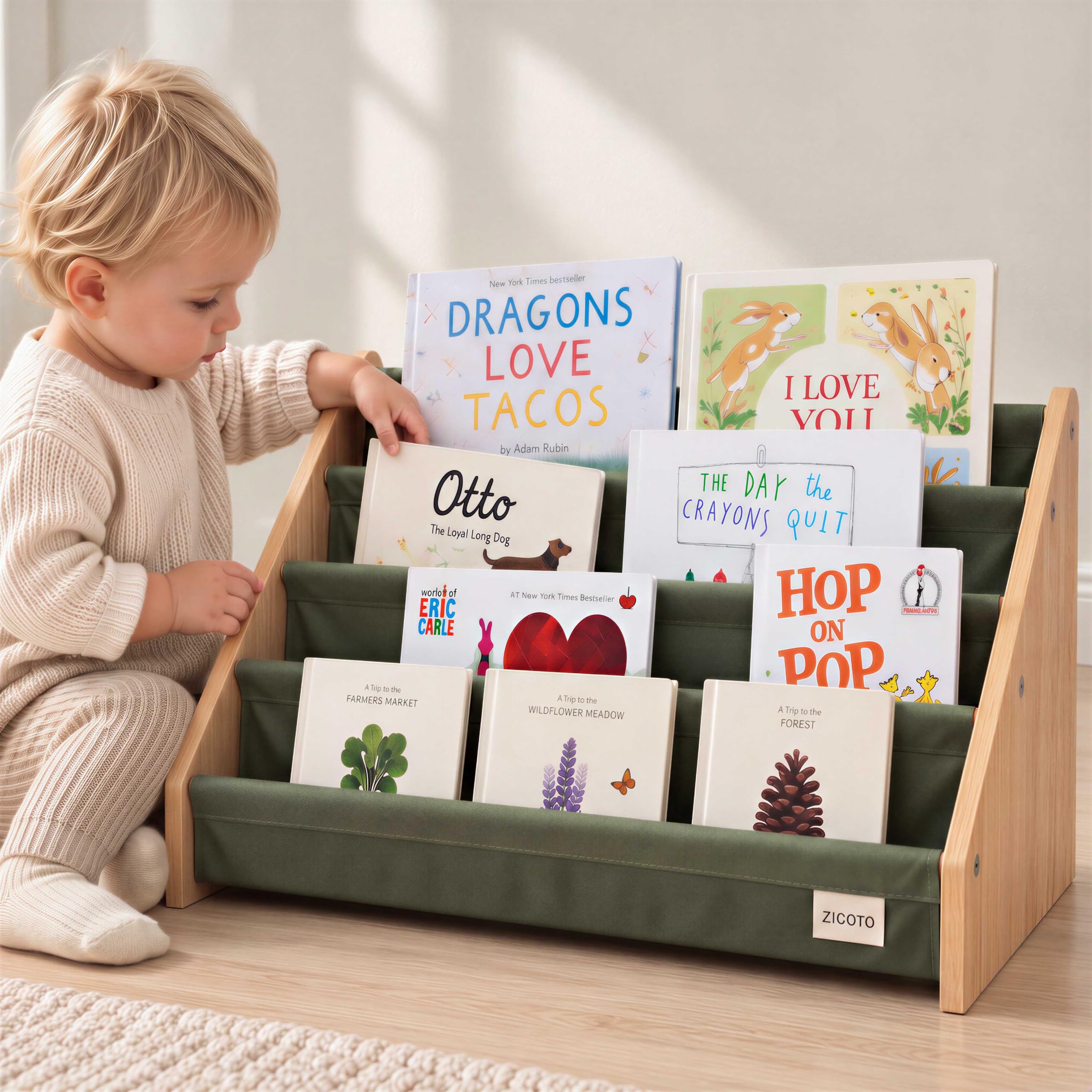
The ZICOTO is a small piece of furniture with a clear point of view. The sage finish, three low tiers, and fabric-fronted pockets are meant to sit in a reading corner, not disappear into a playroom. We like that it treats a child's books as something worth displaying.

The low height puts the top row within reach of a toddler, and the frame is sturdy enough that a child can pull a book without the whole thing walking across the floor. It holds up to 20 books, which is a curated shelf rather than a full library. In a small bedroom, that limit is also a useful editing tool.

The fabric front keeps covers visible and softens the look, and the 20-pound weight capacity is more than enough for a row of picture books. The sage color is the other reason to choose it: it looks at home in a grown-up room, not just a playroom.

Assembly is quick, and the frame feels solid once the bolts are tightened. It is not a piece you will hand down, but it is sturdier than its light frame suggests. The low profile also means it can sit under a window or beside a reading chair without blocking the room.

The ZICOTO is at its best when you want a deliberate, small display rather than maximal storage. Rotate a selection of books every week or two, keep the overflow in a basket, and the shelf stays inviting instead of crammed. It is the sort of piece that makes a corner feel intentional, which is more than the other budget racks here can claim.

Bottom Line: For a low Montessori-style corner, the ZICOTO is the charming choice: a small curated display within a toddler's reach and a soft sage finish.

How We Tested Kids Bookcases

We started by pulling together a shortlist of 12 kids bookcases that spanned the common formats—low front-facing displays, taller cubby shelves, and combination units—and filtered out anything with vague weight limits, no tip-restraint hardware, or a footprint that wouldn’t fit a typical bedroom wall. Then we built each one on a living room floor, timing assembly solo and noting whether the instructions matched the hardware bag; we also checked whether screw heads ended up hidden or left in plain sight on the finished piece.

For six months, the bookcases lived in real playrooms and bedrooms, not a showroom. We loaded them with the same starter set of board books, picture books, and a few heavy hardcovers, then measured how much stayed reachable for a seated 3-year-old and whether front-facing pockets held covers upright or let them slump. Every few weeks we wiped the shelves with a damp cloth, checked corners and edges for swelling or chipping, and gave each unit a firm shake and a weighted-bottom-shelf lean to see if it shifted without the wall anchor.

We also paid attention to the small stuff that decides value: whether the shelf height left room for a lamp or bin, how deep the pockets were compared with the books we owned, and whether the finish still looked decent after a few months of daily use. The final picks are the ones that stayed stable, kept books accessible, and didn’t make us regret the assembly time.

How to Choose Kids Bookcases

Start With How Your Child Browses

Front-facing pockets turn covers into prompts. A toddler is more likely to choose a book they can see, and a low rack lets them put it back without help. Traditional shelves store more in less width, but they ask a child to read spines. We prioritize face-out tiers for ages one to five, then switch to a deeper shelf or a sling rack that can take magazines once the child is older. The trap is buying a tall, handsome shelf that only an adult can reach; the child who is meant to use it should be able to touch the books.

Measure the Wall, the Floor, and the Child

Width decides where a bookcase fits; depth decides how much floor it takes; height decides whether the child can use it. Mark the footprint with painter's tape before ordering and check the path through the door. A 25-inch rack can slip into a nursery corner, while a 48.9-inch playroom unit needs a long clear wall. A wall-mounted shelf may project only 4.72 inches, which is a different kind of space saving. Measure the lowest shelf your child can reach, not the top of the tallest book you own.

Decide Whether Toys Share the Unit

A pure bookcase keeps books visible; a cubby-and-bin system absorbs toys but can bury books behind baskets. If books are the main event, reserve the top row for face-out display and keep bins low. If toys dominate, choose a unit with a mix of open cubbies and tilt-out boxes, as the HOOBRO does, so each item has an obvious home. We think a hybrid works best when the book section is still at child height, not pushed onto the highest shelf.

Check Stability and Anchoring First

Any floor bookcase in a child's room should be anchored to the wall with the supplied strap or an appropriate anchor. A wall-mounted design shifts that load to the wall, so the mounting hardware and stud placement matter more than the paint finish. We also look for a low center of gravity and a base that does not skate on carpet. If the unit wobbles before it is loaded, fix that before adding books; a full shelf is heavier and more tempting to lean on.

Plan for Assembly, Cleaning, and Smell

Flat-pack assembly is normal in this category. Clear instructions and labeled hardware matter more than saving a few minutes. Fabric pockets collect dust and crumbs, so vacuum them regularly; engineered wood needs a dry or barely damp cloth rather than a soaking. If a chemical or paint smell lingers after unboxing, air the piece in a garage or well-ventilated room before moving it into a child's bedroom. A persistent odor is a reason to contact the seller rather than mask it.

Frequently Asked Questions

Final Verdict

The Humble Crew is the bookcase we put in front of most families first because it does the toddler job cleanly: covers at eye level, a low frame, and a footprint that leaves the room usable. If you want a wood piece that looks at home in a nursery, the SpaceAid is the upgrade; if toys are the bigger problem, the HOOBRO is the better shape. Start with the job your room actually has, not the largest shelf you can fit.