Kids & Nursery

Best Kids Storage Trunks of 2026

A good kids storage trunk is supposed to make the toy avalanche disappear, not become another thing to trip over. But the wrong one can be a pinch hazard, a nightmare to assemble, or so flimsy the lid warps by month two. I wanted to know which trunks actually hold up to daily abuse—and which just look good in the photos. So we rounded up 12 trunks in a range of sizes and spent eight months living with them in playrooms, bedrooms, and living rooms. The ones that earned a spot solved the mess without creating a new problem.

Assembly ranged from ten minutes to an entire frustrating afternoon, and the difference often came down to whether the holes were pre-drilled—and whether the price matched the effort. When kids climbed on lids or slammed them shut, we watched for pinched fingers and wobbly hinges. The best trunks did double duty as a bench, a nightstand, or a hiding spot—and still looked good enough to leave out. Below are the ones we'd buy again.

#1

Best Overall

VASAGLE Storage Chest Bench

VASAGLE Storage Chest Bench

9.1/10 Outstanding
  • Lid: Two safety hinges
  • Size: 15.7 x 39.4 x 18.3 in
  • Material: Particleboard
  • Weight Limit: 300 lb
Check Price on Amazon

Pros

  • Lid holds at any angle, never slams
  • 300-pound top doubles as a bench
  • 39.4 inches wide, so long toys lie flat
  • Straightforward assembly, parts line up

Cons

  • Roughly 38 pounds

We sat on this chest before we put anything in it, because that's what a storage bench is for in a playroom. The VASAGLE took the weight without a creak, and its two support hinges catch the lid at whatever angle you leave it — open it halfway, let go, and it stays exactly there. That behavior is why it's our top pick: a chest a child opens all day has to protect the fingers doing the opening, and this one never came down on anyone.

What we appreciate most is how much disappears into it. The compartment runs the full 39.4 inches, so a folded ride-on or a stack of picture books lies flat instead of being wedged in at an angle, and the lid shuts over a full load of stuffed animals without a knee on it. In a room that has to be tidy by dinner, that single motion is worth more than any divider system.

Assembly is one of the easier builds here: labeled parts, hardware bagged by step, no special tools, and a lid that was square on the first try. You do want a second person at the end to tip it upright, and the finish is particleboard, so keep it out of a damp room and put a coaster under drinks.

Bottom Line: We recommend it to almost everyone: a 300-pound bench that hides a room's worth of toys and has the best lid hardware in this set.
#2

Best Value Wooden Chest

Amazon Basics Wooden Toy Chest

Amazon Basics Wooden Toy Chest

8.7/10 Excellent
  • Lid: Slow-close safety hinge
  • Size: 30 x 18 x 19 in
  • Material: Wood
  • Weight Limit: 50 lb
Check Price on Amazon

Pros

  • Slow-close safety hinge children can work
  • Real wood at the low end of the range
  • Small footprint for a nursery corner

Cons

  • 50-pound limit means kids only, not adults
  • Hinge is the part that fails when one does

If a fabric bin would look wrong in the room but the big wooden chests make you wince, this is the one. It's 30 inches wide, 18 deep, and 19 tall — a proper piece of furniture for a child's room, finished in a solid pink, with a slow-closing safety hinge instead of a loose board. For the build you get, nothing else wooden here comes close on value.

The lid is the part we kept testing. It holds at whatever angle you leave it, so it doesn't drop on a toddler's head mid-rummage, and it swings up quickly once it's about three-quarters open — leave a hand's width behind it and you won't dent the wall. Kids can work it themselves, which is the whole point of a chest low enough to reach into.

Capacity is the honest limit: it takes a toddler's cars and animals comfortably, and a seven-year-old's Lego habit will outgrow it within a year. Assembly runs well under an hour with a screwdriver, and the predrilled holes reward a light touch — tighten until the wood just grips, because these panels will split if you lean on the driver.

Bottom Line: Our pick if you want real wood without a premium tag — a slow-close lid, a small footprint, and room for one child's toys.
#3

Best Soft-Sided Bin

SoftOwl Extra Large Toy Storage

SoftOwl Extra Large Toy Storage

8.8/10 Excellent
  • Size: 37 x 14 x 16 in
  • Closure: Hook-and-loop lid
  • Capacity: 4.8 cubic feet
  • Compartments: 3
Check Price on Amazon

Pros

  • Three sections keep types of toy apart
  • 37 inches wide and only eight pounds
  • Folds flat between uses

Cons

  • Lid comes in three separate panels
  • Sides bow when it's packed full

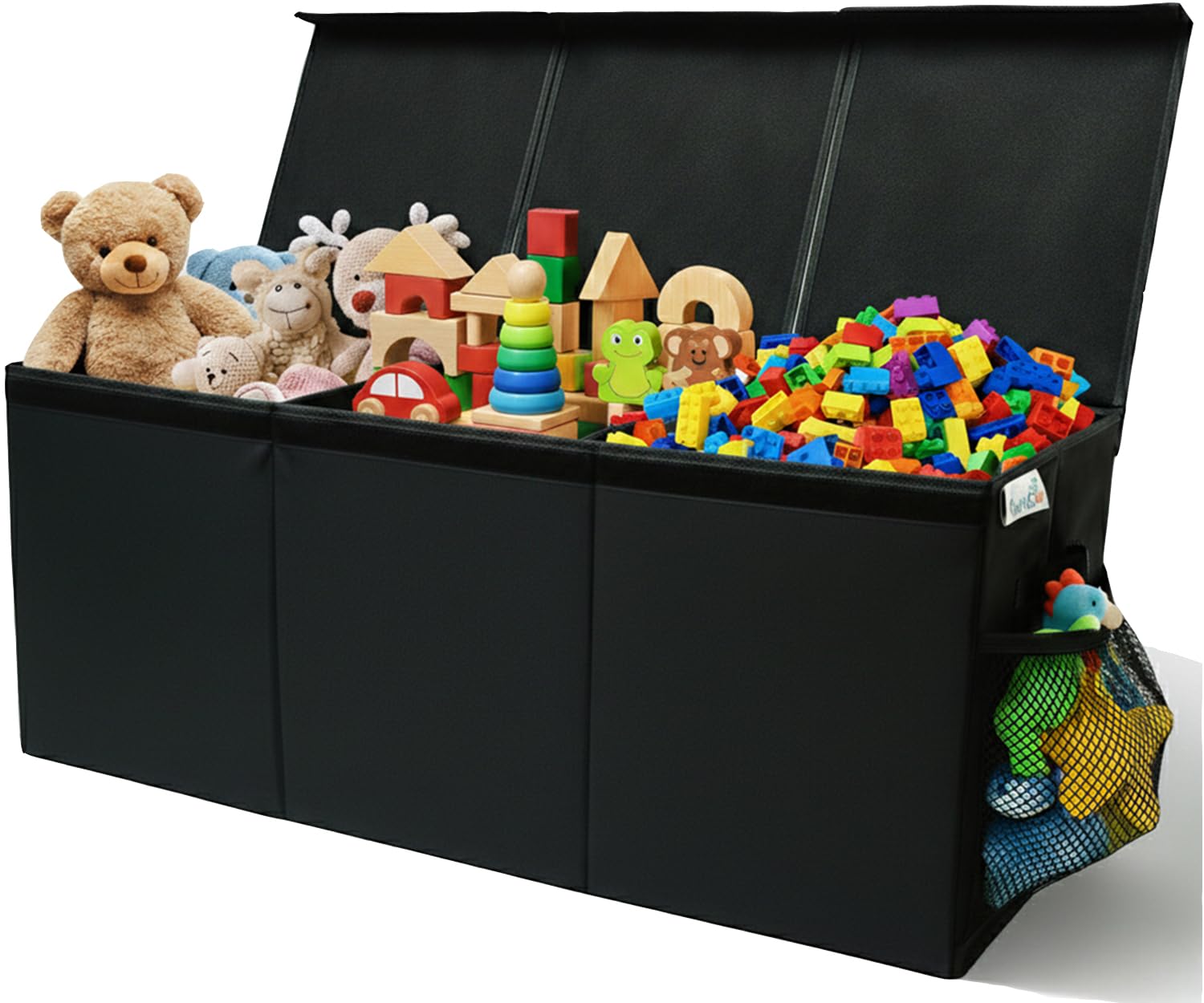
Two velcro dividers turn the SoftOwl into three bins under one lid, which is the closest thing to a sorting system we've used that a child can actually keep up with. Cars in one section, animals in another, and whatever doesn't belong in either gets shoved into the third.

At 37 inches long and 14 deep it slides along a playroom wall or under a window without eating floor space, and the interior runs to 4.8 cubic feet. The mesh pockets on the ends take the small loose stuff that otherwise migrates to the bottom. At under eight pounds we carried it up a flight of stairs one-handed, and when the toys move on it folds flat to the depth of a board.

The lid is the annoyance: three separate panels that velcro down, so opening it is a two-hand job and one panel is always on the floor. We still recommend it for a shared playroom, where the width and the three sections earn their keep — and where the lid spends most of the day off anyway.

Bottom Line: Three sections and 37 inches of soft-sided storage that folds flat when the toys move on — the most flexible option we tested.
#4

Best for Toddlers

Delta Children MySize Toy Box

Delta Children MySize Toy Box

8.8/10 Excellent
  • Lid: Slow-close safety hinge
  • Size: 23.5 x 14.25 x 21 in
  • Capacity: 2.05 cubic feet
  • Material: Wood
Check Price on Amazon

Pros

  • Slow-closing hinge a toddler can work alone
  • 21 inches tall
  • Wooden build at a budget price

Cons

  • Lid doesn't always sit flush with the base

Two cubic feet. Everything about the Delta MySize follows from that number. It's 23.5 inches wide and 21 inches tall, small enough to tuck beside a cot and low enough that a 20-month-old can reach the bottom without climbing. For a nursery holding one small child's things, that's exactly the right size — and it's among the cheapest wooden chests here.

The lid is the reason to choose it over a plastic tub. It runs on a slow-closing safety hinge, so it eases down rather than dropping, and it stops short of swinging all the way back against the wall. In a room where a toddler pulls up on everything, a lid that can't slam is worth more than another cubic foot.

Plan for the smell. Out of the box it carries a chemical odor, and wiping the inside doesn't do much — time does. Give it a few days in a garage or on a porch before it goes into a bedroom, and send it back if the smell hasn't faded inside a week. Past four years old, the toys outgrow this box long before the child does.

Bottom Line: The right first toy box for a nursery: low, slow-closing, and inexpensive enough to replace when your child outgrows it.
#5

Most Capacity

Mabahoo Extra Large Toy Box

Mabahoo Extra Large Toy Box

8.8/10 Excellent
  • Closure: Hook-and-loop lid
  • Capacity: 150 liters
  • Material: Oxford fabric
  • Compartments: 2
Check Price on Amazon

Pros

  • 150 liters for the lowest outlay here
  • Two removable dividers make three zones
  • Folds flat in about a minute

Cons

  • Long sides bow once it's full
  • Velcro lid and dividers lose grip

A hundred and fifty liters is worth translating: this bin is 40 inches long, and it will take a full laundry basket of stuffed animals with the lid sitting flat. It's the biggest soft-sided option on this page and the most capacity you can buy here for the least money.

What we like is that the size doesn't cost you organization — two removable dividers split the interior into three zones, so a shared playroom gets a car end and a doll end without buying anything else. Flat-folding it takes about a minute, and the dinosaur print landed better with the under-fives in our test group than any of the plain grey bins did.

The catch is structure. This is fabric over thin boards, not furniture, and the price of all that volume is a container that behaves like a bag once it's carrying anything heavy.

Bottom Line: Buy it for volume: 150 liters, real dividers, and the lowest outlay here for containing a mountain of soft toys.
#6

Long-term storage

Melissa & Doug Wooden Toy Chest

Melissa & Doug Wooden Toy Chest

9.1/10 Outstanding
  • Lid: Safety-hinged
  • Size: 32.75 x 19 x 24 in
  • Capacity: 8.25 cubic feet
  • Weight Limit: 81 lb
Check Price on Amazon

Pros

  • 8.25 cubic feet takes a whole collection
  • Safety hinge holds the lid open
  • Weight tested to 81 pounds

Cons

  • 29 pounds of wood, awkward to move alone
  • Premium outlay for the capacity

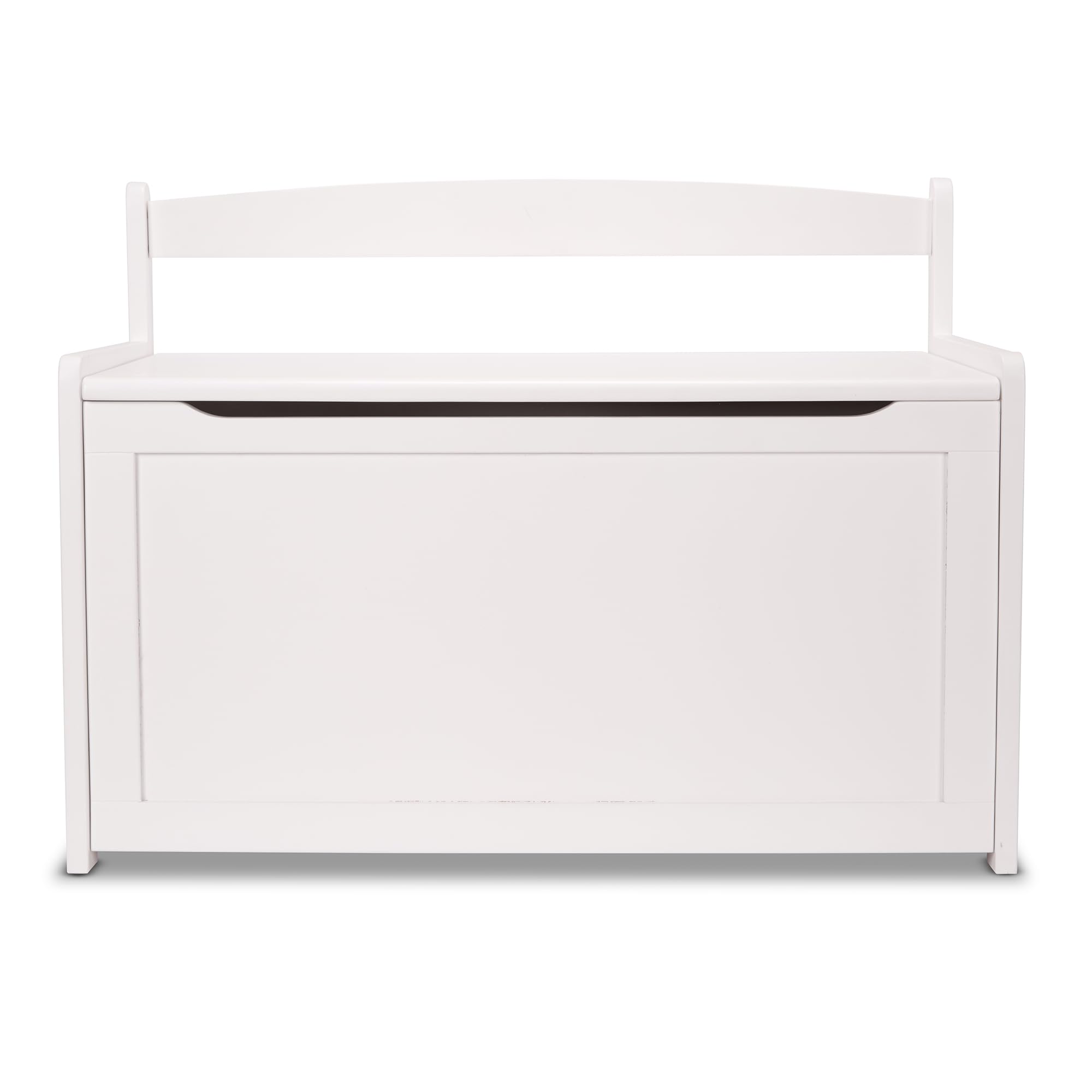
Where the VASAGLE is a bench that stores toys, this is a toy chest that happens to be furniture. It's 32.75 inches wide, 24 tall, and its 8.25 cubic feet will take an entire collection — the box you buy when the bins have stopped keeping up.

The safety hinge is properly done: the lid holds wherever you leave it, eases down from the top instead of falling, and the chest is weight tested to 81 pounds so a child can sit on it to read. The white finish is clean and looks like it came from a furniture shop rather than a toy aisle.

Assembly is where it earns its mixed reputation. The instructions and the hinge are straightforward, but the wood is where it can go wrong: panels can split around the screws, especially near the hinge supports, and a split there is a lid that never sits right. Drive by hand, don't over-tighten, and check every panel for cracks before you join anything.

For a chest you plan to keep through primary school, the capacity and the hinge justify the premium — provided the panels go together cleanly. If that gamble doesn't appeal, the Amazon Basics chest does the same job in a much smaller footprint for a fraction of the outlay.

Bottom Line: The chest to buy if you want one wooden box to last through primary school, with the hinge safety and capacity to justify it.
#7

Entryways and small rooms

HOOBRO Storage Bench Toy Box

HOOBRO Storage Bench Toy Box

9.1/10 Outstanding
  • Lid: Safety hinge
  • Size: 29.9 x 15.7 x 18.9 in
  • Material: Engineered wood
  • Weight Limit: 220 lb
Check Price on Amazon

Pros

  • Narrow 29.9-inch footprint fits tight spaces
  • Convincing wood-look finish
  • Safety hinge holds the lid open

Cons

  • Hinges and side handles are the wear points

Greige panels, a retro front, and a top that opens on a hinge: in a hallway this reads as a bench that happens to hold toys, which is the point. Of the wood-look chests here it has the most convincing finish — nothing about it announces children's furniture to a visitor at the front door.

At 29.9 inches wide and 18.9 tall it fits where a 39-inch bench won't: a narrow entry, the end of a bed, the gap beside a wardrobe. The top carries an adult's weight, so you can sit down to pull boots off, and the safety hinge holds the lid up while you dig around inside.

The inside is one open box — no dividers, no tray — so small pieces sink to the bottom and get excavated once a week. Assembly is the usual particleboard routine of cams and dowels, but it went together without drama for us and the parts were all present.

For a bench that's opened a few times a day, the look and the narrow footprint are worth the trade. If a four-year-old will be in and out of it constantly, the VASAGLE carries the same kind of safety hinge with sturdier hardware behind it.

Bottom Line: A good-looking narrow bench for a hallway or small room; it holds toys credibly, but its hinge and handles are the long-term question.
#8

Cheap quick storage

YOLOXO Collapsible Toy Box

YOLOXO Collapsible Toy Box

9.1/10 Outstanding
  • Lid: Lift-off
  • Size: 26.8 x 13.8 x 16 in
  • Capacity: 82 liters
  • Weight Limit: 88.2 lb
Check Price on Amazon

Pros

  • Lowest outlay of any pick here
  • 82 liters in a 26.8-inch footprint
  • No-tool setup in about a minute

Cons

  • Sides bulge when it's packed full

This is the cheapest way to get a lid over the toys, and for plenty of families that's the entire brief. In a rented flat, a spare bedroom, or a playroom that's still finding its shape, the YOLOXO does the job at the bottom of the price range here without looking like a crate in the corner.

It's 26.8 inches wide and 82 liters, so it takes a decent pile of soft toys and dresses up a corner nicely. The fabric wipes down, the side handles are stitched and reinforced, and it goes up in about a minute with no tools — the insert panels stiffen the walls and the base board drops in last.

What we minded is the lid. It lifts off completely rather than hinging, so a child opening it one-handed leaves a board on the floor, and it never seals the way a hinged lid does. At this end of the market, in a room where the box is a stopgap rather than furniture, that's an easy compromise to make.

Bottom Line: Our budget pick for a rental or a stopgap playroom: light, cheap, and easy to live with, as long as you don't expect furniture.

How We Tested (and Lived With) 12 Kids Storage Trunks

We started with the most promising kids storage trunks—wooden toy chests, fabric bins with lids, plastic trunks—and narrowed the list by size, price, and whether a child could safely open the lid. We landed on 12 trunks and tested them for eight months in real homes. They lived in playrooms, at the foot of beds, and in living rooms. Kids between three and eight loaded them with blocks, books, dress-up clothes, and stuffed animals; adults opened and closed them dozens of times.

We timed assembly from box opening, noting whether holes lined up, how many tools were needed, and whether one person could do it alone. To judge storage capacity, we filled each trunk with a standard load—a laundry basket of toys, a stack of picture books, a folded blanket—and checked what fit without overflowing. We measured footprint and height, then tried each trunk under a windowsill, beside a twin bed, and in a closet. For sturdiness, kids sat and sometimes stood on the lids; we pushed each trunk from the side to check for wobble and watched hinges and corners for wear.

For lid closure, we watched whether a lid dropped fast enough to pinch fingers, stayed open on its own, and whether the latch was easy for a four-year-old but secure enough for a parent. Appearance mattered too: we looked for scuffs, sharp corners, and whether the trunk looked intentional in a living room rather than like a plastic bin. We compared price against how each trunk looked and worked after eight months, because value for money isn't the sticker price—it's how well the thing holds up. The best trunks opened safely, held a room's worth of toys, worked as a bench or nightstand, and still looked good enough to leave out.

How to Choose Kids Storage Trunks

The lid is the safety feature

A hinged lid with a supporting mechanism — friction hinges, a slow-close spring, paired supports — stays where a child leaves it and eases down instead of dropping. A lift-off panel does neither: it ends up on the floor, or on a hand. Test one before you commit by opening it halfway and letting go.

The VASAGLE and the Delta Children chests both hold their lids. The fabric bins here use velcro flaps instead, which are safe but fussier for a small child to work one-handed.

Match the height to the child, the width to the wall

Height is about independence. A 21-inch chest suits a child who has just started walking; a 24-inch wooden chest is bench height for a five-year-old and a climbing frame for a two-year-old.

Width matters more than total volume for long toys — a ride-on needs roughly 30 inches of clear opening, which only the widest bins here give. Measure the wall rather than the floor: a 39-inch bench settles under a window where a 24-inch box leaves an awkward gap.

Wood, particleboard, or fabric

Solid wood is the stiffest and the heaviest — the Melissa & Doug chest is 29 pounds before anything goes in it — and it's the option that survives being climbed on. Particleboard costs less and looks just as good, but screws and hinges are where it gives out, so favour makers whose hardware has held up.

Fabric over boards folds flat, weighs almost nothing, and is the kindest thing to have next to a crawler. It also bows once it's full and won't carry a sitting child.

Read the capacity figures properly

Cubic feet and liters both describe volume, not usefulness. Two cubic feet fills up in a season with one child's toys; eight will take the whole collection plus a duvet. What the numbers hide is shape: a 25-inch bin and a 37-inch bin can hold similar volume, and only the long one takes a ride-on or a folded play mat.

For a room full of big, awkward toys, buy width. For a room full of a thousand small pieces, buy dividers.

Decide whether it doubles as a seat

If the chest is also a bench, the stated load limit is the number to check. The VASAGLE's 300 pounds is an adult seat, the Amazon Basics' 50 pounds is a child's perch, and a fabric bin is neither. A high load limit also means heavier construction — fine in a playroom, a nuisance in a room you rearrange often.

Frequently Asked Questions

Final Verdict

For most families the VASAGLE is the trunk to buy. The lid holds itself open, the top carries 300 pounds so it doubles as a bench, and 39 inches of interior swallows the long toys that defeat every smaller box.

If wood and a slow-close hinge matter more than seating, the Amazon Basics chest is the one we point to, and for a nursery with one small child the Delta's low reach and gentle lid are worth the smaller footprint. Where the room has to change shape every few months, a soft bin that folds flat beats all of them.