Game Room

Best Home Bars of 2026

The picture in your head is a good one: a proper negroni, a shelf of glasses, a few friends leaning on the counter while someone shakes something. The reality often arrives flat-packed, with hardware in an unlabeled bag and instructions that contradict themselves on page four. A home bar worth its footprint should do three things at once — give your bottles and glassware an actual home, put a work surface at a height you can pour at without hunching, and look like furniture in the room rather than a folding table you never quite put away.

My team and I have spent the past nine months living with seven of these: assembling them, stocking them, wiping spilled vermouth off them, and watching guests lean on them mid-sentence. The lesson that surprised me most is that the gap between bars isn't appearance — most of them photograph beautifully — it's sturdiness and quality once a full bottle of bourbon, six tumblers, and a person's full body weight are involved. Height is the spec almost nobody checks until the stools show up and don't fit underneath. Here's what actually held up.

#1

Best Overall

GDLF 60.2-Inch Bar Cabinet

GDLF 60.2-Inch Bar Cabinet

9.0/10 Outstanding
  • Power: AC, USB, and USB-C
  • Width: 60.2 inches
  • Fridge Bay: 19.8 W x 20 D x 34.7 H-inch
  • Bottle Storage: 3-tier rotating lazy Susan
Check Price on Amazon

Pros

  • Dedicated bay fits compact mini fridges
  • Rotating lazy Susan keeps bottles reachable
  • Glass door and three stemware racks
  • AC, USB, and USB-C at the bar

Cons

  • Mini fridge is not included
  • 60.2-inch width needs a long wall

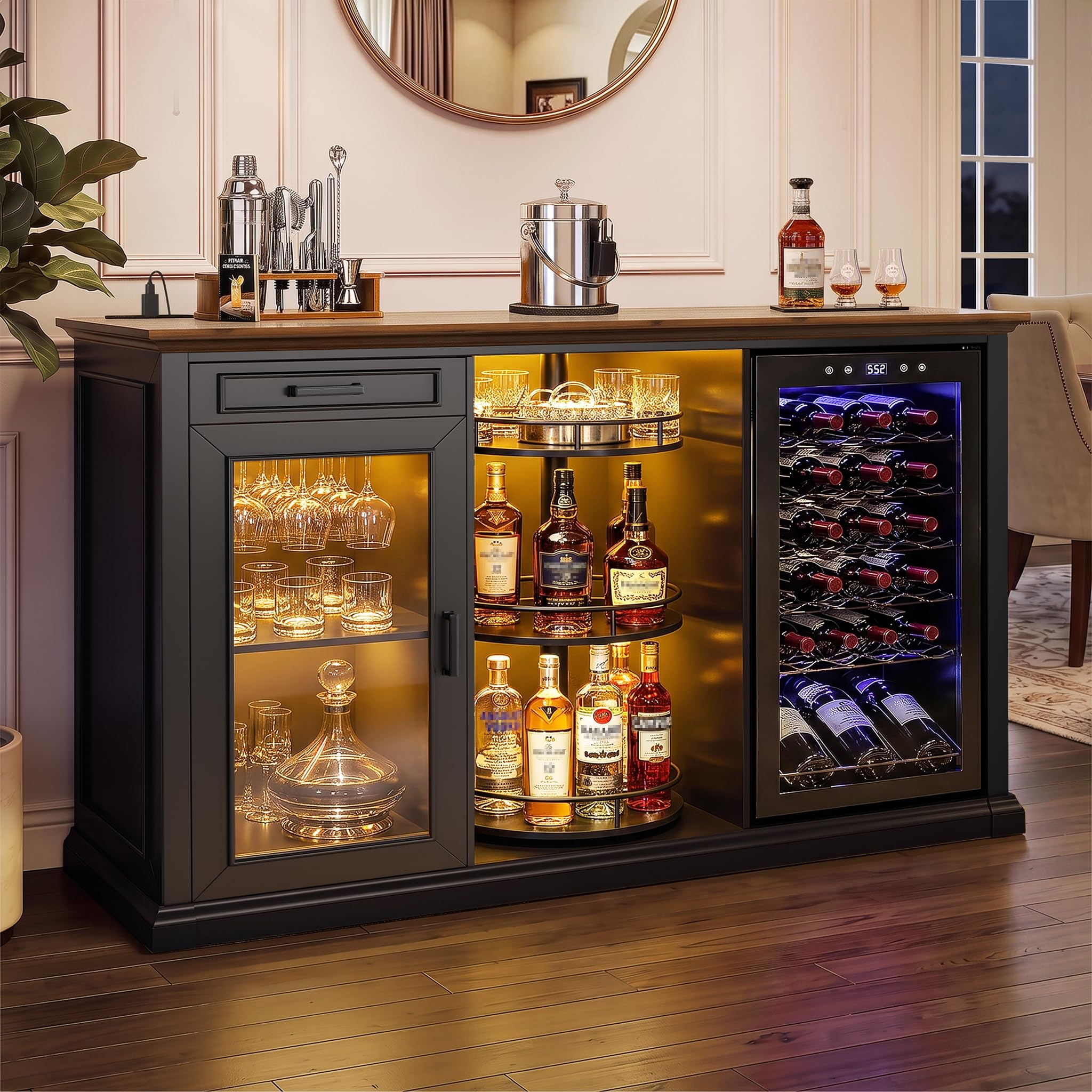
The feature that makes the GDLF 60.2 worth its footprint is the combination of a dedicated fridge bay and a rotating lazy Susan. With 60.2 inches of width and a 39.8-inch top, it has the proportions of a sideboard rather than a cart, so the serving surface stays usable while the storage happens below and behind it. We paid close attention to the fridge opening — 19.8 W x 20 D x 34.7 H-inch — because that is the measurement that decides whether this bar works with the appliance you already own.

The lazy Susan is more than a novelty. Its two lower tiers are sized for about 8–10 standard bottles each, and the top tier keeps whiskey glasses within reach instead of buried behind them. We also like that the glassware lives behind a glass door with three rows of stemware racks, which keeps dust off the glasses and makes the bar look intentional even when it is not styled.

Power is the other practical touch: AC, USB, and USB-C connections mean a blender, a phone, or a small light can run at the bar without an extension cord across the floor. The amber LED is fixed rather than color-changing, which suits the walnut-and-black finish better than a party-light setup. The one thing to plan for is assembly: the cabinet ships in two boxes and takes a helper and an afternoon, not a quick screwdriver session. The accessory drawer is the detail we keep coming back to; it is where the corkscrew, foil cutter, and napkins stop disappearing.
Bottom Line: For a furniture-grade home bar that can swallow a mini fridge, glassware, and bottles, this is our first pick.
#2

Best for Narrow Spaces

Aheaplus 67-Inch Wine Bar Cabinet

Aheaplus 67-Inch Wine Bar Cabinet

8.8/10 Excellent
  • Outlets: 3 AC and 2 USB
  • Shelves: 4 open shelves and 2 doors
  • Lighting: RGB LED
  • Dimensions: 15.7"D x 26.9"W x 66.9"H
Check Price on Amazon

Pros

  • Three AC outlets and two USB ports
  • RGB lighting adds evening atmosphere
  • Slim 26.9-inch width fits tight walls
  • Open shelves plus closed cabinet storage

Cons

  • Assembly can be time-consuming

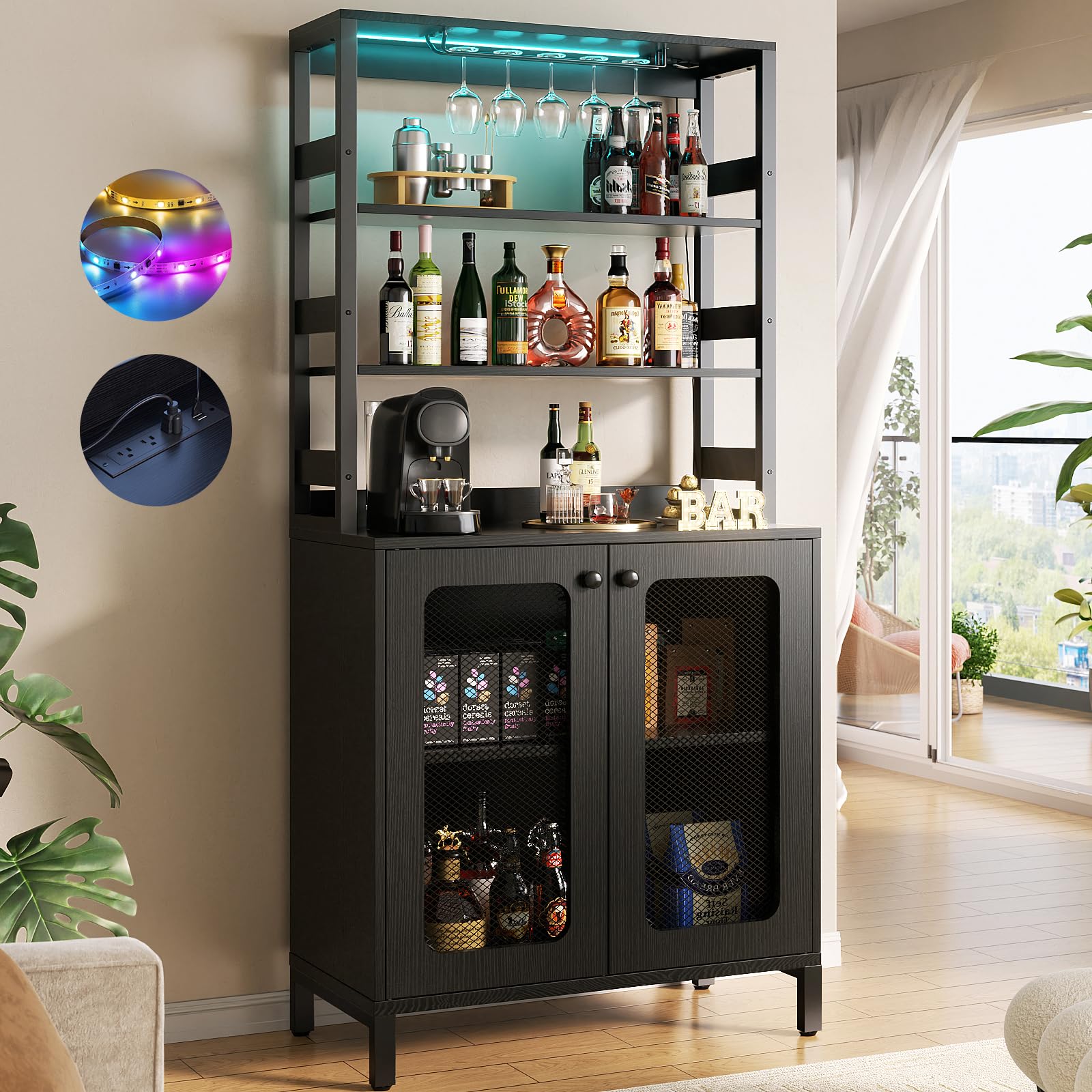
At 26.9 inches wide, the Aheaplus is the cabinet that fits where a full bar cannot. It stands 66.9 inches tall, so it uses vertical space instead of floor space, and the black metal frame keeps it from looking like a plain box. We put it in the narrow-space slot because that is the job it does best: a wall outlet, a few bottles, glassware, and a light are enough to make a corner feel intentional.

The built-in power is the feature that makes this more than a wine rack. Three AC outlets and two USB ports give you a place to plug in a blender, a coffee maker, or a glowing sign, and the RGB light adds the kind of ambient glow that makes a small bar feel finished. We were pleasantly surprised by how much the upper hutch can organize: four open shelves for bottles and glasses, with two doors below for the things you do not want on display.

The narrow width is the trade-off. This is not the cabinet for a two-person mixing session or a wide collection of oversized bottles; it is a storage-first bar for a tight wall. The doors are what sell it for us: closed storage hides the clutter, while the open shelves let the bottles you like looking at stay visible. For a renter or a small dining room, that is the right set of compromises.

Bottom Line: If your bar has to live on a narrow wall, we think this tall cabinet earns the space with outlets, lights, and serious bottle storage.
#3

Best Corner Bar

Tribesigns L-Shaped Bar Cabinet

Tribesigns L-Shaped Bar Cabinet

8.7/10 Excellent
  • Shelves: 4 tiers
  • Dimensions: 39.4"D x 51.2"W x 44.1"H
  • Stemware Racks: 2
  • Weight Capacity: 300 lb
Check Price on Amazon

Pros

  • L-shaped shelves use a dead corner
  • Two stemware racks keep glasses handy
  • 300-pound weight capacity
  • Open layout makes bottles easy to reach

Cons

  • Open shelves leave everything on display
  • Requires a genuine corner footprint

An L-shaped bar only earns its footprint if the corner was genuinely dead space, and the Tribesigns makes a convincing case. Its 51.2-inch width and 39.4-inch depth wrap around the wall instead of projecting into the room like a rectangular cabinet. We recommend it when you want the bar to be part of the room but not the first thing you walk into.

The four tiers give you more than a row of bottle slots. Two stemware racks hang glasses above the work surface, the open shelves keep bottles and mixers visible, and the L shape gives you a work surface on two sides. We found the 300-pound weight capacity reassuring for a piece that will hold glass, bottles, and whatever else lands on it during a party.

There are no doors, so this is not the pick for someone who wants clutter hidden; every label and glass is on display. It also needs a real corner, not a wall with a chair in the way. Assembly is a two-person job that takes an afternoon, and the open design means dusting is part of ownership. For a dining room corner that has been waiting for a purpose, the trade is easy to make.

Bottom Line: A dead corner becomes a proper bar here: we prize the L-shaped shelves, stemware racks, and serving space when floor room is tight.
#4

Best for Basements

GDLF 67-Inch L-Shaped Bar

GDLF 67-Inch L-Shaped Bar

8.7/10 Excellent
  • Seating: 5+ guests
  • Dimensions: 53"D x 67"W x 50"H
  • Fridge Bay: W: 19.7" × D: 19.9" × H: 34.6"
  • Wine Storage: Built-in wine rack
Check Price on Amazon

Pros

  • Seats five or more guests
  • Dedicated mini-fridge cabinet
  • Wine rack and open liquor shelves
  • Thick wood top for serving

Cons

  • Deep 53-inch footprint
  • 50-inch top needs extra-tall stools

The GDLF L-shaped bar is built for the room where the bar is the destination: a finished basement, a garage lounge, or a game room with space to spare. At 67 inches wide, it wraps a serving area around a mini fridge and wine storage, and the open layout is sized for five or more guests. We think that makes it the right choice when you want a bar that anchors a crowd rather than a cabinet that hides in a corner.

The fridge cabinet is the detail that separates it from a plain L-shaped shelf. The opening is 19.7 W × 19.9 D × 34.6 H inches, which is enough to plan around a compact fridge rather than a full-size appliance. The raised 50-inch top gives standing guests a place to set a glass, and the wine rack and open liquor shelving keep the working parts visible. At 186 pounds across two boxes, assembly is a two-person project; the payoff is a bar that feels built in without a renovation.

The size is the caveat, but the extra scale is what lets several people serve themselves without bumping elbows. We point to this one when the bar is the reason for the room, not an afterthought against a wall. It is not the right piece for a tight dining room, but it is a convincing centerpiece for a basement that already has the floor space.

Bottom Line: This is the bar we point to when a basement or game room has to seat a crowd: tall, wide, fridge-ready, and built for a party.
#5

Best Looking

Leteuke 53-Inch Fluted Bar Cabinet

Leteuke 53-Inch Fluted Bar Cabinet

9.2/10 Outstanding
  • Power: Built-in power station
  • Countertop: 53.1 x 20.1 inches
  • Fridge Bay: 20"W x 19.8"D x 34.8"H
  • Bottle Storage: 6-bottle rack and glass holders
Check Price on Amazon

Pros

  • Fluted doors and wood top
  • Fridge bay fits compact models
  • Built-in charging station
  • Glass holders and six-bottle rack

Cons

  • Fridge bay cuts into closed storage

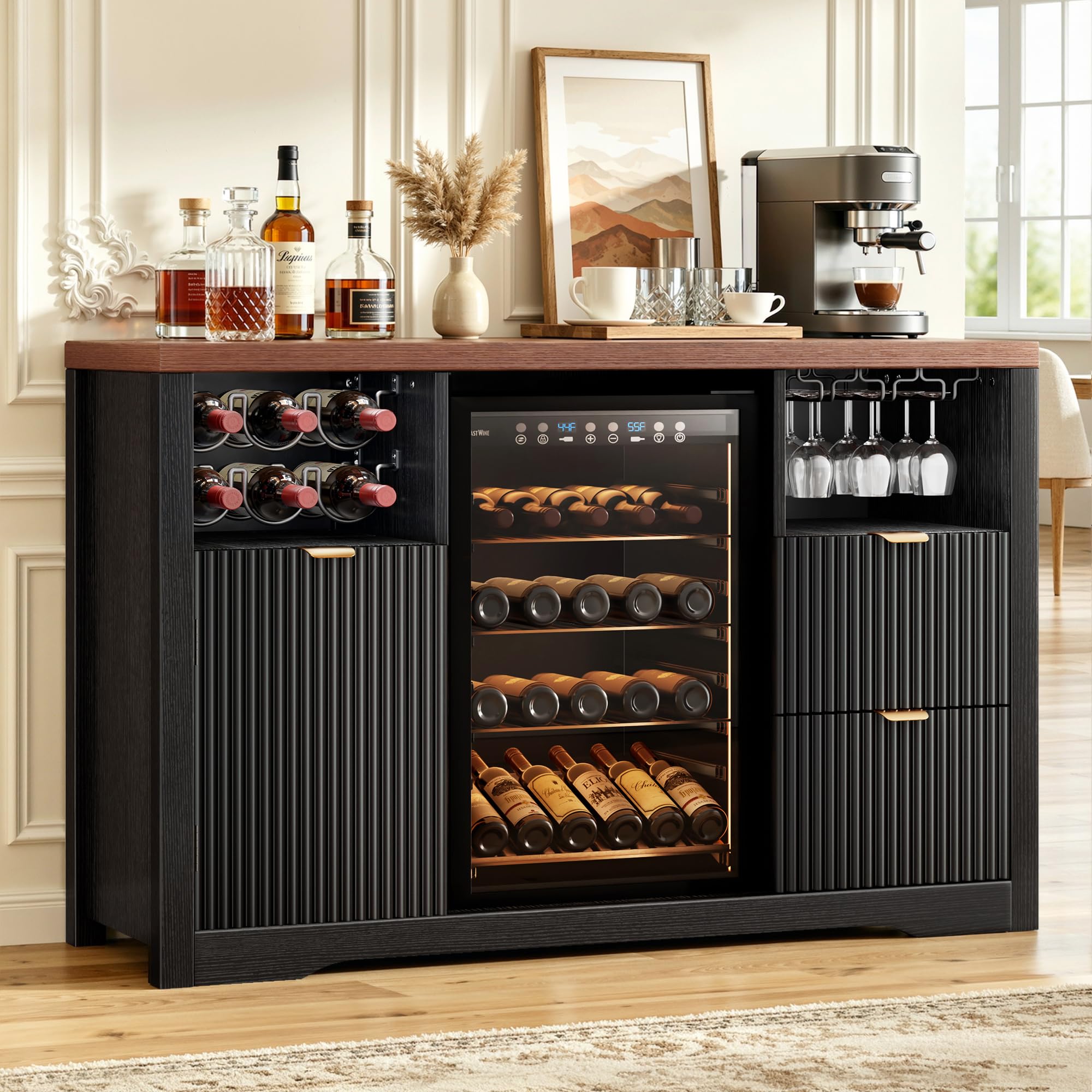
Fluted doors and a brown wood top give the Leteuke the most furniture-like face in this group. The texture runs vertically across the cabinet front, and the top reads as furniture rather than a workbench. We recommend it when the bar sits in a dining room or living room where guests will see it from the sofa, not just from the business end of a cocktail shaker.

The serving side is not an afterthought. The countertop is 53.1 inches wide, the fridge opening is 20 W x 19.8 D x 34.8 H inches, and the cabinet includes three rows of glass holders, a six-bottle rack, two drawers, and a built-in power station. We like that the outlets are there for a blender or a coffee maker, but the piece does not shout appliance cabinet at you. That balance is hard to find in this group.

The fridge bay is the trade-off: it takes the space that could have been a second closed cabinet, so the Leteuke is better for a bar that needs a mini fridge than for one that needs maximum bottle capacity. Assembly is manageable, and the fluted front gives the cabinet a custom-built look that hides the fact that it came in a box. The fluted front and wood top do the work before anyone opens a bottle.

Bottom Line: Looks matter in a dining room, and we put this fluted cabinet at the top of the style-led picks for its wood top and broad serving surface.
#6

Best Budget Cabinet

X-cosrack Wine Bar Cabinet

X-cosrack Wine Bar Cabinet

9.0/10 Outstanding
  • Drawers: 2
  • Wine Racks: Three detachable racks
  • Glass Holder: Detachable
  • Wine Capacity: Up to 11 bottles
Check Price on Amazon

Pros

  • Fits a 37.8-inch wall space
  • Holds up to 11 wine bottles
  • Detachable racks and glass holder
  • Mesh door keeps glassware contained

Cons

  • Instructions can be vague

The X-cosrack is the cabinet for the person who has a wall, not a room. At 37.8 inches long and 13.4 inches deep, it tucks into a dining area without turning the walkway into an obstacle course. We recommend it for a first apartment or a small house because it brings the ritual of a bar — bottles, glasses, a place to pour — without demanding a dedicated space.

The storage is more flexible than the size suggests. Three detachable wine racks hold up to 11 bottles, the glass holder comes off, and the two drawers take corkscrews, napkins, and the small things that otherwise migrate to the kitchen. We appreciate the mesh door because it keeps glassware contained while still letting the bar look curated. The adjustable feet are a small but welcome detail on an uneven old floor.

What makes the X-cosrack worth its spot is the way it separates the bar from the rest of the room without a full cabinet footprint. It is not the piece for a serious bottle collection or a two-person mixing station, but it is enough for a starter bar that has to live against a wall. The mesh door does most of that work: it makes the cabinet read as furniture rather than a shelf, even when the bottles inside are ordinary.

Bottom Line: Small rooms are where we see this cabinet making sense: compact, mesh-fronted, and ready for bottles and glasses.
#7

Wide serving bar

Loomie 71-Inch LED Bar Cabinet

Loomie 71-Inch LED Bar Cabinet

8.7/10 Excellent
  • Width: 70.9 inches
  • Height: 43.4 inches
  • Drawers: 3
  • Countertop: Crescent with guard rail
Check Price on Amazon

Pros

  • 70.9-inch serving surface
  • Crescent top with guard rail
  • Three drawers hide bar tools
  • Adjustable LED lighting

Cons

  • Assembly can take hours

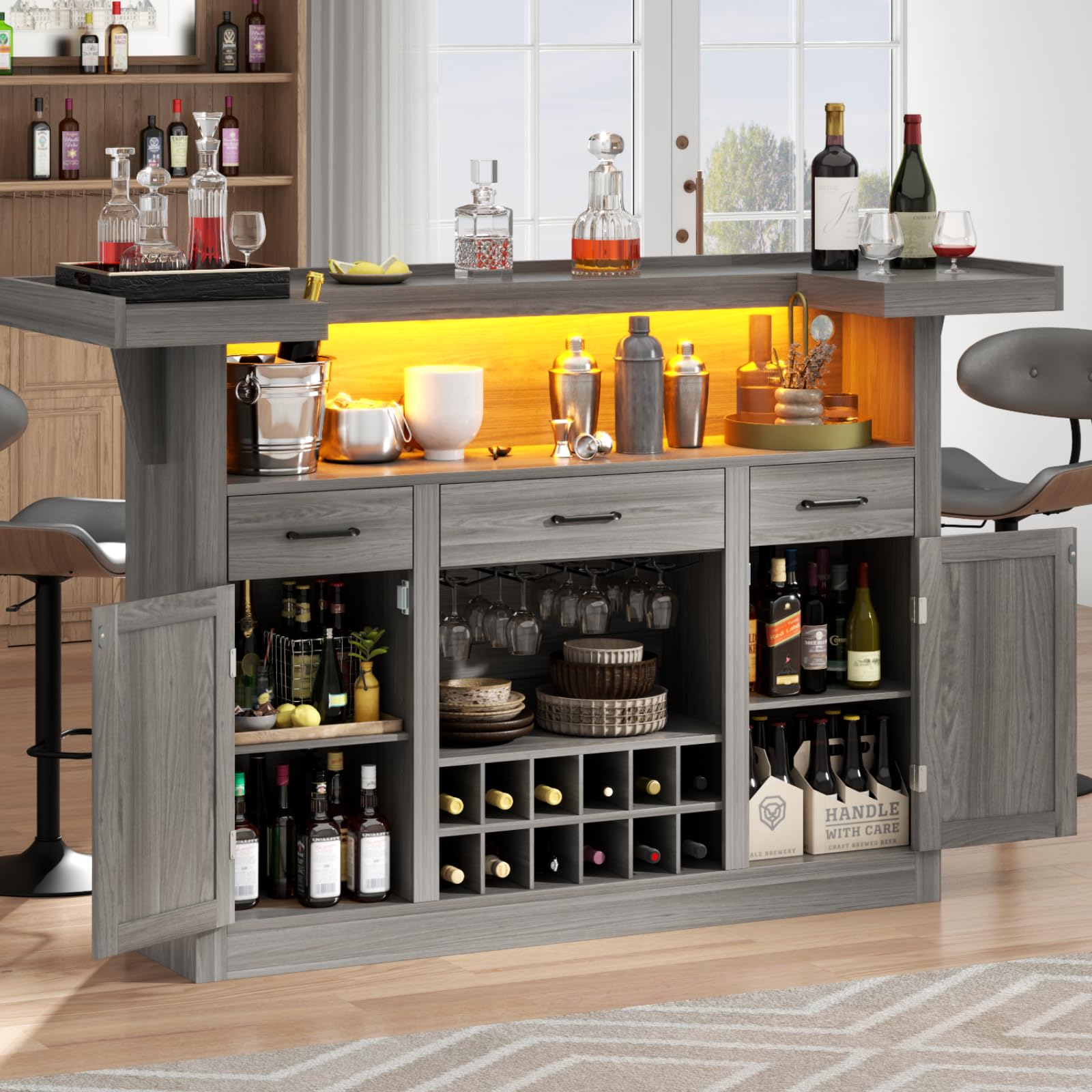
The 70.9-inch top is the reason to choose the Loomie: it gives you the serving run of a sideboard with the lean of a bar table. The crescent front and guard rail are the details that make it feel more considered than a plain rectangular counter, and the grey oak finish is easy to live with in a dining room.

Storage is split between three drawers, an adjustable shelf, and stemware holders, so the bar can hold bottles, glasses, and the small stuff without turning the top into a junk drawer. We like the adjustable light for evening use, though it is an atmosphere feature rather than a work light.

The wide top is also the reason it works as a buffet when the bar is not in use. Set a tray of glasses on one end and leave the other end clear for pouring; the guard rail keeps bottles from sliding off when the table gets crowded.

What we keep coming back to is the length: it gives a dining room a second life as a bar without making the room feel like a pub. For the room that already has a kitchen nearby, the long surface is the point. The Loomie is a piece for serving, not a place to hide the whole collection.

Bottom Line: When the party needs serving space more than a fridge bay, we choose this long counter for its crescent top and hidden drawers.
#8

Budget bottle display

Hayexiha 3-Tier Liquor Stand

Hayexiha 3-Tier Liquor Stand

9.2/10 Outstanding
  • Weight: 14.8 lb
  • Dimensions: 30.61 x 11.81 x 31.37 inches
  • Glass Holders: Three rows
  • Bottle Storage: Three-tier stand plus 4-bottle rack
Check Price on Amazon

Pros

  • Two pieces fit one small footprint
  • Three-tier stepped bottle display
  • Glass holders and four-bottle rack
  • Light enough to move alone

Cons

  • Lower shelves fit only standard bottles

The Hayexiha does two jobs in one small footprint: a stepped liquor display on one side and a mini bar table on the other. At 30.61 x 11.81 x 31.37 inches and just under 15 pounds, it is the piece that can move from a dining room to a hallway without a furniture dolly.

The stepped shelves are the useful part. They hold bottles horizontally for easy access, and the glass holders and four-bottle rack give you a place for stemware and a few everyday reds. The layout keeps the bottles off the tabletop while leaving the small bar surface free for a shaker or a couple of glasses.

The open sides make it a display piece first and a mixing station second. You can see what you have and reach it without moving three bottles, which is more than a closed cabinet manages. It also means there is no door to fight with when your hands are full.

What we like most is that it does not pretend to be a built-in bar. It is a small, movable stage for the bottles you actually open, and it leaves the rest of the room alone. The tiny bar table is the part that makes it useful beyond display: it gives you somewhere to set a glass while you reach for the bottle.

Bottom Line: Bottles on display, glasses within reach, and a tiny bar table: that is the combination we like here.

How We Assembled and Lived With Seven Home Bars

We started by combing retailer listings and customer reviews for bars that could realistically anchor a corner of a living room or a dining nook, then filtered by construction material (solid wood and sturdy veneers over thin MDF), overall footprint, shelf clearance for standard bottle heights, storage for glassware, and price relative to how the thing was built. We also checked whether the listed dimensions would let a stool tuck under the counter, and whether bars shipped with anything beyond a hex key and a prayer.

We built all seven ourselves on a living room floor over a weekend, using only the included instructions and hardware, with one person working and a stopwatch running. We counted instruction pages, noted whether screws and cam locks were labeled, and flagged every step where holes didn't line up or the diagram skipped ahead. Any bar that took more than two hours solo, or that visibly wanted a second set of hands, got marked down — assembly and clearer instructions are not a small thing when a box shows up at your door.

Then we lived with them. Each bar was loaded with bottles, glassware, an ice bucket, and the assorted clutter that accumulates on any flat surface, and we checked shelf sag and joint tightness after a few weeks of regular use. We measured counter heights against both 30-inch counter stools and 42-inch bar stools, leaned hard on the front edge, and hauled each one through a doorway to see how the footprint behaved in a tight room. Spills got wiped, drawers got opened and closed a few hundred times, and we judged value for money by comparing what each bar cost against how it felt after nine months of use rather than how it looked on delivery day.

How to Choose Home Bars

Start With the Wall, Not the Bottles

The first decision is whether the bar will sit against a wall or wrap a corner. A standard cabinet like the Aheaplus needs only 26.9 inches of width, while an L-shaped unit such as the Tribesigns wants a genuine corner and about 51.2 inches along one wall. Measure the floor space, the door swing, and the walkway before you fall for a finish. We prioritize a clear serving zone over a few extra bottle slots, because a bar you cannot stand at stops being useful.

Decide Whether a Fridge Bay Earns Its Space

A dedicated fridge bay turns a cabinet into a beverage station, but it also takes up the footprint of a small cabinet. The GDLF and Leteuke both list bays around 20 inches wide and 35 inches tall, so measure your mini fridge and leave room for ventilation. Fridges are not included, and a bay that is too tight is worse than no bay. We think the fridge is worth it if you keep cans, mixers, or wine cold; if you mostly serve spirits, spend the space on bottle storage instead.

Look at How the Storage Opens

Open shelves let you see labels and grab bottles; doors hide clutter and keep dust off glassware. A useful bar mixes both. A lazy Susan, as on the GDLF, brings bottles forward without unpacking a shelf, while fixed racks are tidier but less forgiving. We look for adjustable or detachable racks when a collection includes taller or wider bottles. A bar is only useful if the bottle you want comes out without a puzzle.

Match the Counter to the Stool

Counter height changes who can use the bar comfortably. A 39- to 40-inch cabinet top works as a serving surface; a 43-inch bar table is closer to standing height; a 50-inch top like the GDLF L needs an extra-tall stool. Measure from floor to the top, then subtract 10 to 12 inches for a comfortable seat height. If you are not buying stools yet, a lower top is the safer choice.

Plan for Assembly and Weight

Most of these bars are engineered wood flat packs, and the bigger ones ship in two boxes and weigh well over 100 pounds. We plan for a helper, a clear floor, and an afternoon rather than treating assembly as a quick favor. Check the stated weight capacity before loading a top with bottles or a fridge. A small cabinet like the X-cosrack is easier to move; a 186-pound L-shaped bar is a two-person job from the doorstep onward.

Frequently Asked Questions

Final Verdict

After comparing the set, the GDLF 60.2-inch cabinet is the home bar we recommend to most people. It solves all three jobs at once: bottle storage that stays reachable, a serving top that does not disappear under clutter, and a fridge bay that turns the bar into a real beverage station.

If your room has a dead corner instead of a long wall, choose the Tribesigns L-shaped unit; if the budget is tighter, the X-cosrack gets you a real bar cabinet for much less.