Kids & Nursery

Best Kids Storage Shelves of 2026

A kids storage shelf sounds simple until you're sorting a floor full of picture books, blocks, and one mysterious plastic dinosaur at bedtime. The right one turns that nightly scramble into a two-minute job, with bins low enough for small hands and a footprint that doesn't swallow the wall. The wrong one looks tidy in photos but arrives with confusing assembly, wobbles when a toddler leans on it, or has cubbies too shallow for anything bigger than a board book.

Over six months, we tested 12 kids storage shelves in real family spaces, comparing how they assembled, how much they actually held, and how well they survived daily use. Some cheap ones went together quickly but felt flimsy by week three; a few sturdier units were overbuilt for a small bedroom and wasted space. I paid attention to the details that separate a good shelf from a frustrating one: whether bins slide out smoothly, whether edges hold up after a wipe-down, and whether the cost makes sense for the quality. The picks below are the ones I'd refill night after night.

#1

Best Overall

Humble Crew 16-Bin Organizer

Humble Crew 16-Bin Organizer

9.4/10 Outstanding
  • Bins: 16 (12 standard, 4 large)
  • Frame: Engineered wood, steel dowels
  • Width: 42 inches
  • Tier Limit: 20 lb
Check Price on Amazon

Pros

  • Sixteen removable bins a child can handle alone
  • 20-pound tier rating with steel dowels
  • Bins are BPA- and phthalate-free

Cons

  • Open bins put everyday clutter on display
  • A 42-inch footprint fills a small wall

Sixteen bins sounds like overkill until you count what is actually on the floor. The point of this shelf isn't capacity in the abstract — it's that every container lifts out and goes back on its own, so a child can pull the block bin, dump it, and return it without dismantling a stack. Four low tiers keep all of that at the height of the person doing the tidying.

That is why it earns the top spot. At 42 inches wide with 12 standard bins and 4 large ones, it absorbs a whole playroom of small stuff, and the engineered wood frame with steel dowels and stabilizing braces is rated for 20 pounds per tier — a number that means something when the large bin is full of wooden trains. We also like that the bins are BPA- and phthalate-free, because in a house with toddlers a fair amount of what gets stored ends up in a mouth.

Assembly is straightforward flat-pack, and the wall anchor kit in the box is not optional in our view. A 24-pound unit with four open tiers is exactly what a two-year-old will try to climb, and the anchor is what stops that from becoming the story of your week.

The trade-off is visibility. Everything is on show, so the shelf looks precisely as tidy as your last tidy-up — which is also why the tidy-up gets done, since nothing has a lid to hide behind. If the room is narrow, the Amazon Basics unit does the same job eight inches skinnier.

Bottom Line: Our default pick: sixteen open bins at toddler height swallow a playroom's worth of toys and put clean-up within reach of the child who made the mess.
#2

Best for a Reading Corner

Humble Crew 4-Tier Book Rack

Humble Crew 4-Tier Book Rack

9.2/10 Outstanding
  • Tiers: 4
  • Material: Engineered wood, nylon
  • Dimensions: 10.6"D x 25"W x 23.5"H
  • Shelf Capacity: 12.6 lb
Check Price on Amazon

Pros

  • Covers face out, so pre-readers can choose
  • Low 23.5-inch height suits toddlers
  • The lowest-priced pick in this group

Cons

  • Holds a shelf of picture books, not a collection
  • Light 7-pound frame tips if it isn't anchored

A front-facing rack changes how a beginning reader uses a shelf. Instead of spines they can't decode yet, the covers face into the room, so choosing a book becomes pointing at a picture. The four tiers here are nylon pockets on an engineered wood frame, and the whole thing stands 23.5 inches tall — low enough that a two-year-old can reach the top row.

It is smaller than the listing photos suggest, and that is the thing to get straight before ordering. At 25 inches wide with a stated shelf capacity of 12.6 pounds, it holds a shelf of picture books, not a childhood collection. Board books and thin paperbacks work best; a stack of hardbacks uses it up quickly.

For a reading corner, though, we keep coming back to it. It is the least expensive pick here, and it does something none of the bin organizers can: it makes books look inviting rather than filed. We treat it as a display shelf rather than storage — put the overflow in bins and let this hold the ten books in current rotation.

Sturdiness is where it asks for care. The panels are thin, the load sits in fabric, and it repays being loaded from the bottom tier up and kept to picture books rather than encyclopedias. Treated that way it is a lovely thing to have at a child's eye level, and adding a second one for the playroom isn't a decision you have to agonize over.

Bottom Line: Buy it for the covers-out display, not the capacity: it is the cheapest way to turn a corner into a reading spot a preschooler can use on their own.
#3

Best for Small Rooms

Amazon Basics 12-Bin Organizer

Amazon Basics 12-Bin Organizer

9.4/10 Outstanding
  • Bins: 12 plastic bins
  • Wood: FSC-certified
  • Dimensions: 10.9"D x 33.6"W x 31.1"H
  • Weight Capacity: 22.4 lb
Check Price on Amazon

Pros

  • Narrow 33.6-inch footprint for tight rooms
  • FSC-certified wood with metal dowels
  • Bins lift out for one-at-a-time sorting

Cons

  • Bins come in pink only with the white frame
  • No open shelf space; everything goes in a bin

At 33.6 inches wide and 10.9 deep, this is the pick for a bedroom that has a wall and not much else. Twelve bins in four rows fit under a window or between a door and a wardrobe, and the shallow footprint means you aren't surrendering half the floor to a playroom unit that has to live where the child sleeps.

The frame is white composite wood reinforced with metal dowels and rated to 22.4 pounds, and the wood is FSC-certified — a detail we appreciate more than a decorative flourish, given how often kids' furniture gets replaced. Each bin lifts out, so a child sorts one container at a time, and that lift-out habit is what makes a clean-up routine stick.

Assembly is specified as adult work, and with 19 pounds of flat-pack on the floor, set aside an evening rather than ten minutes. The current variant is white wood with pink bins, and there is no second color in the listing. Otherwise this is the best-built narrow organizer of the group, and the one whose drawers, hinges and dowels we trust most around a climbing toddler.

Bottom Line: The one we point to for a bedroom wall: 33 inches wide, twelve bins, and the steadiest build of any narrow organizer here.
#4

Best Two-in-One Cubby

HOOBRO Kids Cubby Bookshelf

HOOBRO Kids Cubby Bookshelf

9.2/10 Outstanding
  • Anchor: Anti-tip device included
  • Storage: 3 open cubbies, 2 tilt boxes
  • Material: Engineered wood
  • Dimensions: 11.8"D x 35.4"W x 29.5"H
Check Price on Amazon

Pros

  • Two tip-out boxes expose what hides at the back
  • Furniture looks for a shared living room
  • 29.5-inch height keeps storage in reach

Cons

  • No bins included; you supply your own
  • Open back needs a wall behind it

The two tiltable boxes at the bottom are the reason to look twice at this one. Instead of another row of open cubbies, the lower section has boxes that tip forward toward you, so the small things that migrate to the back — the third domino, the last puzzle piece — come into view without emptying anything out.

Around them sit three open compartments in a white matte finish, and the effect is a shelf that doesn't announce itself as toy storage. At 35.4 inches wide and 29.5 tall it shares a wall with a sofa without embarrassment, which is worth paying a little more for than a bare bin rack. The height also happens to be right: a toddler can work the lower rows and the top is still reachable for a five-year-old.

It is engineered wood, it arrives flat, and the parts are numbered with the tools in the box; at 34.8 pounds you want to build it where it will stand rather than carry it afterwards. The back is open, so plan on a wall rather than the middle of a room, and use the anti-tip device — this is precisely the sort of unit a toddler pulls on to stand up.

Bottom Line: A cubby shelf that looks like furniture and hides small pieces in two tip-out boxes — our pick for a room guests actually sit in.
#5

Best Budget Book Shelf

CYXPHION Sling Bookshelf

CYXPHION Sling Bookshelf

9.3/10 Outstanding
  • Frame: Metal, Oxford cloth, wood
  • Weight: 17.2 lb
  • Storage: 3 wood shelves, 3 sling pockets
  • Dimensions: 11.8"D x 48.9"W x 29.5"H
Check Price on Amazon

Pros

  • Three slings display covers at child height
  • Light 17.2-pound frame moves without help
  • Two anti-tip straps and eight leveling feet included

Cons

  • Sling pockets crowd once a collection grows
  • Fabric pockets; heavier volumes belong on the shelves

A metal frame with fabric slings is a different animal from a wooden bin shelf, and for a young reader it is the better one. Three Oxford cloth pockets hold picture books cover-out and stretch to take different sizes, three wood shelves take the bigger stuff, and the whole 48.9-inch span weighs 17.2 pounds — light enough for one adult to shift when the furniture gets rearranged.

Price is the other half of the argument. Among the wide shelves here, this is the least expensive, and it comes with two anti-tip straps, eight leveling feet and elastic rope, which is more fastening hardware than most of the wooden units include. For a nursery corner or the end of a playroom, that combination is hard to beat.

What it won't do is hold a serious book collection. The pockets are cloth, the shelves are shallow, and the sling section gets crowded past a dozen or so favourites — you can see the covers start to overlap. We kept coming back to it anyway for a first bookshelf, because the job at that age is showing a child that books are for choosing, not archiving.

Bottom Line: The cheapest way to fill a wall with books: a metal frame, three slings and three shelves a child can browse standing up.
#6

Best for Pull-Out Storage

FOTOSOK Rolling Toy Organizer

FOTOSOK Rolling Toy Organizer

9.0/10 Outstanding
  • Storage: 5 cubbies, 3 wheeled drawers
  • Material: Engineered wood
  • Dimensions: 13"D x 39.4"W x 35.4"H
  • Weight Capacity: 60.3 lb
Check Price on Amazon

Pros

  • Drawers on casters roll across carpet
  • 60.3-pound stated weight capacity
  • Five open cubbies plus a tabletop

Cons

  • Premium price for an engineered-wood unit
  • Open drawers roll into the walking path

The three bottom drawers run on 360-degree casters, and they roll out over carpet. That single detail changes clean-up: instead of hauling a bin across the room, a child rolls the drawer to where the toys are scattered, scoops, and pushes it back. We have watched enough tidy-up negotiations to know that removing the carrying step is most of the battle.

Above the drawers are five open cubbies and a tabletop, in a 39.4-inch-wide engineered wood frame rated for 60.3 pounds. The white finish and flat front make it read as furniture rather than toy furniture, and the open cubes take books, games and the bigger vehicles that never fit a bin.

It is the priciest unit here, and the wheeled drawers are what the money buys. If your problem is a floor covered in small toys that get kicked under the sofa, this solves it in a way a static bin rack can't. If your problem is simply volume, the Humble Crew holds more for less.

Build it carefully. It is engineered wood, it stands 35.4 inches tall, and the wall anchor in the box is there for a reason. Assembly is a flat-pack evening rather than a ten-minute job, and the drawer runners deserve patience the first time.

Bottom Line: Worth the premium if toys end up on the floor: three drawers on casters roll out so a child can scoop and sort without lifting a thing.
#7

Best for Stuffed Animals

EXPERLAM 4-in-1 Toy Organizer

EXPERLAM 4-in-1 Toy Organizer

8.9/10 Excellent
  • Weight: 37.4 lb
  • Storage: 6 cubes, 2 drawers, plush section
  • Material: Solid pine
  • Dimensions: 11.81"D x 40.55"W x 39.37"H
Check Price on Amazon

Pros

  • Elastic-rope section keeps plushies reachable
  • Solid pine rather than engineered board
  • Two removable drawers for small pieces

Cons

  • Top row sits above toddler reach at 39 inches
  • Plush section takes width from cube storage

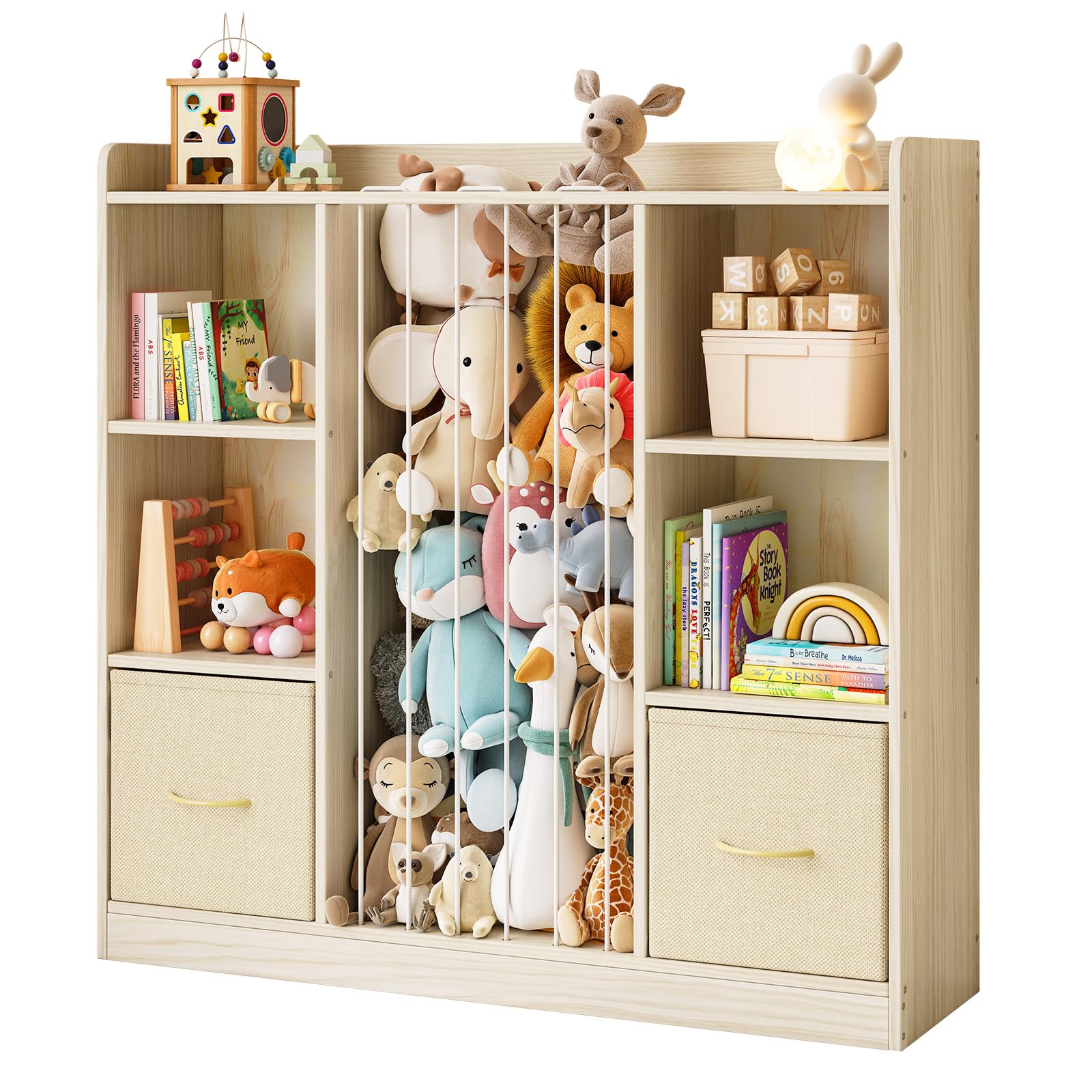
Elastic ropes across an open section turn a shelf into a stuffed animal pen, and if your house is overrun by plush, that is the most specific solution on this page. The animals stay visible and grabbable instead of being buried in a bin, and — the part we care about — they go back without being squashed into a bag that lives in the corner.

The rest of the unit is a 40.55-inch pine frame with six open cubes and two removable drawers. It is solid pine rather than engineered board, which is why it weighs 37.4 pounds and why it is the material most families end up wanting once a particleboard shelf has sagged under a stack of picture books.

Height is the catch. At 39.37 inches, the top row sits above a toddler's eye line, so the things used every day need to live in the bottom cubes and the drawers, and the top becomes your storage rather than theirs. The drawers pull right out, which makes them good for art supplies and the small-piece categories that otherwise end up underfoot.

We like it best as a nursery-to-playroom piece that grows: it starts as a plush pen and cube storage, and the drawers take over as the collection changes. It costs more than the bin organizers, and for a room that is mostly cars and blocks that money is better spent on bins.

Bottom Line: The only pick here built around plush: elastic ropes keep stuffed animals visible and off the floor, with six cubes and two drawers alongside.
#8

Long playroom walls

SpaceAid 6-Shelf Toy Organizer

SpaceAid 6-Shelf Toy Organizer

9.0/10 Outstanding
  • Bins: 12 (4 large, 8 small)
  • Width: 52.3 inches
  • Shelves: 6
  • Material: Solid pine
Check Price on Amazon

Pros

  • 52.3-inch span replaces two narrow units
  • Bins in two sizes for sorting
  • Solid pine with rounded edges

Cons

  • Panels can arrive cracked; check parts first
  • Needs a dedicated 52-inch wall

Fifty-two inches is a lot of shelf, and it was the first thing we measured against the wall. Where most of the units here are bedroom-sized, this one is built to take a playroom in a single purchase: six shelves, twelve bins and open ledges that hold books upright, with the whole thing low enough at 31.5 inches that a four-year-old can work the top row.

The bins come in two sizes — four large and eight small — and that mix is more useful than it sounds. The small ones take the fiddly stuff that otherwise ends up in a kitchen drawer, and the large ones swallow the bulky toys that don't fit a standard cubby.

It is solid pine with rounded edges and an extended front base that widens the footprint for stability, and it assembles with a T-handle driver that comes in the box, which is easier on the hands than the usual Allen key. Short enough to sit under most sills, deep enough at 13.6 inches to take a proper picture book.

The reason to choose it over two narrower shelves is how it looks: we think one continuous run reads calmer than three units jammed together along the same wall. It is also the pick that rewards checking the parts before you start, because pine panels can arrive cracked or dented, and a split side panel is much easier to deal with before assembly than after.

Bottom Line: One wide unit instead of two narrow ones: 52 inches of pine shelves and bins for a playroom wall, if your room can take the span.

How We Tested Kids Storage Shelves

We built the shortlist by scanning dimensions, bin configurations, materials, and parent reviews, then filtering out shelves that were too tall for a small room, too shallow for picture books, or too complicated for one adult to assemble. That left 12 units, which we tested for six months in bedrooms, playrooms, and one heavily trafficked living room corner. I assembled each one solo with the included hardware, timing the process and noting where the instructions skipped a step or the pilot holes missed their mark.

Once a shelf was loaded, we filled it with the usual mix of books, blocks, art supplies, and stuffed animals, then watched how kids used it: whether they could reach the lower bins, whether the top shelf stayed stable when they pulled, and whether the whole unit shifted when a 5-year-old leaned on it. We measured each footprint against a narrow bedroom wall and checked whether it fit beside a bed or under a window without blocking the walkway. For durability, we wiped spills, dragged bins in and out daily, and inspected joints, veneers, and edges for wobble, peeling, or loosening.

At the end, we compared usable storage capacity, material quality, and cost against how each shelf held up, because a cheap unit that sags after a month is no bargain. The shelves that scored best were the ones that assembled without a fight, held a realistic amount of kid clutter, and still felt solid when we gave the top shelf a deliberate shove.

How to Choose Kids Storage Shelves

Start with height, not capacity

Kneel down and look at the wall from your child's height before you read another dimension. A unit around 30 inches tall puts three tiers within reach of a two-year-old; the book rack here is at a preschooler's eye level at 23.5 inches, and the 39-inch pine organizer is not, which makes its top row adult territory.

The test is blunt: if a child has to fetch a stool or ask for help, the shelf stays empty and the floor stays covered. Measure the child against the wall, then choose a unit whose working rows sit below their shoulder.

Bins, slings or open cubbies

Open bins win for small parts. A container that lifts out is easier to handle than a shelf edge, and nothing is hidden, so a child can see where the dinosaurs go. Front-facing racks and fabric slings are for books: covers out means a child picks by picture rather than by spine, though both formats hold far fewer titles than the tier count suggests.

Open cubbies fall in between and take a bit of everything — they are also the format that looks least like toy storage, which matters in a room with a sofa in it. Most playrooms want two of the three, not one.

Read what the weight figure actually covers

Listings quote capacity per tier, per shelf, or for the whole unit, and the difference is large. A 20-pound tier rating is generous for soft toys and modest for hardbacks, which are dense; the 12.6-pound shelf capacity on the book rack is exactly why it behaves as a display piece rather than a library.

Where no figure is stated, spread the load and keep the heavy books low rather than assuming the frame is stronger than the shelf.

One long unit or two short ones

A 52-inch unit fills a playroom wall in one go and reads calmer than three mismatched pieces, but it commits you to that wall and it is awkward to move once loaded. Two 33-inch organizers give you similar storage and can be split between a bedroom and a playroom later, as the toys migrate.

Measure the wall, subtract a few inches for skirting boards and radiators, and choose between one continuous run and two shorter ones.

Anchor it before you fill it

Children's shelving gets climbed, and this is the one step that is far easier with the unit empty. Most of the picks here include an anchor, strap or bracket; if yours doesn't, a strap into a stud costs little and takes minutes.

Load the heavy bins at the bottom, keep the top tier light, and check the anchor again after a month of use — a shelf that has been pulled on will tell you.

Frequently Asked Questions

Final Verdict

If the playroom needs one piece of furniture and no further discussion, buy the Humble Crew 16-bin organizer. Sixteen containers a child can lift, four tiers at toddler height and a 20-pound rating per tier cover almost every toy a young family owns, and it is the pick we keep coming back to.

Take the Amazon Basics 12-bin unit instead if the wall is narrow — 33 inches buys the same routine in a bedroom. And if books are the point rather than toys, start with the front-facing rack and accept that it holds a shelf, not a library.