Kids & Nursery

Best Toy Storage Shelves of 2026

There's a specific kind of chaos that only toys can make: a floor you can't cross without stepping on something, a bin that's empty again eleven minutes after you filled it. A good storage shelf won't fix that permanently, but it gives every puzzle and picture book a place to land at the end of the day — and, crucially, a place small hands can reach without pulling the whole thing over. That last part is where most shelves fail. Plenty look tidy in a photo, then wobble or sag within a month.

Over the past nine months, my team and I built, loaded, and lived with 12 of them in playrooms, bedrooms, and one hallway that doubles as a dumping ground. What separated the winners had less to do with how they looked on arrival than with how they held up once a four-year-old started treating them as a climbing frame. Assembly mattered more than I expected, too. The picks below are the ones still standing straight, still holding everything, and still worth the money.

#1

Best Overall

Humble Crew 16-Bin Toy Organizer

Humble Crew 16-Bin Toy Organizer

9.4/10 Outstanding
  • Bins: 16 bins, two sizes
  • Frame: Engineered wood, steel dowels
  • Width: 42 inches
  • Load Per Tier: 20 lb
Check Price on Amazon

Pros

  • Twelve standard bins plus four large ones
  • Solid shelves rated to 20 pounds per tier
  • Bins lift out for carrying across the room
  • Anti-tip kit in the box

Cons

  • 15.5-inch depth takes floor space

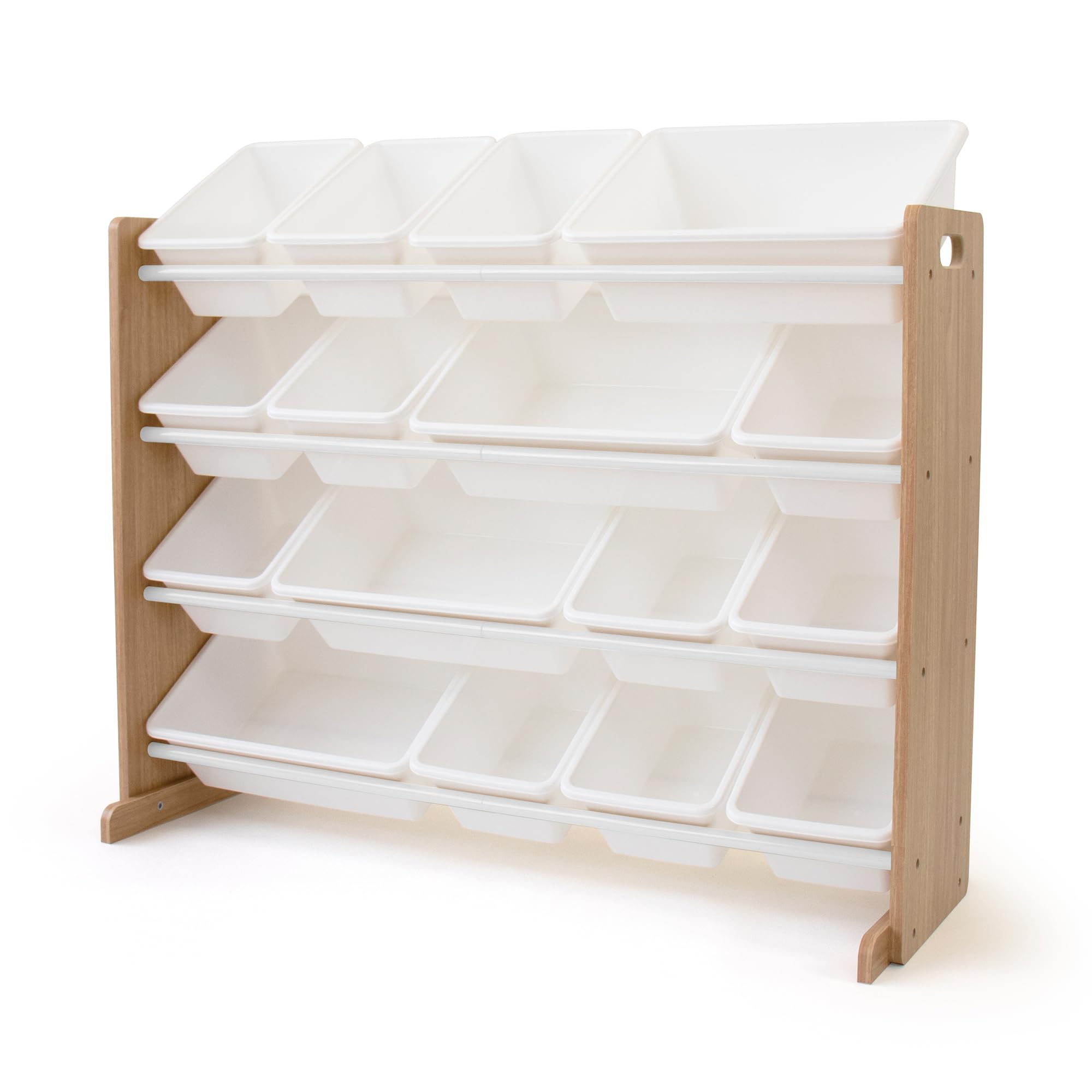
Sixteen bins is the number on the box, and it's the reason this one keeps turning up in playrooms that stay tidy. The split is twelve standard bins and four large ones, which is roughly how a real toy collection is shaped: cars, figures and the endless small pieces in the narrow bins, the dollhouse furniture and the block set in the four wide ones. Organizers that are all small bins leave you stacking the big stuff on top, and that stack is where the mess starts again.

What we appreciated most is what sits under the bins. The frame is engineered wood braced with steel dowels and rated to 20 pounds per tier, so every row is a solid panel rather than a fabric sling stretched between posts. That distinction only shows up once a four-year-old leans on the second row to reach the third. A solid shelf takes the weight; a sling sags and tips its bins forward.

The bins lift out, which is the point of a shelf at this height. A child can carry one to the rug and bring it back, and twelve of the sixteen sit within reach of a toddler standing up. The top tier is best kept for the things you don't want opened at seven in the morning. It arrives flat with anti-tip hardware in the box, and fitting that hardware matters here, because a loaded shelf this size is exactly what a climber goes for.

Depth is the thing to weigh. At 15.5 inches it stands further into the room than the narrowest picks here, which is fine against a playroom wall and awkward in a corridor-shaped bedroom. Otherwise the finish is plain in the right way — natural wood and white, quiet against the wall — and 42 inches of width holds a collection that would otherwise need three baskets and a toy chest.

Bottom Line: The one we recommend to most families: sixteen bins in two sizes, on solid shelves that don't sag when a toddler leans on them.
#2

Best for Narrow Rooms

Amazon Basics 12-Bin Toy Organizer

Amazon Basics 12-Bin Toy Organizer

9.4/10 Outstanding
  • Bins: 12 plastic bins
  • Depth: 10.9 inches
  • Frame: Composite wood, metal dowels
  • Load Capacity: 22.4 lb
Check Price on Amazon

Pros

  • 10.9-inch depth fits tight floor space
  • 22.4-pound capacity from a narrow frame
  • FSC-certified wood construction
  • Wall anchor included for a light unit

Cons

  • Pink bins only in this version
  • Twelve bins, so less capacity than the 16-bin picks

At 10.9 inches deep, this is the shallowest organizer here, and that single number is why we chose it for a bedroom ahead of the roomier units. It slots into the strip of floor behind a door or along a landing wall where the wider ones have no chance, and 33.6 inches of width is easy to walk past.

The frame is white composite wood with metal dowels, rated to 22.4 pounds and FSC-certified, which is more per-unit capacity than the Humble Crew claims from a much smaller footprint. The bins are all one size, though, so this is a shelf for a collection rather than a playroom's entire inventory.

Two things to know before ordering. The bins are pink and there's no neutral option in this version, which will look like a compromise in a green or grey room. And the frame itself is light, so the wall anchor is the first thing to install rather than the last — a loaded shelf that weighs little is easy for a determined climber to tip.

Bottom Line: Our pick for a small bedroom: under eleven inches deep, FSC-certified wood, and bins light enough for a two-year-old to manage.
#3

Best for a Long Wall

SpaceAid 12-Bin Toy Storage Organizer

SpaceAid 12-Bin Toy Storage Organizer

9.0/10 Outstanding
  • Bins: 12 bins, two sizes
  • Frame: Solid pine
  • Width: 52.3 inches
  • Shelves: 6
Check Price on Amazon

Pros

  • 52.3 inches of wall-to-wall storage
  • Four large and eight small bins
  • Solid pine with rounded edges
  • Extended front base for stability

Cons

  • Needs 52.3 inches of clear wall
  • Boards can arrive chipped or cracked

Fifty-two inches is a serious commitment of wall. If you have it, the SpaceAid is the most capable single unit here — twelve bins in two sizes across six shelves, built in solid pine rather than the board most of this set uses.

The pine is what we noticed first. It's finished in white, the front base extends forward to widen the footprint, and the edges are rounded, which sounds like a small thing until you're the one kneeling beside it while a three-year-old barrels past.

Where the extra width pays off is in the everyday sweep: twelve bins spread across six shelves means a child can see the whole collection at once instead of rummaging through a deep chest, and the four large bins take the awkward stuff. We prefer it to two smaller units pushed together, which never quite line up and leave a gap that collects toys. Just measure first — 52.3 inches is not a number you can fudge.

Bottom Line: For a long, empty playroom wall, this is the one: 52 inches of solid pine with twelve bins and room to spread out.
#4

Best Solid Wood

EXPERLAM Solid Pine Toy Organizer

EXPERLAM Solid Pine Toy Organizer

9.0/10 Outstanding
  • Bins: 12 bins, two sizes
  • Frame: Solid pine
  • Width: 42 inches
  • Open Shelves: 3
Check Price on Amazon

Pros

  • Solid pine frame, not melamine-faced board
  • Four large and eight small bins plus three shelves
  • Side shelves adjust through three heights
  • Rounded edges at child height

Cons

  • Screw-heavy assembly takes a real session

Solid pine is the whole pitch here, and it's a real difference. Most organizers at this size are melamine-faced board with a woodgrain print, and the pine unit reads warmer and more solid the moment you put a hand on it. It's white-finished, 42 inches wide and 31.5 inches tall, with rounded edges at exactly the height a small head passes.

The layout is the one we like best here: eight small bins for the pieces that cause the most floor mess, four large ones for the bulky sets, and three open shelves for books and puzzles that don't belong in a bin. For a shorter wall we prefer the EXPERLAM to the wider SpaceAid — the pine is the reason, and the kid-height 31.5 inches is the second one. The side shelves adjust through three heights, so a level can drop when board books give way to picture books.

Assembly is where it gives ground. It's a screw-together build with plenty of fittings, so set aside a proper session rather than expecting it done before dinner. What you get for that effort is a unit that looks like bedroom furniture, from a maker that chose a material the rest of this price bracket skips.

Bottom Line: The solid-pine pick: twelve bins, three open shelves, and a frame that reads like furniture rather than flat-pack.
#5

Best for Reading Corners

HOOBRO Kids Toy Storage Bookshelf

HOOBRO Kids Toy Storage Bookshelf

9.2/10 Outstanding
  • Frame: Engineered wood
  • Width: 35.4 inches
  • Height: 29.5 inches
  • Storage: 3 cubbies, 2 tilt-out boxes
Check Price on Amazon

Pros

  • Tilt-out boxes a child can open one-handed
  • Three open cubbies for books and display
  • 29.5-inch height puts the top at child level
  • Anti-tip device included

Cons

  • Holds far less than the bin units here

Two tilt-out boxes are what make this one worth a place. Instead of pulling a bin out, a child tips the front down and the contents come to them. We like that motion better than a pull-out bin in a small room, because the box never ends up sitting in the middle of the floor with its contents spread around it.

The rest is a proper little bookshelf: three open cubbies above the tilt boxes, 29.5 inches tall and 35.4 inches wide, in white engineered wood with an anti-tip device included. At that height a toddler can see onto the top surface, so the whole thing reads as theirs rather than as furniture they've been allowed to use.

It's a reading-corner piece rather than a main storage unit — two tilt boxes and three cubbies hold a curated collection, not the bin-and-blocks inventory a playroom generates. If you need raw capacity, the sixteen-bin units here beat it comfortably. If the problem is books and small figures on the floor every night, this is the shape that fixes it.

Bottom Line: Best for a room that's half reading nook: two tilt-out boxes hide the small clutter, and open cubbies keep books in sight.
#6

Best Splurge

FOTOSOK Toy Organizer with Drawers

FOTOSOK Toy Organizer with Drawers

9.0/10 Outstanding
  • Width: 39.4 inches
  • Drawers: 3 on casters
  • Open Cubes: 5
  • Load Capacity: 60.3 lb
Check Price on Amazon

Pros

  • Three drawers on swiveling casters
  • 60.3-pound total frame rating
  • Rounded top corners and a wall anchor
  • Five open cubes above the drawers

Cons

  • Most expensive pick in this set
  • Top cubes sit above toddler reach

Three drawers on casters is the idea, and it's a good one. A child pulls a loaded drawer out and rolls it to wherever they're playing, then rolls it back. The casters swivel, so a drawer comes out sideways as easily as straight, which is what saves the design in a corner where there's no room to pull straight back.

Above the drawers are five open cubes, and the whole thing is built like bedroom furniture: 39.4 inches wide, 35.4 inches tall, rounded corners on the top board, and a metal anti-tip anchor in the box.

The weight rating is the highest here at 60.3 pounds, though the bin units quote per tier rather than in total, so the figures don't line up neatly. What it tells you is that this frame is built to take a full load without complaint, which is why we stopped thinking about how much we put in it.

It's the most expensive pick here, and we think the money lands where you can point at it: the rolling drawers, that weight rating, and a finish that belongs in a room you actually look at. Worth it in a shared living space or a bedroom that doubles as a guest room. In a basement playroom, the cheaper bin units do the same job for less.

Bottom Line: The furniture-grade pick: three drawers on casters roll out to the rug, a 60.3-pound frame rating, and a finish that passes as bedroom furniture.
#7

Toddler rooms

Fulhope Toy Storage Organizer

Fulhope Toy Storage Organizer

9.1/10 Outstanding
  • Frame: Engineered wood
  • Width: 40.2 inches
  • Height: 23.7 inches
  • Drawers: 2 on casters
Check Price on Amazon

Pros

  • 23.7-inch height puts everything in reach
  • Two drawers with 360-degree casters
  • Children's Product Certificate on record
  • Rounded edges and a beech-look finish

Cons

  • A toddler's capacity, outgrown by preschool

At 23.7 inches tall this is the lowest organizer here, and for a one-year-old that changes everything: nothing is stacked above their eyeline, so they can see the whole collection and reach all of it without climbing.

Two drawers on casters take the heavier toys and roll out to wherever the play is happening, with open cubbies above for books and soft toys. The frame is engineered wood in a light beech-look finish — warmer than white board — with rounded edges, and it carries a Children's Product Certificate.

We chose it for a nursery or a small bedroom where the shelf doubles as a low surface beside the crib, and where the priority is a child who can tidy up alone. The trade-off is capacity: low means small, so it takes a toddler's collection comfortably and will be overflowing by the time your child is four. As a first shelf for a first child, that's a fair deal.

Bottom Line: For a one- or two-year-old, the low height is the whole argument: everything is within reach, and two drawers roll out on casters.
#8

Book-first rooms

CYXPHION Kids Bookshelf and Toy Storage

CYXPHION Kids Bookshelf and Toy Storage

9.3/10 Outstanding
  • Frame: Metal and particleboard
  • Width: 48.9 inches
  • Height: 29.5 inches
  • Storage: 3 shelves, 3 sling pockets
Check Price on Amazon

Pros

  • Three front-facing sling pockets for books
  • 48.9 inches wide at only 29.5 tall
  • Metal frame with leveling feet
  • Two anti-tip straps included

Cons

  • No storage bins included
  • Open shelves do little for small pieces

Front-facing books change how often they get read: a child picks by cover rather than by spine, and three sling pockets across a 48.9-inch span put those covers at eye level.

Underneath are three wood shelves on a metal frame, with leveling feet for an uneven floor and two anti-tip straps in the box. At 29.5 inches tall it's a toddler-height unit the length of a small sofa, which is a useful shape in a narrow room where a deep chest would block the way.

No bins are included, so the shelves take your own baskets, puzzles and bigger toys, and the sling pockets swallow the stuffed animals that never fit anywhere else. Budget an extra purchase if you want the closed-bin look.

We call it a bookshelf that stores toys rather than a toy organizer, and that's the honest limit: with no bins in the box and shallow open shelves, a room full of small plastic pieces will still need something else. What very little money buys here is the thing the bin units can't do — books a child actually chooses — in a footprint that slides under a window where a three-foot unit won't.

Bottom Line: The budget way to get book covers facing out: three sling pockets and three shelves for baskets, in one low, wide unit.

How We Tested the Best Toy Storage Shelves

We started with roughly 40 shelves sold by the major retailers and narrowed the field by footprint, material, shelf height, and whether the brand sells replacement bins separately — a detail that matters more than it should the first time a canvas bin meets a juice box. From that group we bought 12 and tested them for nine months.

Every shelf was assembled solo, with a timer running from box opening to the final screw, and we noted whether the hardware came labeled and whether the instructions matched what was actually in the bag. We then loaded each one the way a real playroom gets loaded: about 20 pounds of blocks and board books on the lower shelves, stuffed animals up top, and heavier things wherever a child could plausibly grab them. Twice a week we did a full reset with a four-year-old and a seven-year-old doing the sorting, which is the quickest way to learn whether a bin slides back in smoothly or jams at the corner.

Sturdiness got tested the unpleasant way. We pushed each unit at the top corner to see how far it shifted, watched for shelves bowing under load, and rechecked every joint and cam lock at the three- and six-month marks. Durability showed up in smaller places: paint chipping along the bin edges, a particleboard shelf that swelled after a spilled cup, a fabric handle that pulled loose from its stitching. We wiped each unit with a damp cloth to see whether fingerprints came off the finish, looked at them from the doorway with the toys actually in them, and compared how much each shelf held against what it cost, since storage capacity per dollar was where the spread between these shelves was widest.

How to Choose Toy Storage Shelves

Match the bins to the toys you actually have

Bin counts sell shelves, but the mix matters more. Twelve small bins and four large ones is the split that works in most homes, and it's the one the Humble Crew and the SpaceAid both use: the small bins take the cars, figures and assorted pieces that cause most of the floor mess, while the large ones take the dollhouse furniture and the block sets that fit nowhere else.

Count your bulky toys before you buy. A shelf with sixteen identical small bins is a shelf with a pile on top of it within a month, and that pile is where the mess starts again.

Measure depth before you measure width

Depth decides whether a shelf works in your room. The picks here run from 10.9 inches on the Amazon Basics to 15.5 on the Humble Crew, and five inches is the difference between fitting behind a door and blocking it. Compact in a product name usually refers to the whole footprint, not to how far the unit stands out from the wall.

Tape the footprint to the floor before you order. Then check reach: on anything around three feet tall, the top row belongs to you rather than to a toddler, and a unit under about two feet puts everything in reach of a one-year-old.

Look at what holds the bins

Two constructions dominate. Solid shelves — wood panels, sometimes braced with steel dowels — take a child leaning on the second row to reach the third. Fabric slings strung between posts do not: the fabric is the part that sags, tears, and eventually lets a loaded bin drop through.

Judge the frame in the photographs rather than the bins, which look much the same everywhere. If the structure is fabric, expect it to be the wear point and price the unit accordingly.

Decide between open cubbies and closed bins

Open shelves get used more, because a child can see what's in them. Bins keep a room looking tidy, because the mess is inside. The picks that handle both do it by mixing: bins at child height, open shelves above for books and whatever is currently the favourite.

The HOOBRO's tilt-out boxes and the CYXPHION's front-facing sling pockets are the two most useful variations on the idea. One hides small pieces behind a tipping door, the other displays books by their covers.

Anchor it before it's full

Every one of these is a freestanding piece a child will pull on, and a shelf full of toys is top-heavy however wide the base. The Humble Crew, the Amazon Basics and the FOTOSOK include anti-tip hardware; on the others, check what's in the box and add a strap kit if there isn't one.

Fix it into a stud rather than drywall alone, and load the heaviest bins on the bottom row so the weight sits over the base instead of above it.

Frequently Asked Questions

Final Verdict

Sixteen bins in two sizes is the deciding advantage. It takes the small plasticky tide and the bulky sets in the same piece, on shelves that hold their shape, at a height a four-year-old can work — which is why the Humble Crew is the one we recommend first.

If your floor space is a narrow strip behind a door, the Amazon Basics at 10.9 inches deep is the better buy. If there's a long wall to fill and the budget stretches that far, the SpaceAid turns it into storage you stop noticing.